Posted in School Paper Articles

THE STORY OF MY AUNT KIKI – English School Paper, February 2011 Issue

The story of my aunt Kiki,
22nd May 1974 – 8th May 2008
by Evaggelia Zaharaki (6th grade)

Kiki was my aunt and she was born on 22nd May, 1974. She was always a good girl in her junior years.

When she was in the 1st class of Primary School, she was playing in the garden, but, one day, when she was playing there, she hit her knee and the ambulance drove her to the hospital. Luckily, this accident wasn’t serious, but she screamed and cried a lot, because it hurt. She didn’t play in the garden for four days, but after a while, she felt well. From then on, she was playing games without having any accidents.

When she was going in Junior High School and Senior High School, she used to walk on mountains and plains. When I was born, Kiki was 24 years old. She loved me very much. She taught me lots of things! Unfortunately, she died on May 8th, 2008.She died when she was 34 years old and I was 10 years old. When she died, I was very sad, because I loved her as much as she did. She had a problem with her heart.

Her life was short but I will always remember her!

Posted in 6th Grade, School Paper Articles

STAR SIGNS – English School Paper, February 2011 Issue

STAR SIGNS
by Chryssa Papalexopoulou (6th grade)

Aries
You are lucky because you have the chance to go shopping and leave the stress.

Taurus
Have fun with your friends and think about nothing else (except school, of course!)

Gemini
Don’t forget your friends. They need you by their side.

Cancer
Be more discreet because your friends trust you and it will be horrible to lose them!

Leo
You have found time for yourself. Change everything on you and make a big surprise.

Virgo
Every morning give everyone a big smile. That will make their day better. Trust me!!!! With this you help them in the best way possible!

Libra
Help the environment. If you help it, something good will happen to you!!!

Scorpio
Unfortunately, you will have a bad week. Be careful and study hard because you might have a test at school.

Sagittarius
You are an incredible person and you make everyone happy. You must know that a big surprise is on its way.

Capricorn
At Christmas you ate a little bit more so you must exercise. Why don’t you take your friends with you for more fun?

Aquarius
You have fantastic clothes but you must go shopping because something will happen and you must shine!!!

Pisces
You are good at school projects but you must not stop trying.

Posted in School Paper Articles

CHRISTMAS IN GREECE, BRITAIN AND RUSSIA – English School Paper, February 2011 Issue

Our 4th graders this term were invited by their course book to compare customs between different countries. Vasso and Zoe decided to present Christmas!

CHRISTMAS IN GREECE, BRITAIN AND RUSSIA
by Zoe Gerogiakomou & Vasso Boukorou (4th grade)

Christmas in Greece is great! We decorate our houses and tree with balls and lights. The children sing carols. We always open our presents on New Year’s Day. At Christmas we have lunch. In the evening we have dinner with all the members of our family.

In Britain, Christmas is a very popular holiday. People there decorate their tree and houses, too. They send cards to their friends and family and children there sing carols, too. At home, children have a stocking and Santa Claus puts presents in it. They always open their presents on Christmas day. They eat roast turkey or beef with fried potatoes and Brussels sprouts. For dessert they usually have Christmas pudding.

Julie Alamanioti, a Russian 6th grade student in our school, says that people in Russia celebrate Christmas every year. They decorate their houses, too. They go to the church and then the whole family comes home to eat homemade food. On New Year’s Eve in the afternoon people there eat homemade salads and other food and they drink wine. Some people go to the church and spend the night there. They put the presents under the Christmas tree and, on New Year’s Day, the children wake up and open their presents.

Posted in 5th Grade, 6th Grade, School Paper Articles

MY FAVOURITE ACTRESS – English School Paper, February 2011 Issue

MY FAVOURITE ACTRESS
by Helen Kaltsouni (5th grade)

My favourite actress is Laura Natalia Esquivel. She is from Argentina. She plays on the TV series “Patty, the most beautiful story”. We see her every afternoon at 6 o’clock here in Greece.

This series was a big success in many other countries like Argentina and Greece. That’s why she visited Greece just before Christmas and we saw her on TV live. She wanted to thank all her fans for their love. She was very kind.

She is only a girl and she is a good actress, a very good singer and she dances well, too! That’s why I admire her, because she does all these things very well although she has her college and a lot of studying too. She’ll be here, in Greece soon, again for a concert. I would like to go to see her!

Posted in School Paper Articles

CITIES AROUND THE WORLD – English School Paper, February 2011 Issue

CITIES AROUND THE WORLD
by our 5th graders

As part of a course book project, 5th grade learners present different cities in the world!

LONDON
by Helen Kaltsouni

London is the capital of England and the United Kingdom, the largest metropolitan area in the United Kingdom and the largest urban zone in the European Union. London has been a major settlement for two millennia, its history going back to its founding by the Romans who called it Londinium. In London you can find people with different cultures and religions, and more than 300 languages are spoken there. The Greater London Urban Area is the second largest in the E.U. with a population of 8.278.251, while London’s metropolitan area is the largest in the E.U., with total population of between 12 million and 14 million.

In London you can visit the ‘Big Ben”, the Bukckingham Palace, St Paul’s Cathedral, Tower Bridge, St Margaret’s Church, the Tower of London, the Palace of Westminster, Madame Tussaud’s Museum, e.t.c. Also, London is home to numerous museums, galleries, libraries, sporting events and 40 theaters. London’s Chinatown is the largest in Europe. The London Underground network is the oldest underground railway network in the world and the most extensive after the Shanghai Metro. For more information, you can visit: http://en.wikipedia.org/wiki/London

LARISSA
by George Papargiris

Larissa is a big Greek city. Today 124.367 people live there. Larissa is next to a big river. Its name is Pinios. The river is 185 kilometers long. Larissa has got a big plain. People can grow a lot of things. Larissa has got a lot of beautiful things. You must visit it!

ISTANBUL (Turkey)
by Danae Xiromeriti

Istanbul is the largest city and port of Turkey. It is the cultural, economic and industrial centre of the country. The population of Istanbul is about 13 million people and it was the capital of Turkey until 1923. Istanbul is named after its founder Constantine, the Great. This city is a historical treasure that will impress and charm you.

Everywhere around Istanbul there are a lot of monuments indicating its history. The most famous is the church of St Sofia, the archaeological museum located in the region Eminonu, between the park Gulhave and the palace of Topkapi. Other famous attractions are the museum of carpets and rugs and the art museum. For more information, you can visit: http://en.wikipedia.org/wiki/Istanbul

ROUSSE, MY HOMETOWN
by Valentina Velikova

I come from Rousse, in Bulgaria. It is a city which has a population of 165.285 people. It is in the northeastern part of the country.

Many tourists visit Rousse and it is called “little Vienna”. Tourists usually visit the Monument of Liberty , which was made by an Italian sculptor, Aleksandrovska street, which is the main streets of the city and it is full of shops and Rousse Historical museum which was built in 1904 and people can see 140.000 items in it (clothes, china, glass and silver items).

Now, I live in a Greek village, so I miss my hometown very very much it is a beautiful city with wonderful places to visit.

LOS ANGELES
by John Kalantzis

Los Angeles is the biggest city in California State in the USA (United States of America). It has a population of about 3.000.000 people, but with the suburbs the population is 6.000.000 people. It is the biggest city of the USA with the biggest extension.

Los Angeles was made by the Spanish Phillip de Neve in 1781. It was a Mexican city, but in 1835 it was added in the USA.

Los Angeles has got lots of sights, like its city hall with the 32 floors, the temple of ‘Romaeocatholics’, the temple of ‘Mormonon’, Griffith’s park, Disneyland, the state of Hollywood, the state of Beverly Hills where the stars of the cinema live.

Los Angeles is a very big and a great city too!!!

Posted in School Paper Articles

A THANK YOU NOTE – English School Paper, February 2011 Issue

A THANK YOU NOTE

The Head Teacher, the teachers and mainly the learners of the Primary School of Pteleos would like to thank Mr. Anastasios Goudis for the donation of an English encyclopedia, two dictionaries and a book to our school. We would like him to know that we are really grateful for this unexpected and so valuable present! The learners of our school already use the encyclopedias in order to find information for their newspaper articles! These are some of the ‘Thank You’ cards we sent to Mr. Goudis:

Posted in 6th Grade, School Paper Articles

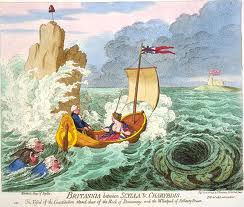
SCYLLA AND CHARYBDIS by Bill Tsouvalias – English School Paper, February 2011 Issue

SCYLLA AND CHARYBDIS
by Bill Tsouvalias (6th grade)


They are two mythical Sea creatures who live in two opposite cages in the Sicily straits of Gibraltar. Scylla is a monster with six heads. She eats big fish and people who travel with their boats near her cage. So, she managed to eat Odysseus’ companions. Charybdis looks like a mermaid, meaning that she is half a woman and half a fish. She lives opposite Scylla and she sips water of the sea with everything in it.

Posted in 6th Grade, School Paper Articles

JOKES by Chryssa Papalexopoulou – English School Paper, February 2011 Issue

JOKES
by Chryssa Papalexopoulou (6th grade)

When one of your shoes has a hole and the other one has two, what time is it?
It’ time to buy new shoes!

**********************************************************************

One woman was coking eggs when her husband came home. When he went to the kitchen he started to speak:
– Watch out! Put some oil! Oh my God, turn the frying pan, the eggs will burn! No, not like this, honey! You shake it very fast. Oooh, you will destroy it! Now you must put salt. Don’t forget it! No, it’s too much! Are you crazy? Oooh, can you tell me where your mind is?
Then she looked at him and told him:
– Do you think that I can’t even cook two eggs?
He smiled at her and he told her:
– No, honey, but I wanted to give you an idea about how I feel when I drive and you are by my side!

************************************************************************

Totos asked his dad:
– Dad, do you know where is Spain?
– No. Ask your mum, she cleaned up the house this morning!

Posted in 5th Grade, 6th Grade, Projects

Project – Our Village, Amaliapolis

Since the beginning of this school year, learners in the Primary School of Amaliapolis have been exchanging projects with various schools in the USA. After exchanging presentations of our schools, it was time to present the areas we live in! Learners in Amaliapolis took their own pictures of their village and added some other, wonderful pictures they found on the internet. They wrote about their village, and here is their presentation:

Some of the pictures used in the presentation were retrieved from the following pages:
Picture
Picture
Picture
Picture
Picture
Picture
Picture
Picture
Picture
Picture
Picture
Picture
Picture

Posted in Ideas, Thoughts, Concerns

Experiential EFL learning in Greek public schools: can I make it happen, or not?

Experiential EFL learning in Greek public schools: can I make it happen, or not?

Can we really expose Greek EFL learners in public primary schools to experiential EFL learning (learning by doing and making meaning from having a direct, personal experience)? I couldn’t really answer that by saying just a ‘yes’, or ‘no’. We work in public schools with outdated and or inadequate facilities, we only have 3 45-minute sessions with our learners per week at best, transporting learners to the appropriate place for experiential learning to take place costs a lot … I could go on forever, but would I only be making excuses?

Last night, while I was ‘visiting’ various ELT blogs, I came across ( at Task-Based Language Teaching blog) a very inspiring, influential presentation by Diane Laufenberg (TEDxMidAtlantic, November 2010 presentation, “How to Learn From Mistakes”). It presents what experiential learning is all about and it exonerates learners (and teachers!) by saying that it’s through mistakes that we all learn. Here is the presentation (take some time to view it, it’s REALLY worth it)!

When I finished watching this video, I found myself standing in front of the computer screen for some minutes, brainstorming, self-evaluating, being carried away by the enthusiasm and excitement of this teacher, Ms Laufenberg, thinking about her learners’ idea of school compared to mine. And I still couldn’t answer the question: Can we really expose Greek EFL learners in public primary schools to experiential EFL learning?

To begin with, there are so many projects suggested by our materials that invite learners to discuss, make decisions, solve problems, take action, but do we really involve learners in an experiential nature of learning? Speaking experientially, there have been some projects we have worked on in my schools, like the one in the 5th grade, that encourages learners to think and decide how they can help poor children spend Christmas almost like they would (they organized a Christmas bazaar selling things they had made), or another one that invites them to work on an evironmental project (they created recycling bins with cardboard, we cleaned up the school yard and the surrounding pavements, they gave out leaflets written – unavoidably – in Greek), but, aside from making them better citizens, better people, there was not much actual experiential EFL learning (most of the decision-making – problem-solving part is performed in English, but there have been instances where they thought and decided something during the break and came to the teachers’ office in excitement to let me know).

This seems to be mainly owing to the fact that we are asked to link EFL learners with a community that speaks their native and not the target language. Creating a leaflet in English with information regarding recycling, or other environmental issues could be experiential in the sense that it is actually distributed to english-speaking people in the community, getting immediate feedback on their work from them. A school trip linked to a school project would more likely evolve with the learners employing their native language, rather than the english, in order to collect the information required for the project.

So? What is there an EFL teacher can do? Is experiential learning only a non-subject-specific teacher’s priviledge? Well, linking with colleagues from other countries is all I can come up with, not being though so certain that this is the actual answer to the question! At my school, we exchange english school papers with other European schools and this allows learners to write and read with a real-life purpose. But, how about speaking, or listening? Could we connect with other learners, work on joint projects, have our learners discuss, brainstorm, solve problems and take action along with learners coming from other countries? A positive response or perhaps a nodding of the head may come instictively, but there are always administrative, time management and facilities issues.

With regard to the first obstacle, well, I have been incredibly lucky to have cooperated with encouraging and supportive management so far, so, owing to lack of experience in the uncooperative/negative/leave-me-alone ‘field’, there is not much I could say to English teachers who are not even allowed to use the photocopier (a colleague shared this experience with me and I still can’t get over it!), or exploit the technology available! As for the last two, ‘evelikti zoni’ and cooperation with the Technology teacher sound and have proven to be valuable for EFL teachers working on projects. Or maybe I’m just romantic, I wouldn’t know! All I know is that I want my learners to feel like Ms Laufenberg’ learners!

Posted in Events / Seminars / Conferences

EFL teachers sharing ideas for professional development!

I always look forward to seminars, they can be enlightening, eye-opening, inspiring … Today I attended the PEKADE event in Larissa, which was related to ‘Facing Greek School Reality’. I had never attended a PEKADE event before, mainly owing to distance issues, but this time, Larissa was less than an hour far!!! And, although it was a day with heavy rain, there were many colleagues there and the room was almost full.

The first speaker was Ms Anna Varna, an EFL state school teacher. It was great to see her again after two years that she visited Volos as the eTwinning ambassador (she actually gave a 4-hour afternoon seminar and managed to inspire us and open our eyes). Her presentation was about “A day in the life of a connected teacher”, and she had a lot to say about facebook, twitter, blogging and their benefits in the life of an educator. Eye-opening once again, her presentation was great, attracting everybody’s attention! So, the day started with an experienced speaker who passed on her message efficiently, with a lot of sense of humour and a great video she will upload on her wonderful blog.

The day continued with the inexperienced speaker, meaning myself! The presentation was related to “Creating an English school newspaper with a real-life purpose” and, given that it was my first time in front of a crowd, I can only say that it felt good and there were many colleagues that had a nice thing to say about it! The most encouraging aspect was the fact that there were people who had more questions to ask during the break and wanted to try this project at their schools! That’s what this presentation was all about anyway!!! However, there was something that got me thinking how lucky some of us can be to have been working with cooperative Headteachers and, while recommending a project like that one should not take some things for granted: One of my colleagues there suggested the introduction of an English school paper at her school and all she got from the Headteacher was “What kind of mal …ies is all that?”! How disappointing and discouraging can that be? And of course the school wouldn’t fund her project, so she had to give it up! To refer to the presentation again, I hope everyone there understood how passionately and enthusiastically I have been working on this and what a funfilled, enjoyable, creative experience it has been both for my learners and I. This is the slideshow of the presentation:

Then, it was time for Mr Eleftherios Avramidis, an EFL state school teacher as well, to talk to us about a pilot study related to “Strategies employed while learning a foreign language”. It was a very interesting study, indeed, referring to the strategies employed by fifth grade learners while writing in the target language.

Ms Marina Kollatou is the State School Advisor for Karditsa and she was the following speaker. She had prepared a wonderful presentation on “Differentiated instruction: a challenge and a necessity” and had a lot to suggest regarding teaching mixed ability classes, presenting useful theoretical insights and more practical aspects on dealing with this issue in class. She is going to upload her presentation on her blog soon.

After the break, it was time for Ms Marianthi Kotadaki, the State School Advisor for Achaia, and her wonderful presentation! It had to do with the exploitation of YouTube videos in the EFL classroom (“You Tube for English? Connecting the Senior Secondary classroom to the real world”). The best part of the presentation was the fact that we had the chance to stand on our learners’ shoes and somehow feel what they would feel like during a well-organised, enjoyable lesson that included YouTube videos! A wonderful, exciting way to teach, presented very inspirationally by Ms Kotadaki!

The following presentation was about ” Using the video to improve students’ listening skills”. Ms Maria Stefanidou, an EFL state school teacher, presented the theoretical background underlying the exploitation of videos in the classroom. We also had the chance to watch a video on the use of the mobile phone and social networking by teenagers.

Ms Maria Mintsidou and Ms Katja Korpinurmi, EFL State School teachers, presented “Alternative ways of approaching the teaching of English at technical vocational schools through the example of the 2nd Technical Vocational School of Karditsa”. Contrary to what the majority of people assume about technical vocational schools, these two colleagues showed that there can beautiful things going on in these schools, with the wonderful Comenius and other projects they have been working on with their learners. Ms Korpinurmi is actually an assistant teacher from Finland, who now cooperates with Ms Mintsidou, the EFL teacher of the 2nd Technical Vocational School of Karditsa. So, we were all informed, that anyone who applies for a Comenius project related with ELT, can ask for an assistant teacher, who will assist, bring his/her cultural background into the classroom and make the learners communicate in the target language with a real-life purpose!

The last presentation was that of Ms Apostolia Tsipra, who is also an EFL state school teacher working on her Master’s degree. Her interesting research was related to “Innovation within innovation: using a Task-Based approach to train Greek EFL teachers in the implementation of DEPPS principles”.

The PEKADE event ended with a round-table discussion concerning the activities of the Union, its quarterly magazine “Aspects Today” and its suggestions to the Ministry of Education regarding main concerns, we, EFL teachers have in the public sector.

Although this day was moody today weatherwise, it actually evolved as a great opportunity to develop as a teacher, broaden your horizons, contact with colleagues (or ‘connect’, as Ms Varna pointed out in her presentation) and share ideas! Congratulations to PEKADE for this great, well-organised event! I personally look forward to the next!!!

Posted in Events / Seminars / Conferences, Public Education

Ημερίδα Π.Ε.Κ.Α.Δ.Ε., 19 Φεβρουαρίου 2011

H Πανελλήνια Ένωση Καθηγητών Αγγλικής της Δημόσιας Εκπαίδευσης θα πραγματοποιήσει ημερίδα με τίτλο: “Facing Greek School Reality”. Η ημερίδα θα πραγματοποιηθεί στο LARISSA IMPERIAL (Φαρσάλων 182, Λάρισα), στις 19 Φεβρουαρίου 2011, ημέρα Σάββατο από 9.00-14.30.

Την ημερίδα καλούνται να παρακολουθήσουν οι εκπαιδευτικοί ΠΕ06 της Α/θμιας και Β/θμιας Εκπ/σης. Για τα μη μέλη της Ένωσης, η συμμετοχή είναι 10 ευρώ. Όσοι συνάδελφοι δεν είναι μέλη της Ένωσης μπορούν να πραγματοποιήσουν την εγγραφή τους την ημέρα διεξαγωγής της ημερίδας.

Μετά το πέρας των εργασιών της ημερίδας θα δοθούν βεβαιώσεις στους παρευρισκομένους. Για το πρόγραμμα της εκδήλωσης, κάντε κλικ εδώ: PEKADE event – Facing Greek School Reality – Programme.
Περισσότερες πληροφορίες θα αναρτηθούν στην ιστοσελίδα της ΠΕΚΑΔΕ (www.pekade.gr). E-mail επικοινωνίας: info@pekade.gr

Πηγή: www.pekade.gr

Posted in 5th Grade, Projects, Public Education

English breakfast at school!

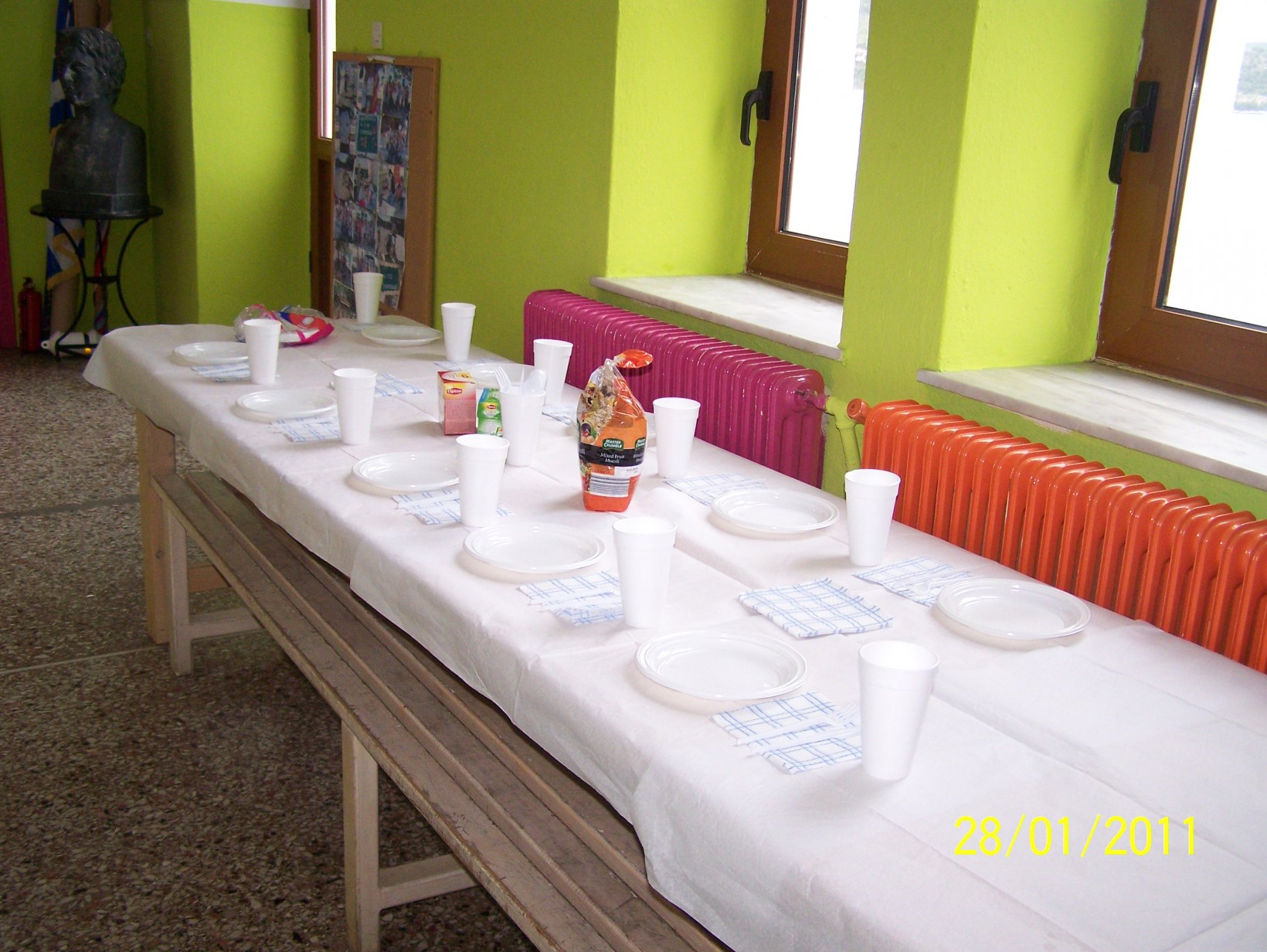
Our 5th grade English coursebook introduces pancakes as part of the American breakfast (Unit 4, Lesson 2, p. 54), but they are also included in the English breakfast. After a discussion with the 5th grade learners at the Primary School of Amaliapolis regarding what an English breakfast includes, its nutritional value and its differences from the Greek breakfast, learners were invited to try the English breakfast at school!!! They had the opportunity to drink tea, have milk with cereals and enjoy delicious pancakes! As they have said, the English breakfast is quite enjoyable and the best part of it was the pancakes!!!

Pancakes (20 pieces)
by Chris and Tsetsi Logofetov

Solid Ingredients:
5 cups of flour
5 tablespoons of baking powder
5 tablespoons of sugar
2 vanillas
a little salt

Liquid ingredients:
5 eggs
5 tablespoons of olive oil
5 glasses of fresh milk

Procedure:
We mix all the solid ingredients in a bowl and we mix all the liquid ingredients in another bowl. We put the mixture of the liquid ingredients into the mixture of the solid ones and we mix. We put half a teaspoon of butter into a small, hot frying pan. When the butter melts, we put some of the dough in the frying pan. As soon as it starts steaming (you will see bubbbles), we turn it over with a spatula.

To see the recipe in Greek, click here.

Posted in 4th Grade, Projects

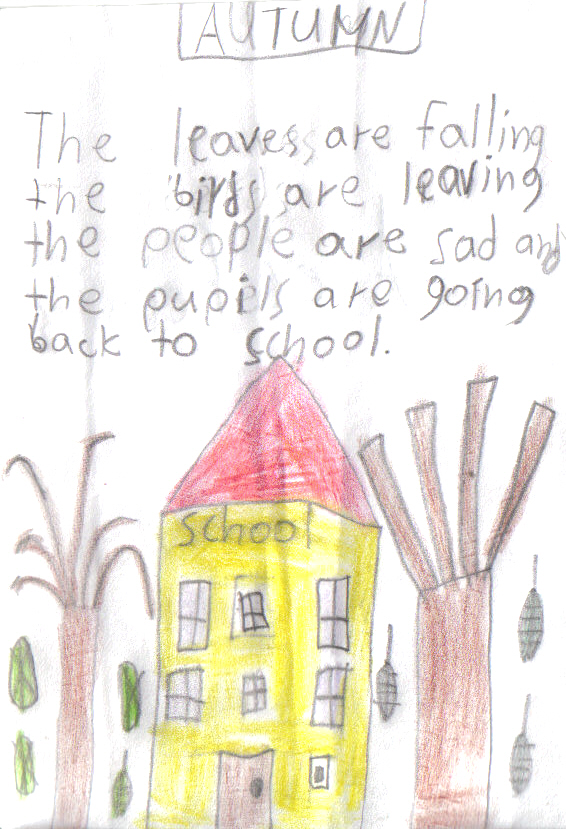
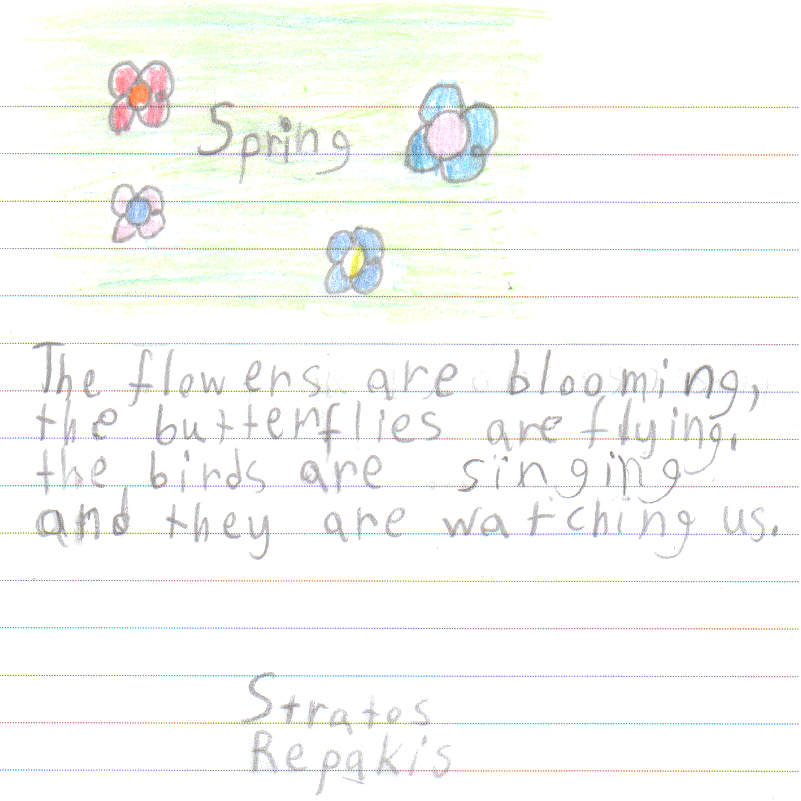
POEMS ABOUT THE SEASONS

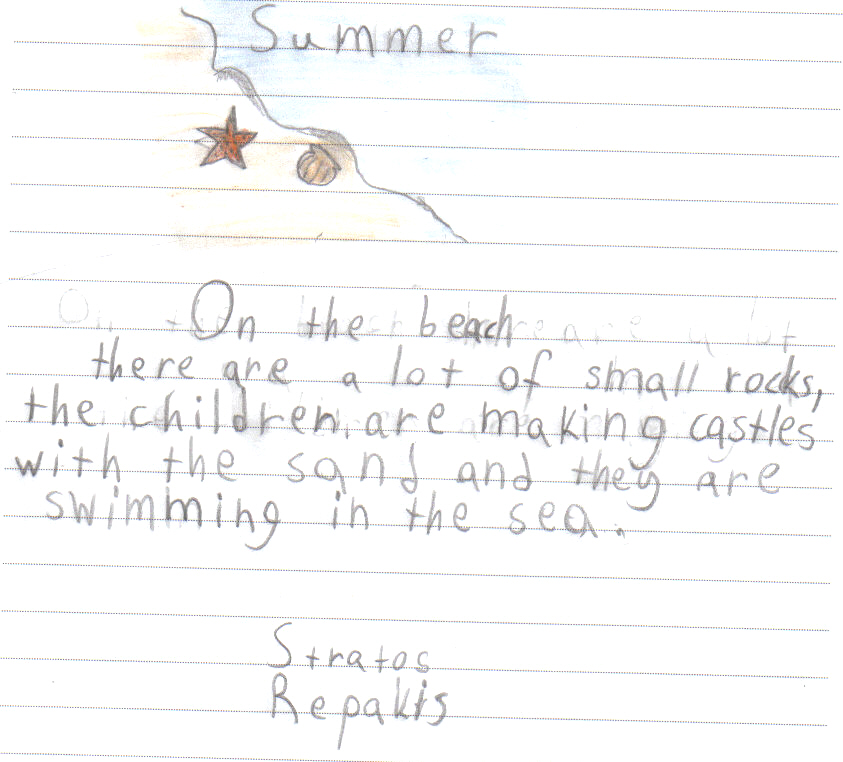
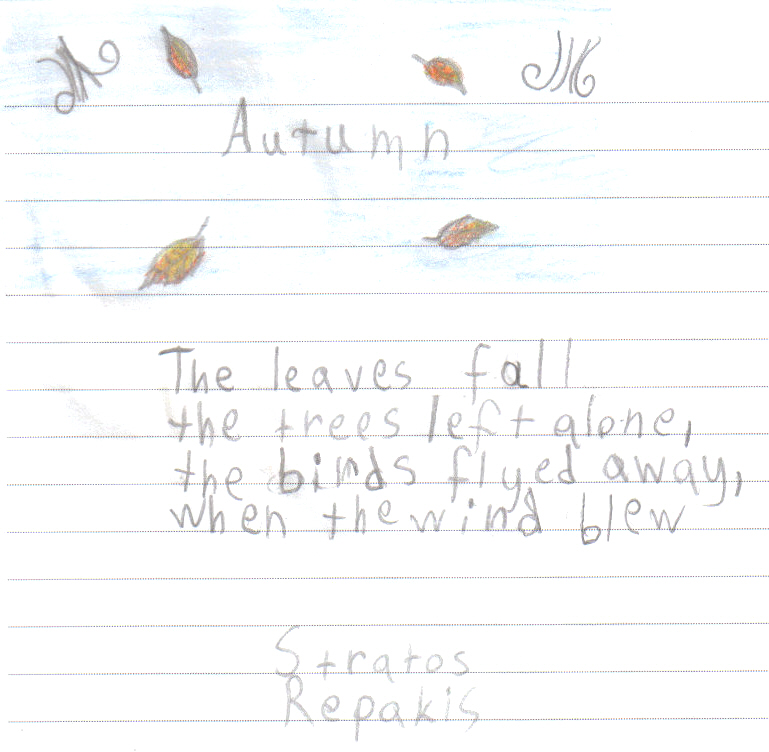
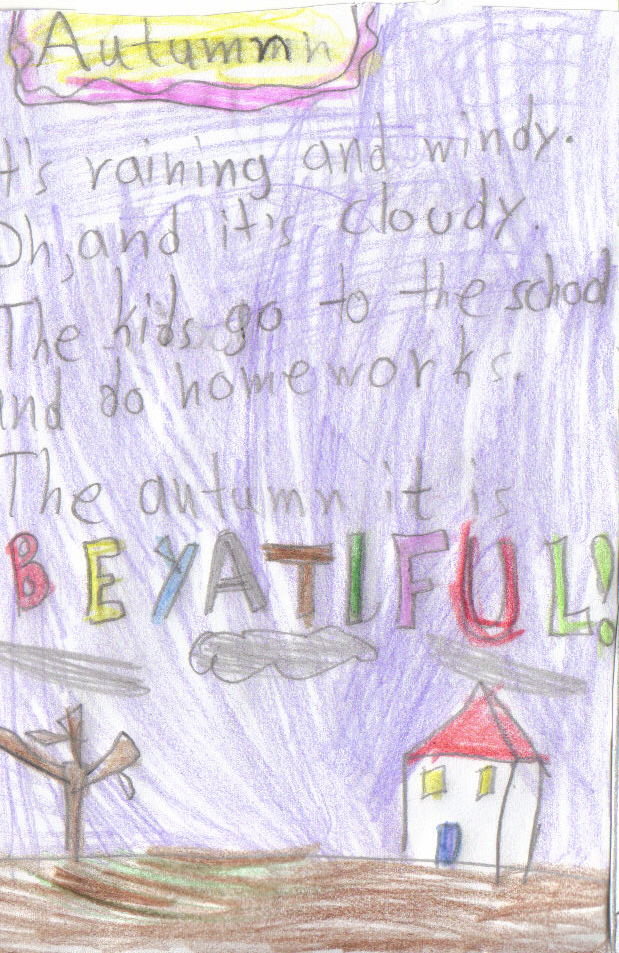
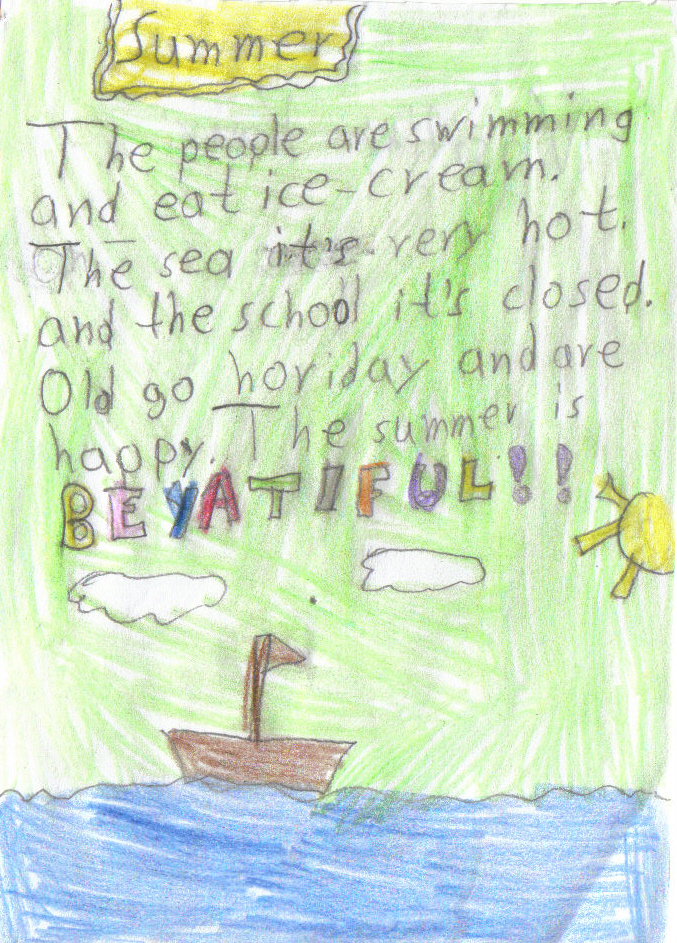
Our English 4th grade coursebook this year invites learners in writing poems about the seasons! When I first told my learners at the Primary School of Amaliapolis that they had a poem for homework, they were shocked at first, but they told me they would definitely try it! Here is what they wrote about the seasons:

This is what Alex Repakis wrote:


And here is what his brother Stratos wrote:


SUMMER
by Nick Stekkas

In the summer we swim
The school is closed
The kids smile
And they feel happy.

SPRING
by Nick Stekkas

In the spring we are happy
The spring is funny
The sun is shining
And the flowers are laughing.

AUTUMN
by Nick Stekkas

The school is open
The autumn is here
The kids do their homework
The autumn is here.

WINTER
by Nick Stekkas

The winter is great
The snow is here
In the winter we wear warm clothes
Because the snow is here.

Here is what Vassiliki Kouri wrote:


SUMMER
by Chris Xanthis

The summer is hot
The sun is in the sky
The people are swimming
And the boats are in the sea.

WINTER
by Chris Xanthis

The winter
The flowers are sleeping
It’s snowing
And it’s cold.

SPRING
by Chris Xanthis

The spring
it’s hot
Children are playing in the park
And it’s sunny.

AUTUMN
by Chris Xanthis

The autumn
It’s cold
It’s windy
And it’s raining.

Well done, children!!!

Posted in Computer-Assisted Language Learning, Public Education

Dissertation: EXPLORING CALL IN THE GREEK PUBLIC PRIMARY SCHOOL: FROM THEORY TO PRACTICE

Abstract

Greek public education is part of the social context and, in this age of rapid technological innovation, it should definitely not be inferior. More and more teachers and learners use computers on a daily basis and are gradually becoming more familiar with a variety of applications that can serve their needs. Using technology as a medium or a tool, English language teaching seems to have the potential to become more effective.

This dissertation aims at exploring the current employment of CALL in Greek public primary schools and investigating ways in which teachers can apply theory to practice. Beginning with the history and theoretical background of CALL worldwide, there has been an attempt to relate computer applications to the pedagogical benefits they can contribute to ELT, without though neglecting reference to potential barriers to the use of technology in schools. History of ELT and CALL in Greece is also explored with an eye to conducting a research on the available home and school equipment, school facilities, familiarity with and frequency of use of computer applications, teacher training and attitudes towards CALL.

This research that has been conducted by means of questionnaires will prove that, although English state primary school teachers are positively predisposed towards CALL and are familiar with most of the computer applications in question, they are in need of training on the use of educational technology, technological and building improvements at schools, supportive materials and a plethora of other reforms that are suggested in the end of this dissertation.

This dissertation / research was submitted in the Hellenic Open University as part of my Master’s education in the school year 2009 – 2010. To view the dissertation, click here: EXPLORING CALL IN THE GREEK PUBLIC PRIMARY SCHOOL: FROM THEORY TO PRACTICE

* This dissertation has been cited in: Proposal The Perception of Students towards the Effectiveness of the Usage of CALL Tools in Language Learning

Posted in Computer-Assisted Language Learning, Public Education

ΔΙΠΛΩΜΑΤΙΚΗ ΕΡΓΑΣΙΑ: EXPLORING CALL IN THE GREEK PUBLIC PRIMARY SCHOOL: FROM THEORY TO PRACTICE

Περίληψη

Η Ελληνική δημόσια εκπαίδευση αποτελεί μέρος του κοινωνικού πλαισίου και, στην εποχή της γρήγορης τεχνολογικής καινοτομίας, σίγουρα δεν θα πρέπει να υστερεί. Όλο και περισσότεροι καθηγητές και μαθητές χρησιμοποιούν τους υπολογιστές σε καθημερινή βάση και εξοικειώνονται σταδιακά με ποικίλες εφαρμογές που δύνανται να εξυπηρετήσουν τις ανάγκες τους. Χρησιμοποιώντας την τεχνολογία ως μέσο ή εργαλείο, η διδασκαλία της Αγγλικής γλώσσας φαίνεται να έχει τη δυνατότητα να γίνει πιο αποτελεσματική.

Αυτή η διατριβή στοχεύει να εξερευνήσει την τρέχουσα εφαρμογή της υποβοηθούμενης από υπολογιστή γλωσσικής διδασκαλίας στα ελληνικά δημόσια σχολεία πρωτοβάθμιας εκπαίδευσης και να ερευνήσει τους τρόπους με τους οποίους οι καθηγητές μπορούν να εφαρμόσουν τη θεωρία στην πράξη. Αρχίζοντας με την ιστορία και το θεωρητικό υπόβαθρο της γλωσσικής μάθησης μέσω υπολογιστή παγκοσμίως, έχει γίνει μια προσπάθεια να συσχετιστούν οι εφαρμογές των υπολογιστών με τα παιδαγωγικά οφέλη που μπορούν να συνεισφέρουν στη διδασκαλία της αγγλικής γλώσσας, χωρίς εν τούτοις να παραμελείται η αναφορά στα πιθανά εμπόδια στη χρήση της τεχνολογίας στα σχολεία. Επίσης, ερευνάται η ιστορία της διδασκαλίας της αγγλικής και της γλωσσικής μάθησης μέσω υπολογιστή στην Ελλάδα, στοχεύοντας στη διεξαγωγή έρευνας για το διαθέσιμο εξοπλισμό των σπιτιών και των σχολείων, τις σχολικές εγκαταστάσεις, την εξοικείωση με τις εφαρμογές των υπολογιστών και τη συχνότητα χρήσης τους, την κατάρτιση των εκπαιδευτικών και την προσωπική στάση τους απέναντι στην υποβοηθούμενη από υπολογιστή γλωσσική εκμάθηση.

Η παρούσα έρευνα που έχει διεξαχθεί με τη βοήθεια ερωτηματολογίων θα αποδείξει ότι, αν και οι καθηγητές αγγλικών των δημόσιων δημοτικών σχολείων είναι προδιατεθειμένοι ευνοϊκά απέναντι στην διδασκαλία με τη χρήση υπολογιστών και είναι εξοικειωμένοι με τις περισσότερες από τις εφαρμογές υπολογιστών που αφορούν την έρευνα, χρειάζονται επιμόρφωση πάνω στη χρήση της εκπαιδευτικής τεχνολογίας, τεχνολογικές και κτιριακές βελτιώσεις στα σχολεία, υποστηρικτικό υλικό και μια πληθώρα άλλων μεταρρυθμίσεων που προτείνονται στο τέλος αυτής της διατριβής.

Η διατριβή αυτή εκπονήθηκε στα πλαίσια Μεταπτυχιακών Σπουδών στο Ελληνικό Ανοιχτό Πανεπιστήμιο Πάτρας κατά το σχολικό έτος 2009 – 2010: EXPLORING CALL IN THE GREEK PUBLIC PRIMARY SCHOOL: FROM THEORY TO PRACTICE

Posted in Exams

Δελτίο τύπου προκήρυξης εξετάσεων ΚΠγ Μαΐου 2011

Ανακοινώνεται ότι από τη Δευτέρα 31 Ιανουαρίου μέχρι την και την Τρίτη 22 Φεβρουαρίου 2011 θα υποβάλλονται στις Διευθύνσεις ή Γραφεία Δευτεροβάθμιας Εκπαίδευσης της χώρας αιτήσεις για συμμετοχή στις εξετάσεις του Κρατικού Πιστοποιητικού Γλωσσομάθειας εξεταστικής περιόδου Μαΐου 2011.

Οι εξετάσεις θα διεξαχθούν στις 7 και 8 Μαΐου 2011 για τα επίπεδα:
α) Α (Α1 «στοιχειώδης γνώση» και Α2 «βασική γνώση») σε ενιαίο διαβαθμισμένο test, στις γλώσσες Αγγλική, Γαλλική, Γερμανική και Ιταλική γλώσσα,
β) Β (Β1 «μέτρια γνώση», Β2 «καλή γνώση») σε ενιαίο διαβαθμισμένο test στις γλώσσες Αγγλική, Γαλλική, Γερμανική Ιταλική, Ισπανική και Τουρκική γλώσσα και
γ) Γ1 «πολύ καλή γνώση» στις γλώσσες Αγγλική, Γαλλική, Γερμανική Ιταλική και Ισπανική γλώσσα.

Όσοι επιθυμούν να λάβουν μέρος στις εξετάσεις υποβάλουν τα παρακάτω δικαιολογητικά:

Μία φωτογραφία μικρού μεγέθους.

Ένα έντυπο παράβολο δημοσίου :
α. των 60 ευρώ για το επίπεδο Α (Α1 «στοιχειώδης γνώση» και Α2 «βασική γνώση»),
β. των 80 ευρώ για το επίπεδο Β ( Β1 «μέτρια γνώση» και Β2 «καλή γνώση»),
γ. των 80 ευρώ για το επίπεδο Γ1 («πολύ καλή γνώση»).

Σε περίπτωση έλλειψης εντύπων παραβόλων, τα αντίστοιχα ποσά μπορούν να εισπράττονται και με την έκδοση διπλοτύπων είσπραξης από τις Δημόσιες Οικονομικές Υπηρεσίες (Δ.Ο.Υ.). Τα παράβολα ή τα διπλότυπα εισπράττονται υπέρ του Δημοσίου ( Κ.Α.Ε. 3741).

Φωτοαντίγραφο των δύο όψεων της αστυνομικής ταυτότητας. Ελλείψει αυτής, κατατίθεται φωτοαντίγραφο διαβατηρίου ή άλλου νόμιμου αποδεικτικού εγγράφου από το οποίο προκύπτουν τα στοιχεία ταυτοπροσωπίας του υποψηφίου όπως στοιχεία ταυτότητας και φωτογραφία αυτού.

Ειδικό έντυπο «Aίτηση» που διατίθεται προς συμπλήρωση από την επιτροπή συγκέντρωσης δικαιολογητικών, στις κατά τόπους Διευθύνσεις ή Γραφεία Δευτεροβάθμιας Εκπαίδευσης.

Πηγή: http://www.kpg.ypepth.gr/

Posted in EFL Teacher Resources, Public Education

Let’s Learn English

Let’s learn English is a blog that contains useful and inspiring resources for the teaching of English in Greek Primary Schools. Mr. Papadamos from Kastoria has done a remarkable job uploading materials, games and videos that can be used in class and are related to the curriculum currently used in Greek Primary Schools!

Everything uploaded in this blog has been categorized depending on the class that it may be used, making it thus easier for users (that can be either teachers or learners) to exploit its potentials! One of the most useful uploads in this blog is the vocabulary list (companion) of the first 4 or 5 units of each coursebook!

Keep up the good work Mr. Papadamos, it’s really inspiring! I’m definitely going to visit your blog with my learners one of those days!!!