Our 3rd graders at the Primary School of Sourpi have drawn animal families, practicing the related vocabulary!
Δείτε το στο slideshare.net
Ideas, news, thoughts …
Our 3rd graders at the Primary School of Sourpi have drawn animal families, practicing the related vocabulary!

Ένας διαφορετικός διαγωνισμός για όλες τις σχολικές μονάδες Πρωτοβάθμιας και Δευτεροβάθμιας Εκπαίδευσης της χώρας: Φτιάξτε το “doodle” της “google”! Η εγκύκλιος αναφέρει:
“Σας ενημερώνουμε ότι η εταιρία “Google” διοργανώνει το διαγωνισμό «Doodle4Google». Ο διαγωνισμός, που τελεί υπό την αιγίδα του ΥΠΑΙΘΠΑ, αφορά στο σχεδιασμό του «doodle», του λογότυπου δηλαδή της “Google”, από μαθητές, με θέμα «Η Ελλάδα μου». Απευθύνεται στους μαθητές ηλικίας 6 έως 18 χρονών όλης της χώρας (Δημοτικά, Σχολεία Δ/θμιας Εκπ/σης) και θα διεξαχθεί κατά τη σχολική χρονιά 2012-2013. Ανάλογα με την ηλικία τους, οι συμμετέχοντες θα κατηγοριοποιηθούν σε τέσσερις ομάδες και θα αξιολογηθούν ξεχωριστά.
Η υποβολή συμμετοχής των σχολείων στο διαγωνισμό λήγει στις 29 Μαρτίου 2013 (σφραγίδα ταχυδρομείου). Για περισσότερες πληροφορίες μπορείτε να επισκεφτείτε την ιστοσελίδα: www.google.gr/doodle4google (περιλαμβάνει όρους, πληροφορίες συμμετοχής και απαντήσεις σε συχνές ερωτήσεις) ή για επιπλέον ερωτήσεις επικοινωνήστε με την “Google Hellas” μέσω email (d4G@ssq.gr), μέσω φαξ (αριθμός φαξ: 2164000899) ή μέσω τηλεφώνου (αριθμός τηλ. 2109287510).”
Οι μαθητές καλούνται να αναδείξουν την καλλιτεχνική τους διάθεση σχεδιάζοντας ένα νέο λογότυπο για την Google με θέμα «Η Ελλάδα μου»! Ένας τυχερός μαθητής θα δει το έργο του να εμφανίζεται στην αρχική σελίδα της Google (www.google.gr), την οποία βλέπουν εκατομμύρια επισκέπτες κάθε ημέρα και θα κερδίσει επιπλέον δώρα!

The Kerpoof Studio has been another useful after-midnight-surfing discovery that I would like to share with you. And if you ‘re reading these lines and it’s after midnight, DO NOT try Kerpoof Studio now, because it can keep you up all night long!
So, what is Kerpoof Studio? There’s no better way to describe the site than the presentation provided by the site itself, so here it goes: “The answer to that is not so simple. Kerpoof is all about having fun, discovering things, and being creative. Here are just a few ways that you can use Kerpoof:
Make artwork (even if you aren’t good at drawing!)
Make an animated movie (really! it’s easy!)
Earn Koins which you can trade for fun things in the Kerpoof Store
Make a printed card, t-shirt, or mug
Tell a story
Make a drawing
Vote on the movies, stories, and drawings that other people have made
Check out our What’s New and How-To pages to learn more about what you can do with Kerpoof. Kerpoof doesn’t come with a manual or a directory or a map. If we’ve done our job right, then finding your way to the various nooks and crannies of Kerpoof will be half the fun.
In addition to being a lot of fun, Kerpoof has many educational uses. Visit our educator page (with ideas and lesson plans for how to use Kerpoof) or read our flyer for educators if you are in a hurry but want to learn more.
If you are a parent, you may also want to read our for parents page.”
All in all, this is a user-friendly tool that allows its users to express themselves creatively! There are many ways we can all exploit it the ELT classroom, but if you feel need help with the latter, make sure that you consult with the Teacher’s Guide provided within the site! Can’t wait to use it with my learners and … if you try it soon (or have tried it in the past), please, let us know how it was!!!

Did you know that the second Monday of January is National Clean Off Your Desk Day? I just found out today and … I better start tidying these piles right away if I want to make it till Monday!!!
Anyway, this post is to inform you about the many national days we are probably not aware of and suggest their potential inclusion in EFL lessons! I bet your learners would love to celebrate and learn about Get A Different Name Day, Ice Cream Day, Fresh Breath Day, Make A Difference Day, Pancake Day, or even Get Over It Day! I know my learners would and I hereby declare that No Housework Day is my personal favourite (that’s on April 7th, though, I hope I don’t forget by then!).
Surfing the net, I came across Sean Banville’s ESL Holiday Lessons Website, which provides a list of all the national days. Clicking on each day, you have at your disposal a wonderful lesson plan for the day you have selected! Each lesson plan promotes both productive and receptive skills, and you can choose to download it in Word-Processing, or PDF format, or even as an online exercise (you can also download the audio input in MP3 format)! There is also plenty of vocabulary and grammar practice!
The moment I came across this site, the first thing that crossed my mind was all these days at school that learners are tired or do not feel like having a lesson (before/after a school trip, the last days before Christmas or Easter break, some Fridays, etc) and the days that they have begged me to do something other than the coursebook! I believe that lessons on holidays would be a pleasant, yet educational deviation from the coursebook! Perhaps it would be a good idea to keep monthly calendars on the classroom anouncement board and maybe choose one or two days per month that we would like to find more about! We can also ask learners to work in groups and find information about some of these special days!
Can’t wait to use them in class (maybe after some adaptation, as I work with beginner and elementary level learners)! If you make it sooner than me, do feel free to provide us with feedback!
Το ηλεκτρονικό μάθημα «Web 2.0 εργαλεία στην ανάπτυξη συνεργατικών δραστηριοτήτων» εντάσσεται στο πλαίσιο των ηλεκτρονικών μαθημάτων της Ελληνικής Εθνικής Υπηρεσίας Υποστήριξης (ΕΥΥ) για το eTwinning και έχει σκοπό να διερευνηθεί η δυνατότητα αξιοποίησης web 2.0 εργαλείων σε eTwinning projects.
Εκπαιδευτικοί στόχοι
Το εν λόγω ηλεκτρονικό μάθημα απευθύνεται σε εκπαιδευτικούς της Πρωτοβάθμιας και Δευτεροβάθμιας Εκπαίδευσης με μικρή εμπειρία σε etwinning προγράμματα (0 1 έργα) και έχει στόχο την ικανότητα χρήσης και ενσωμάτωσης των δυνατοτήτων εργαλείων Web 2.0 σε ένα eTwinning project
Αναμενόμενα αποτελέσματα
Τελειώνοντας αυτό το μάθημα οι εκπαιδευόμενοι θα πρέπει να έχουν συνειδητοποιήσει ότι εργαλεία web 2.0 μπορούν να χρησιμοποιηθούν τόσο στην καθημερινή μαθησιακή διαδικασία, όσο και σαν υποστηρικτικό εργαλείο συνεργατικών projects, αφού αποδεδειγμένα :
Αυξάνουν τον ενθουσιασμό και το ενδιαφέρον των μαθητών
Δίνουν περισσότερες ευκαιρίες για συμμετοχή και συνεργασία
Συνεισφέρουν στην αυξημένη ανταπόκριση και δυνατότητα αφομοίωσης σύνθετων εννοιών
Προσφέρουν δυνατότητες για καλύτερη εκμάθηση για παιδιά με διαφορετικά στυλ μάθησης (Ακουστικό, Οπτικό, Κιναισθητικό)
Ενισχύουν και διευκολύνουν τις συνεργατικές δραστηριότητες και την επικοινωνία μεταξύ των μελών μίας ομάδας αλλά και μεταξύ ομάδων συνεργασίας.
Χρονοδιάγραμμα μαθήματος
Ενότητα 1 (αναμενόμενη διάρκεια 3 ημέρες) – Γνωριμία με το περιβάλλον του moodle, απορίες για το μάθημα, τεχνικές απορίες, μίνι κουίζ, φόρουμ γνωριμίας.
Ενότητα 2 (αναμενόμενη διάρκεια 4 ημέρες) – Voki δημιουργία του voki σας στο Profil σας, – Glogster, δημιουργία συνεργατικής αφίσας – Prezi, δημιουργία συνεργατικής παρουσίασης.
Ενότητα 3 (αναμενόμενη διάρκεια 2 ημέρες) – wallwisher δημιουργία wallwisher με την ομάδα σας, titanpad, δημιουργία titanpad με την ομάδα σας.
Ενότητα 4 (αναμενόμενη διάρκεια 2 ημέρες) – oovoo, δημιουργία λογαριασμού, πραγματοποίηση μίας συνομιλίας βίντεο-συνδιάσκεψης με την ομάδα σας- Αξιολόγηση μαθήματος
Το μάθημα θα διαρκέσει 11 μέρες και η επιτυχής παρακολούθησή του (συμμετοχή σε όλες τις δραστηριότητες του μαθήματος) θα οδηγήσει σε πιστοποιητικό επιτυχούς παρακολούθησης εξ ‘ αποστάσεως σεμιναρίου 30 ωρών.
Οι θέσεις εκπαιδευόμενων είναι 30 και θα τηρηθεί αυστηρά σειρά προτεραιότητας.
Εκδήλωση ενδιαφέροντος παρακολούθησης σεμιναρίου (έως τα μεσάνυχτα της Παρασκευής 21-12-2012):
http://www.etwinning.gr/survey/index.php?sid=14177&lang=el
Πηγή: http://www.etwinning.gr

Treasure Trove is a website that includes worksheets, posters, labels and PowerPoint presentations that ESL teachers may find really useful in class! New resources are added daily and the already-uploaded ones may be what you have been looking for all this time for your learners! Check it out!
ΠΡΟΣΚΛΗΣΗ ΣΕ ΗΜΕΡΙΔΑ ΣΤΙΣ 16 ΦΕΒΡΟΥΑΡΙΟΥ 2013
“Links in Education”

Η Π.Ε.Κ.Α.Δ.Ε. διοργανώνει ημερίδα με τίτλο: “Links in Education” στις 16 Φεβρουαρίου 2012 στην Ελληνοαμερικανική Ένωση, με θέματα που αφορούν στην καθημερινή εκπαιδευτική πρακτική. Η ημερίδα θα περιλαμβάνει εισηγήσεις καθώς και βιωματικά εργαστήρια.
Στόχος της ημερίδας μας θα είναι η ενδυνάμωση των συναδέλφων στο πλαίσιο της εκπαιδευτικής διαδικασίας και των σύγχρονων παιδαγωγικών πρακτικών. Οι κεντρικοί θεματικοί άξονες της ημερίδας θα είναι:
networking
new practices in ELT
mobility programmes
classroom management
Παρακαλούμε θερμά να καταθέσετε περίληψη με τις προτάσεις σας έως 10 Ιανουαρίου 2013, στην ηλεκτρονική διεύθυνση: info@pekade.gr
Πηγή: http://www.pekade.gr/
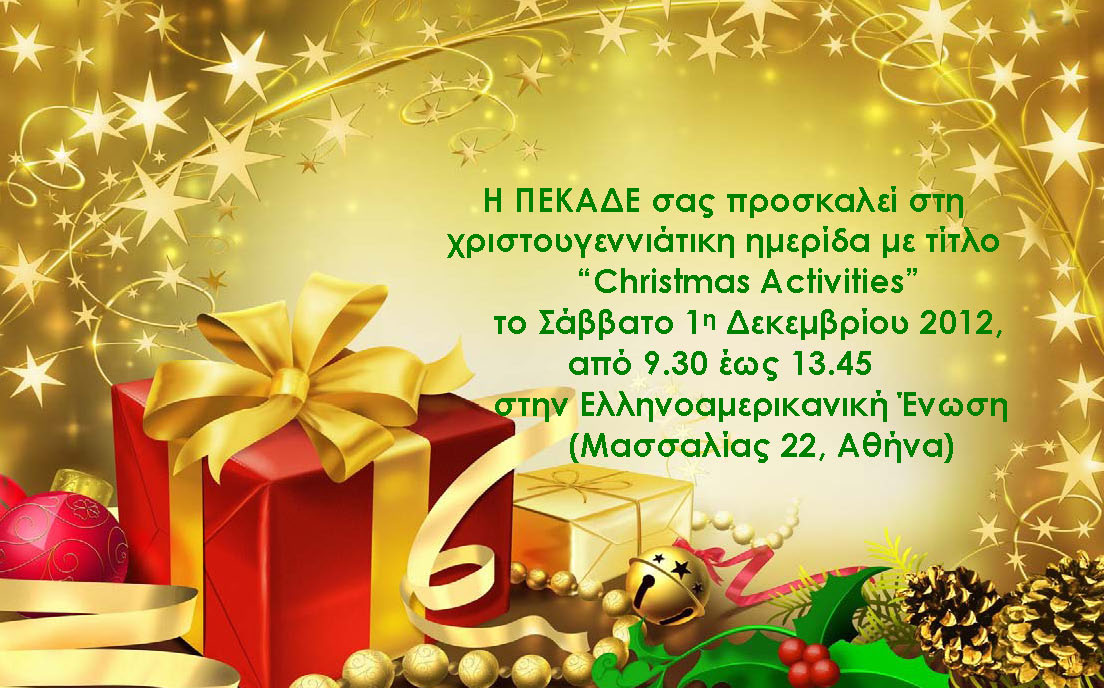
Η Πανελλήνια Ένωση Καθηγητών Αγγλικής Δημόσιας Εκπαίδευσης(Π.Ε.Κ.Α.Δ.Ε.) διοργανώνει Χριστουγεννιάτικη Ημερίδα με τίτλο “Christmas Activities” το Σάββατο 1η Δεκεμβρίου 2012, από 9.30 έως 13.45 στην Ελληνοαμερικανική Ένωση (Μασσαλίας 22, Αθήνα). Το πρόγραμμα της Ημερίδας είναι διαθέσιμο εδώ.
Πηγή: Πανελλήνια Ένωση Καθηγητών Αγγλικής της Δημόσιας Εκπαίδευσης (ΠΕΚΑΔΕ)

The Greek Applied Linguistics Association (GALA) announces its 15th International Conference to be held in Thessaloniki, Greece, on November 23-25 2012. The theme of the conference will be Cross-curricular Approaches to Language Education. In particular, the papers will relate to the following topics:
Content-based Education
Content and Language Integrated Learning (CLIL)
Immersion Education
Language Across the Curriculum
Interdisciplinary Approaches to Language Education
For the programme click here!
Η 6η Μαρτίου έχει καθιερωθεί ως η μέρα κατά της ενδοσχολικής βίας, ένα φαινόμενο που, απ’ ότι φαίνεται, παίρνει ανησυχητικές διαστάσεις στη χώρα μας. Το Υπουργείο Παιδείας, Δια Βίου Μάθησης και Θρησκευμάτων δημοσιεύει ότι θύμα επιθετικής παρενόχλησης από συνομιλήκους ή παιδιά διαφορετικών ηλικιών έχει πέσει το 10% του συνόλου των μαθητών στα Ελληνικά σχολεία, σύμφωνα με έρευνα. Παράλληλα, υπογραμμίζεται ότι στο 5% του μαθητικού πληθυσμού ανέρχεται το ποσοστό των θυτών, με τα αγόρια να υπερτερούν σε περιστατικά σωματικής βίας και τα κορίτσια να δρουν κυρίως λεκτικά.
Οι δράσεις που προτείνονται να πραγματοποιηθούν στο σχολείο είναι οι ακόλουθες:
Τι μπορούμε να κάνουμε στα σχολεία την 6η Μαρτίου;
Συζητήσεις ανάμεσα στους μαθητές στις τάξεις με θέμα «Πως εκδηλώνεται η βία ανάμεσα στα παιδιά, τι μπορεί να κάνει η τάξη μας / το σχολείο μας για να περιοριστούν και να αντιμετωπίζονται καλύτερα τα περιστατικά βίας;» Στις συζητήσεις είναι σκόπιμο να ακούγεται η γνώμη των μαθητών για τα αίτια και τους τρόπους εκδήλωσης της βίας και να προκύπτουν ιδέες για εναλλακτικούς τρόπους πρόληψης, αντιμετώπισης, ανάληψη ευθυνών και ρόλων, ανάλογα με τις ειδικές συνθήκες του κάθε σχολείου.
Βιβλιοπαρουσιάσεις και συζητήσεις μεταξύ μαθητών, με αφορμή βιβλία που αναφέρονται στην σχολική βία, ύστερα από κατάλληλη προεργασία, με την ανάληψη παρουσιάσεων από τους ίδιους τους μαθητές.
Προβολές ταινιών συναφούς θεματολογίας, που ανταποκρίνονται στο ηλικιακό και γνωστικό επίπεδο των μαθητών, ακολουθούμενες από σχετικές συζητήσεις και περαιτέρω δράσεις.
Δημιουργία αφισών ή/και φυλλαδίων με μηνύματα και πληροφορίες κατά της βίας, χρησιμοποιώντας κολλάζ, ζωγραφική και άλλα εργαλεία των νέων τεχνολογιών.
Εικαστικά εργαστήρια με δημιουργίες των μαθητών σχετικά με τη βία, ακολουθούμενα από συζήτηση και έκθεση των έργων σε χώρους του σχολείου, πιθανά δε και με δημιουργία σχετικών τοιχογραφιών σε επιλεγμένους χώρους της σχολικής μονάδας.
Παρουσιάσεις σχετικά με επιμέρους άξονες της θεματολογίας, από ομάδες μαθητών σχολείων, βασισμένες σε έρευνες υλικού από το διαδίκτυο, συζητήσεις, συμπλήρωση ερωτηματολογίων, καταγραφή απόψεων και αξιοποίηση σύγχρονων μέσων επικοινωνίας και νέων τεχνολογιών.
Θεατρικά, μουσικά ή/και χορευτικά δρώμενα, σε σχολικές μονάδες όπου υπάρχουν εκπαιδευτικοί με εξειδικευμένη επιμόρφωση, ώστε να αναδειχθούν θέματα σχετικά με την πρόληψη και αντιμετώπιση και ειρηνική επίλυση της βίας.
Αναρτήσεις στο διαδίκτυο, σε σχολικά sites / blogs, αναφορικά με δράσεις και έρευνες σχετικά με το φαινόμενο.
Συναντήσεις Σχολικών Συμβουλίων και Υπευθύνων Αγωγής Υγείας-Σχολικών δραστηριοτήτων με συμμετοχή εκπροσώπων των εκπαιδευτικών, των μαθητών και των γονέων, με θέμα την βελτίωση της λειτουργίας της σχολικής μονάδας, με στόχο τη συστηματική πρόληψη και ήπια, ειρηνική και ουσιαστική αντιμετώπιση περιστατικών βίας.
Πραγματοποίησηδιαδραστικών ομιλιών και βιωματικών σεμιναρίων για το φαινόμενο από εξειδικευμένους επιστήμονες σε ομάδες γονέων, εκπαιδευτικών και μαθητών, σε χρόνο εκτός της λειτουργίας του σχολείου.
Στον ειδικό ιστοχώρο: www.antibullyingnetwork.gr, που έχει δημιουργήσει το Δίκτυο κατά της Βίας στο Σχολείο, προβάλλεται σχετικό ενημερωτικό και εκπαιδευτικό υλικό, βιβλιογραφία και προτεινόμενες ταινίες. Επίσης, παρουσιάζονται φορείς, δράσεις και καλές πρακτικές από διάφορα σχολεία και περιοχές της χώρας, βίντεο, συνδέσεις και άλλες χρήσιμες πληροφορίες για το φαινόμενο, που μπορούν να αξιοποιηθούν από εκπαιδευτικούς, γονείς και τους μαθητές.
Παράλληλα :
Το Δίκτυο με χρηματοδότηση της Γενικής Γραμματείας Νέας Γενιάς θα εκδώσει και θα διανείμει μέσω του Υπουργείου Παιδείας στα σχολεία αφίσα με σύνθημα Αναγνωρίζω Αρνούμαι Αντιδρώ στη βία στο σχολείο για την Πανελλήνια Ημέρα κατά της Βίας στα Σχολεία.
Η Γενική Γραμματεία Νέας Γενιάς αναλαμβάνει και την πρωτοβουλία διοργάνωσης διαδικτυακής εκδήλωσης, με συμμετοχή φορέων του “Δικτύου κατά της Βίας στα Σχολεία”, με σκοπό την ευαισθητοποίηση και την ενημέρωση του κοινού σχετικά με το φαινόμενο του ενδοσχολικού εκφοβισμού (bullying), δίδοντας ιδιαίτερη έμφαση στους γονείς, τους μαθητές και τους εκπαιδευτικούς. Επισημαίνεται ότι η διαδικτυακή εκδήλωση θα λάβει χώρα στην Αθήνα και θα μεταδοθεί διαδικτυακά (live streaming) μέσω του καναλιού που διαθέτει η Γενική Γραμματεία Νέας Γενιάς στο www.youtube.gr. Κατά τη διάρκεια της διαδικτυακής εκδήλωσης θα απαντηθούν από τα μέλη του Δικτύου ερωτήματα των ενδιαφερομένων, τα οποία θα έχουν υποβληθεί στη Γενική Γραμματεία Νέας Γενιάς. Για το λόγο αυτό προτείνεται στους εκπαιδευτικούς η παρότρυνση των μαθητών να επισκεφθούν τον ιστότοπο της Γενικής Γραμματείας Νέας Γενιάς (www.neagenia.gr) για την παροχή πληροφοριών σχετικά με την παρακολούθηση της εκδήλωσης και την υποβολή ερωτημάτων.
Το διαδίκτυο παρέχει άφθονες παρουσιάσεις και βίντεο που μπορούν προβληθούν την 6η Μαρτίου στο σχολείο. Έπειτα από προσωπική έρευνα κατέληξα στα ακόλουθα:
Ενδοσχολική βία – 2 ιστορίες για τη βία στο σχολείο, από παιδιά για παιδιά!
Καταπληκτικό διαδραστικό εκπαιδευτικό εργαλείο για την αντιμετώπιση του σχολικού εκφοβισμού εδώ.
Το παρακάτω βίντεο, με τίτλο «Tο This Day» αφηγείται τις ιστορίες εκφοβισμού παιδιών και εστιάζει όχι μόνο στα τραύματα, στην απομόνωση και στη μάχη για να ξεπεραστούν συναισθηματικές ουλές, αλλά και στην ελπίδα για ένα καλύτερο αύριο.
Σε αυτό το post θα βρείτε υλικό σχετικό με τον εκφοβισμό που μπορεί να υπάρχει σε έντυπη ή ηλεκτρονική μορφή π.χ. βιβλία, άρθρα, παρουσιάσεις, έντυπα κλπ ή οπτικοακουστικό υλικό, που μπορούν να χρησιμοποιηθούν ως παιδαγωγικά μέσα για χρήση από εκπαιδευτικούς ή γονείς, για ενημέρωση και ευαισθητοποίηση.
Η ταινία «Το καναρινί ποδήλατο» του Δημήτρη Σταύρακα, που κυκλοφόρησε το 1999, ασχολείται με την ιστορία ενός μικρού αλλοδαπού μαθητή. Ένα καναρινί ποδήλατο γίνεται το διαβατήριο που θα τον εντάξει στην ελληνική σχολική τάξη.
Making carnival masks is always fun for kids (and this goes for some grown-ups as well!), but making a mask in which you can hide your whole head can bring tremendous excitement in the house, especially if one of your kid’s best friend happens to be there when you make it! My daughter Mary and her friend Thanassis started working on the masks yesterday! We cut lots of strips of old newspapers and we bought some wood glue, a color spray (white) and two balloons!

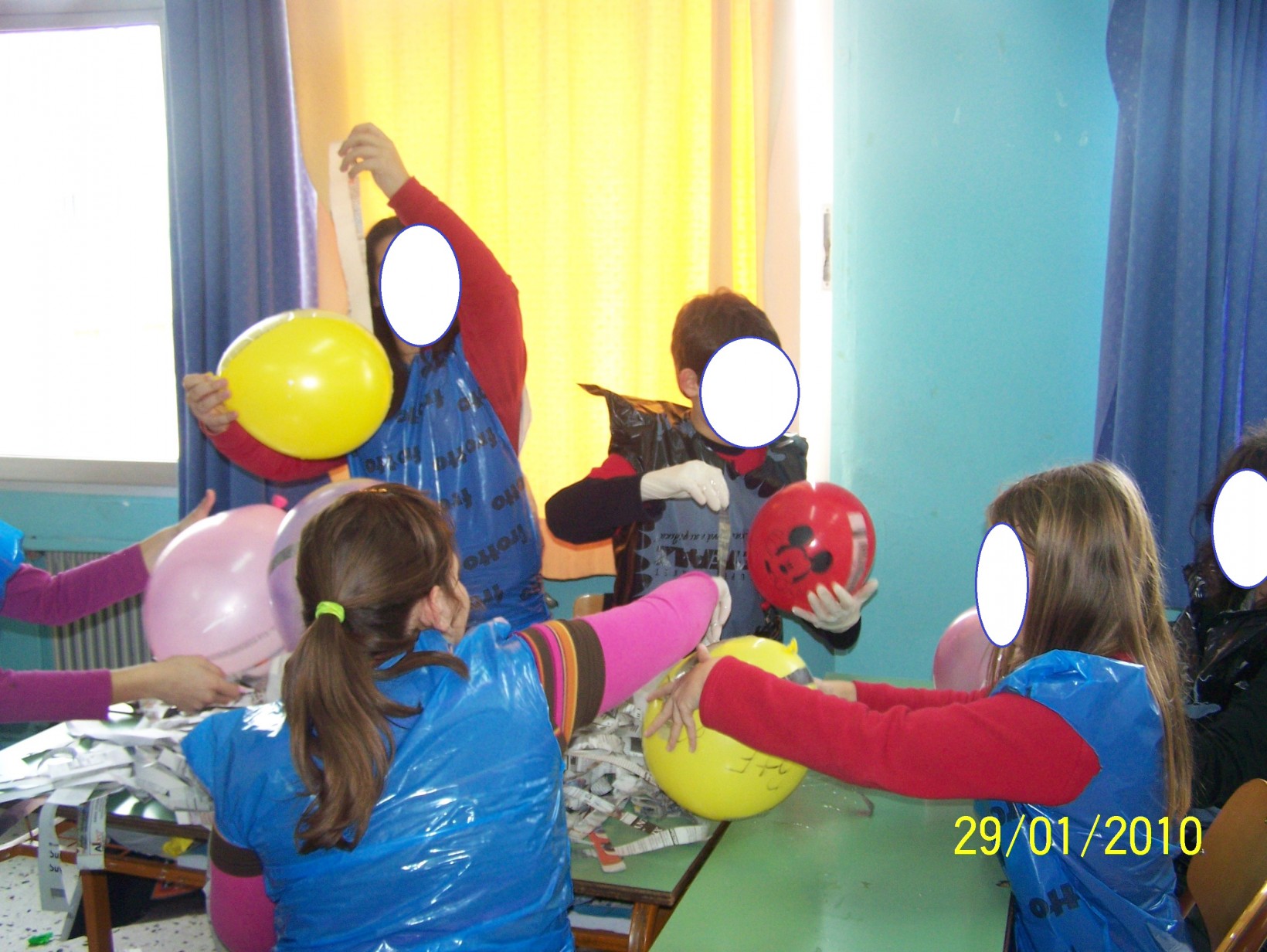
We mixed some wood glue in a bowl of water and we put the newspaper strips in the mixture one by one. Every newspaper strip was placed on the balloon, one next to the other and we finished when we had completed at least 3 layers of newspaper strips on the balloons.
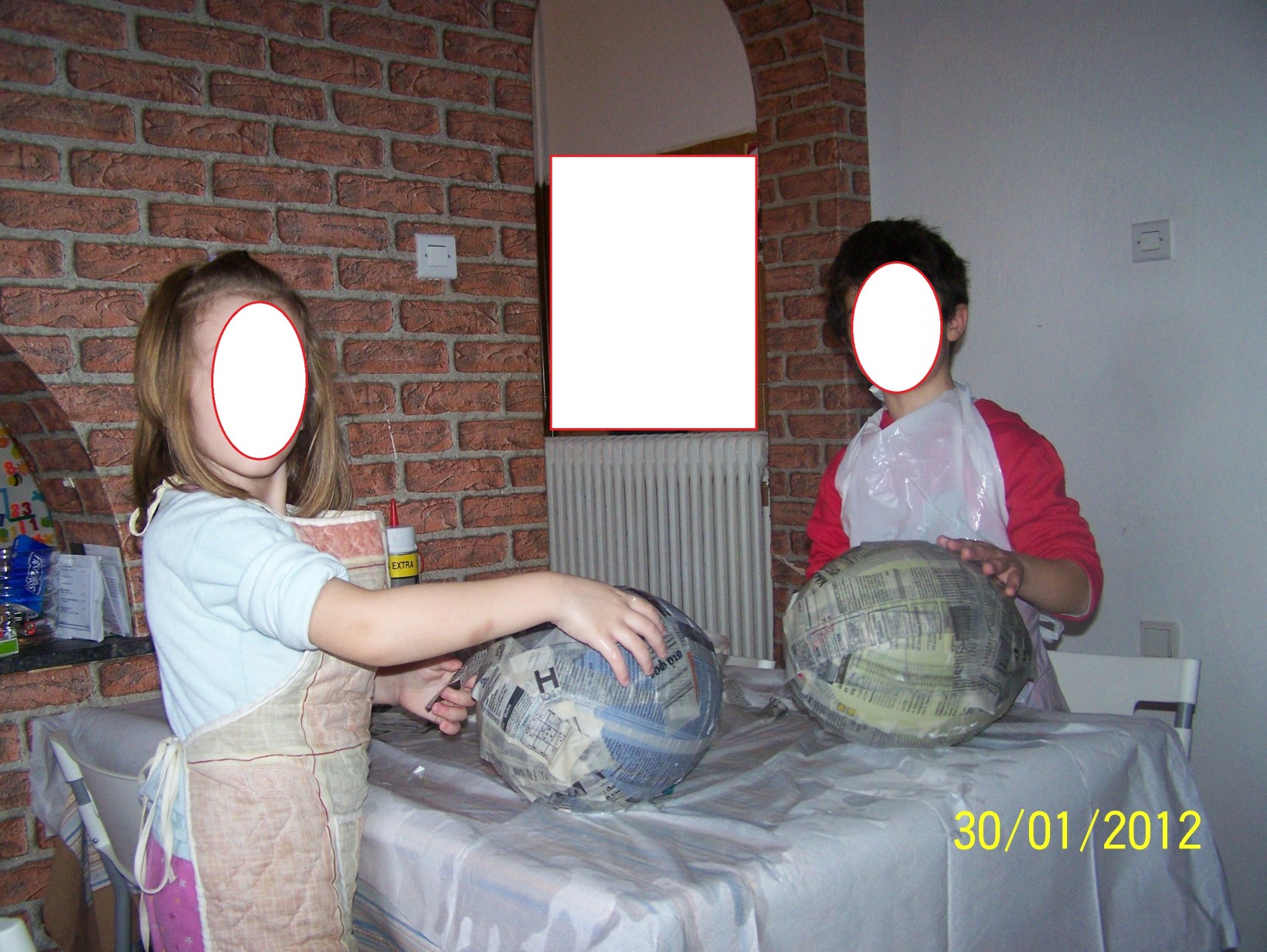
Then, we let the balloons dry for a whole day!

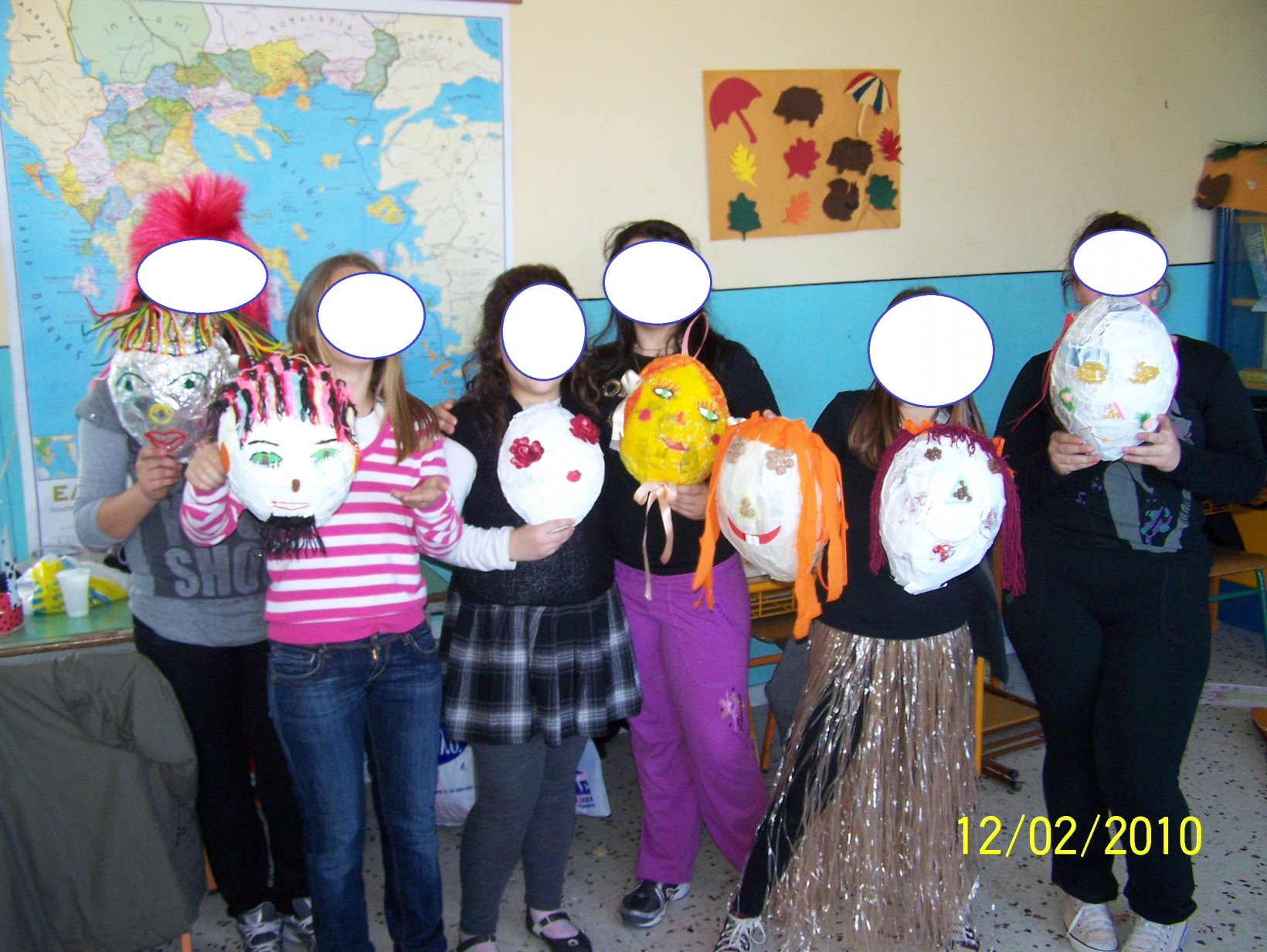
Today schools were closed owing to the snow and cold, so here we were again, painting this time the balloons with the white spray! Actually, you can use tempera or finger paints instead (it’s more fun for the kids and the result will be much more impressive if you use a variety of colours!), but the spray works faster, so that is what we did (the kids were not involved this time, this was all up to me, so that they wouldn’t inhale any chemicals). Again, we let them dry for a while. And then, the fun begins!!! We popped the balloons, made an opening at the back for the head to enter and we cut eyes and mouths! Then, they used their imagination and any materials I happened to have at home to decorate their masks any way they liked! Here’s what they made!

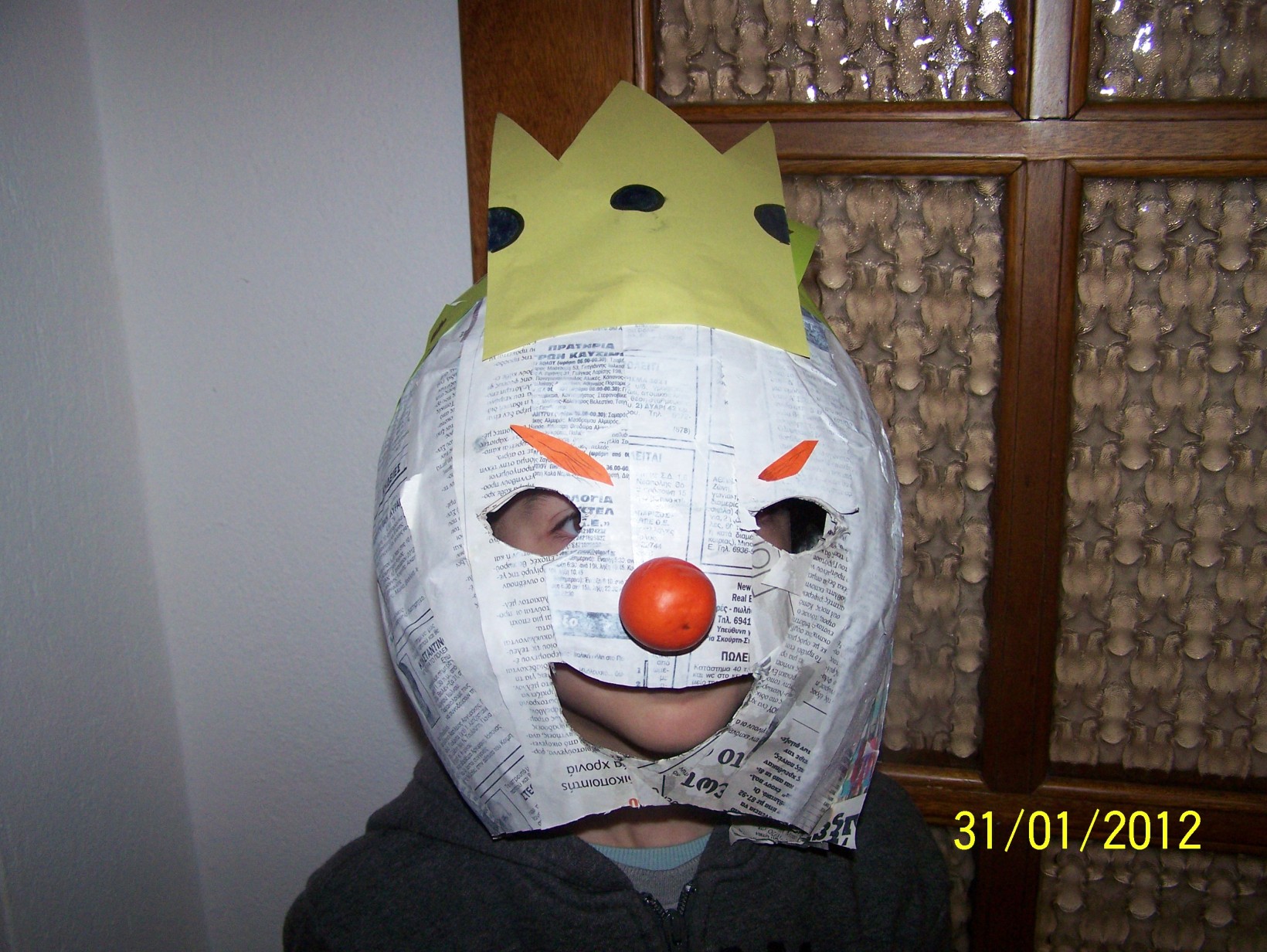

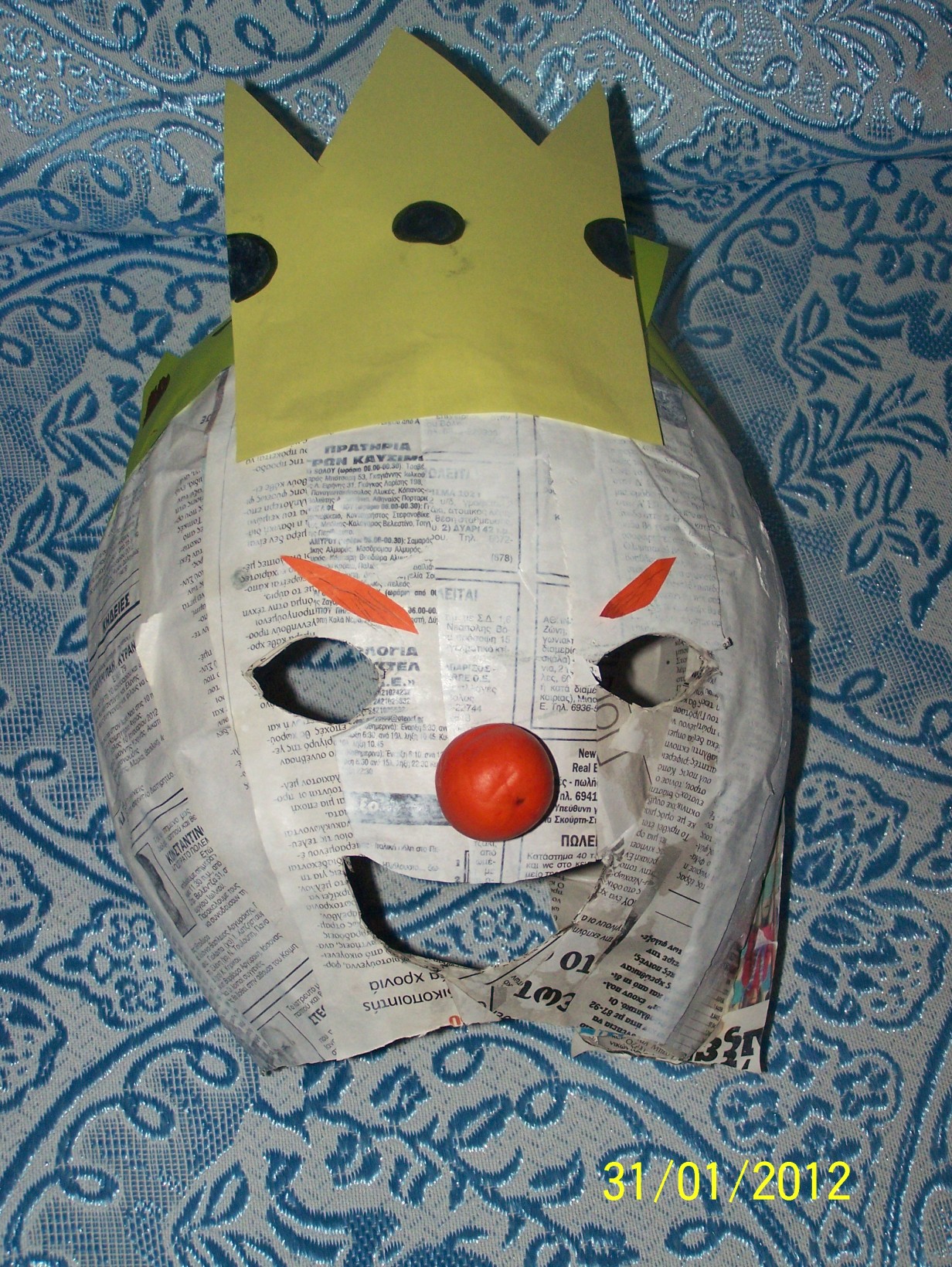

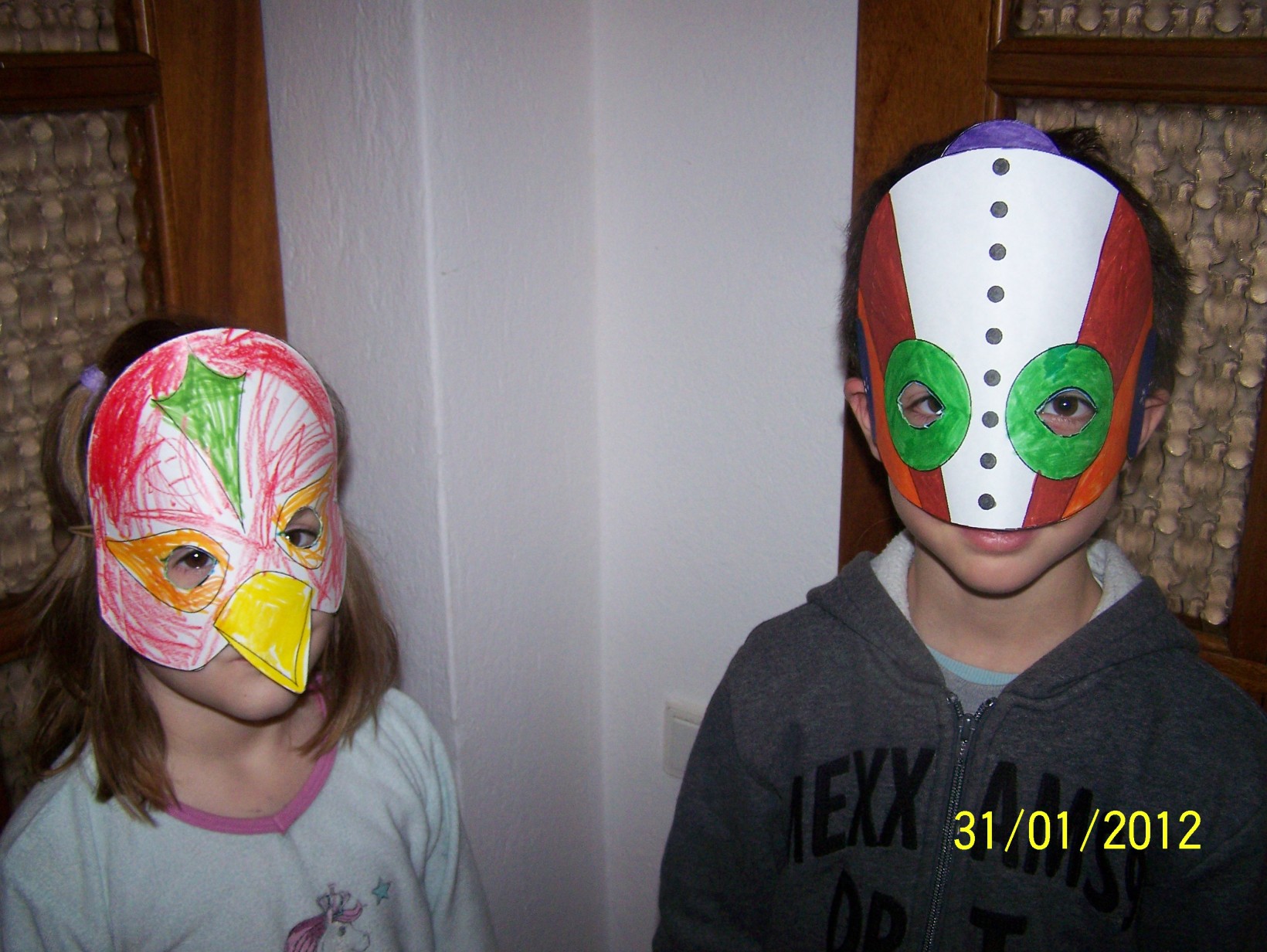
While we were waiting for the spray paint to dry on the balloons, we made some simple cardboard masks (we printed them from www.paidika.gr)! The kids had so much fun with them, but not as much as they did with the ones that covered their whole head!
Although it takes time to make a mask like this, we actually attempted to make it at the 1st Primary School of Almyros with the 6th graders a couple of years ago. My learners back then did a wonderful job indeed and they used their masks at the carnival party at school, they took pictures of them for the English School Newspaper and they decorated the school corridors with them throughout the Carnival period (they thought of it as something like a carnival art exhibition)! They even wrote an article for the school paper on how one can make the mask (You can read the article – in Greek – here). You can try this at school, too, by all means, but it is definitely going to take you more than one teaching hours if you decide to do everything with your learners involved. In my case, learners spent one teaching hour to place the newspaper strips on the balloons, I spray-painted them all on my own and, when they were dry, the learners took them at home to decorate them any way they liked! It would have been much more fun if they had decorated them at school, but the element of surprise when they brought the masks at school was almost equally enjoyable and fun (it also boosted the learners’ self-confidence, given that learners from other classes gathered to check the masks out and ended up congratulating the learners involved)! Here are some pictures of my learners working on the masks at school and some pictures that present what they have created!



WILD WEB WOODS is an online game for kids that has been created by the Council of Europe as part of the programme “Building a Europe for and with children”. The programme comprises two closely related stands: the promotion of children’s rights and the protection of children from violence. This particular game has been designed to help children understand the internet and become wise users of it! It is fun (I really enjoyed it!) and it will be easily played by children who can read on their own! Younger kids are going to need your help! Hope they enjoy it as much as I did!

The Greek carnival is usually celebrated at the end of winter and the beginning of spring, Halloween, though, is celebrated on October 31st! There are major differences between the Greek carnival celebration and Halloween celebration, but there is surely one thing they have in common: dressing-up!
In terms of dressing-up, Halloween seems to be all about spooky costumes, whereas the Greek carnival appears to fulfil our dream of transforming into anything we desire! Whether it is Halloween or Carnival, every year, we, teachers, try to find crafts we can do with our learners in class! Here you will find an assortment of sites that abound in crafts, decorations, coloring pages, costume ideas, treats recipes and printables! Have fun with your learners at school and don’t forget your kids at home! You can have so much fun with them!
Ματιά (Carnival crafts and costumes ideas!)
Hartaetoi (Carnival crafts with pictures!)
EnchantedLearning.com (great, easy to make crafts!)
AllCrafts.net (Halloween crafts, decorations, even treats recipes!)
DLTK’s Holiday Crafts for Kids (Frankenstein, ghost, vampire, witch, owl crafts …)
ActivityVillage (Skeletons, witches, bats and cats, pumpkins of all sorts, candy corn, monsters and ghosts too, so with well over 80 craft ideas here you should find something that is just the right amount of spooky for you!)
AllFreeCrafts (Here you can find crafts and decorations, Halloween recipes, party ideas and Halloween games, Halloween costumes and makeup, as well as printables!)
FamilyCorner.com (Crafts, decorations, recipes … you can try them at home with your kids, too!)
FreeKidsCrafts.com (Halloween printables, recycled crafts, costume ideas and food crafts!)
CraftBits.com (Halloween crafts, project ideas, decorations and wreaths!)
AllKidsNetwork (Halloween crafts for kids of all ages!)
42 Super Easy Halloween Craft Ideas (Wonderful and easy-to-make crafts for classrooms and families!)
20 Kid-friendly Halloween decorations (last-minute crafts, perfect for at-home or in the classroom)
Here is the video we normally watch at school to find out how Halloween is celebrated in Britain:
Erasmus for all
Investing in Europe’s education, training and youth
Erasmus for All is the new EU programme for education, training, youth and sport proposed by the European Commission on 23 November 2011. The proposal is now under discussion by the Council (27 Member States) and the European Parliament who will take the final decision.
Erasmus for All would bring together all the current EU and international schemes for education, training, youth and sport, replacing seven existing programmes with one. This will increase efficiency, make it easier to apply for grants, as well as reducing duplication and fragmentation. It is due to start in 2014.
Up to 5 million people, almost twice as many as now, could get the chance to study or train abroad with a grant from Erasmus for All. Among them would be nearly 3 million higher education and vocational students. Full-time Masters’ students would also benefit from a new loan guarantee scheme set up with the European Investment Bank Group.
What is Erasmus for All?
Erasmus for All is the new programme proposed by the European Commission for education, training, youth and sport. It would start in 2014 and would significantly increase the funds allocated for the development of knowledge and skills.Erasmus for All is based on the premise that investing in education and training is the key to unlocking people’s potential, regardless of their age or background. It helps them to increase their personal development, gain new skills and boost their job prospects.
What will Erasmus for All support?
Erasmus for All will have a streamlined structure which will improve effectiveness, which means more grants for students, trainees, teachers and others. The benefits for individuals will also bring benefits for the EU economy as a whole.
Opportunities for mobility and cooperation will be significantly strengthened under the new programme: in particular, there will be more funding available for study, training, teaching and volunteering opportunities abroad for higher education and vocational students, trainees, teachers, trainers and youth workers. There will also be more opportunities for education and training institutions or youth organisations to engage in partnerships to exchange good practice and with businesses to promote innovation and employability, as well as greater support for IT platforms, such as e-twinning, to connect schools and other learning providers via the internet.
The programme will support three main types of actions:
Learning opportunities for individuals, both within the EU and beyond, including: study and training, traineeships, teaching and professional development and non-formal youth activities such as volunteering.Erasmus for All would provide opportunities for learning abroad for up to 5 million people across all education and training sectors. Europeans would have the option to study, train or teach at higher education institutions anywhere in the world, and non-European students and staff would have more opportunities to study, teach and learn in Europe. Extending the programme beyond the EU’s borders will increase the attractiveness of European higher education and at the same time support the development of higher education elsewhere in the world.
Institutional cooperation between educational institutions, youth organisations, businesses, local and regional authorities and NGOs, to encourage the development and implementation of innovative practices in education, training and youth activities, and to promote employability, creativity and entrepreneurship.
Support for policy reform in Member States and cooperation with non-EU countries, with a focus on strengthening the evidence-base for policy making and exchange of good practices. Support will include the implementation of EU transparency tools, cross-country studies and support for specific policy agendas such as the Bologna (higher education) and Copenhagen (vocational education and training) processes.
Two completely new elements will be part ofErasmus for All:
A loan guarantee scheme to help Master’s degree students to finance their studies abroad and to acquire the skills needed for knowledge intensive jobs.
The creation of 400 ‘knowledge alliances’ and ‘sector skills alliances’. Knowledge alliances are large-scale partnerships between higher education institutions and businesses to promote creativity, innovation and entrepreneurship by offering new learning opportunities and qualifications. Sector skills alliances are partnerships between education and training providers and businesses to promote employability by forming new sector-specific curricula and innovative forms of vocational teaching and training.
How will Erasmus for All differ from the current programmes?
The main aim remains the same – to improve people’s skills and ultimately their employability as well as to support the modernisation of education and training systems.Erasmus for All would replace seven existing programmes with one: it brings together the existing Lifelong Learning Programme (Erasmus, Leonardo da Vinci, Comenius and Grundtvig), Youth in Action, and five international cooperation programmes (Erasmus Mundus, Tempus, Alfa, Edulink and the programme for cooperation with industrialised countries).
The main actions of the existing programmes will continue (i.e. learning mobility, cooperation projects and support for policy reform), but activities will be strengthened where the systemic impact is strongest and where there is a clear EU added value. There are also a number of new innovative proposals, such as the Erasmus Master’s degree student loan guarantee scheme, the knowledge alliances and the sector skills alliances. A single programme will result in simpler application rules and procedures, as well as avoiding fragmentation and duplication.
Why do we need a new EU approach to education and training?
The world was different when the existing programmes were created. We are currently experiencing one of the most tumultuous economic periods of our time. The EU has responded with a co-ordinated strategy for growth and jobs called Europe 2020 – and education and training are an integral part of this.
The European job market is also changing. The number of high-skilled jobs is growing while the number of low-skilled jobs is decreasing. It is estimated that by 2020 nearly 35% of all jobs will require high skills, innovation capacity and the ability to adapt. One of the headline targets in the Europe 2020 strategy is to raise higher education attainment to 40% (from 32% now). . Erasmus for All can contribute by helping people to gain more and better skills through opportunities to study and train abroad.
The other education headline target in the Europe 2020 strategy is to reduce the share of early school leavers from 14% to less than 10%. To contribute to this goal,Erasmus for All will support modernisation at all levels of education and training, including school education, from early childhood to secondary level and initial vocational training. Non-formal learning will be supported as well through youth exchanges and volunteering.
How will Erasmus for All address youth unemployment?
Erasmus for All will help young people to get training and skills that can increase their personal development and job prospects. Studying abroad can also increase language skills and adaptability. Studies have showed that students who have spent part of their studies abroad are more likely to take up a job abroad when entering the labour market.
Erasmus for All also recognises the importance of non-formal learning. Evidence shows that getting a job is not just about having the right diploma; employers increasingly look for skills acquired through non-formal learning experiences such as volunteering. Indeed, 75% of those who had participated in the European Voluntary Service said that their career prospects had improved thanks to this experience.
Who will be the main beneficiaries?
As the name suggests, Erasmus for All is open to all learners and trainers, through any public or private body active in education, training, youth and sport. It will support formal and non-formal learning experiences and activities across all sectors.
Will the target beneficiaries change from those supported by the existing programmes?
No. The new programme will still focus on the needs of young people, whether they are pupils, students, trainees, volunteers or involved in associations. It will place more emphasis on support for teachers, trainers, information officers and youth workers because of their importance as ‘multipliers’.
Cooperation projects will focus more on including business as partners with educational establishments and youth organisations.
Schools will be encouraged to collaborate with their peers in other EU countries to enhance the impact of EU support and promote synergies between different forms of cooperation, such as pupil and staff mobility and educational projects.As for adult education, the programme will boost mobility of teachers and trainers and foster closer cross-border cooperation between organisations.
Some activities supported by the current programmes will be reduced or discontinued in view of their limited systemic impact, or because they provide poor value for money or if they could be more efficiently supported through other EU funding, such as the European Social Fund (ESF). Mobility of people who are already on the job market, for instance, would be more of a priority for the ESF.
What is the added value of a student loan guarantee at EU level when many Member States have their own student loan scheme?
Student loan schemes exist in a number of countries, but they are often restricted to studies in national institutions or to undergraduates. Many national loan schemes have restrictions in terms of portability abroad.
The proposed EUstudent loan facility focuses on Master’s students studying in a different European country. Master degree courses are likely to be more expensive than undergraduate courses. The initiative would be complementary to national funding schemes, where they exist. .
What else is the Commission doing to increase student and youth mobility?
Funding is important, but money alone is not enough to make mobility a realistic opportunity for all. This will require a joint effort and new partnerships to remove obstacles which persist at national and regional levels. Part of this effort will be to improve the availability of information, to ensure grants and loans are “portable” (i.e. that they can be used by students studying or training abroad) and to improve recognition for study and training results.
In May, EU Education Ministers agreed on a joint plan [in the form of a Council Recommendation] to remove obstacles to studying or training abroad.
Why has the Commission decided to stop using existing names of mobility programmes such as Leonardo da Vinci, Comenius and Grundtvig?
Erasmus is a name which is widely recognised by the public and strongly associated with learning abroad and European cooperation. In setting up an integrated single programme, it makes sense to avoid multiple names and to capitalise on the popularity and awareness of the Erasmus brand.
Which countries will be able to participate in Erasmus for All?
Erasmus for All will be open to all EU Member States, Iceland, Liechtenstein, Norway, Switzerland, EU candidate countries benefiting from a pre-accession strategy and other countries in the Western Balkans.
In addition, non-EU, mostly neighbourhood countries, will be able to benefit from actions aimed at promoting study and training opportunities abroad, as well as youth activities.
Source: European Commission

The Learning Chocolate is a vocabulary learning platform I’ve recently found out about upon surfing the net. It allows the introduction of new vocabulary with visual aids, listening and pronunciation practice, as well as spelling practice! It goes without saying, of course, that it can only be used in the school computer lab, or by projection of the computer screen in class! So, if you have a computer lab at school with internet connection, you can try the Learning Chocolate, it seems fun and mind-engaging (the ‘chocolate’ part makes it sound tempting, too)!
ΠΡΟΣΚΛΗΣΗ ΓΙΑ ΣΥΜΜΕΤΟΧΗ ΕΚΠΑΙΔΕΥΤΙΚΩΝ ΠΡΩΤΟΒΑΘΜΙΑΣ ΕΚΠΑΙΔΕΥΣΗΣ ΣΤΗΝ ΕΥΡΩΠΑΪΚΗ ΕΚΠΑΙΔΕΥΤΙΚΗ ΔΡΑΣΗ “TEACHERS 4 EUROPE”.
Η Αντιπροσωπεία της Ευρωπαϊκής Επιτροπής στην Ελλάδα σε συνεργασία με το Υπουργείο Παιδείας, Δια Βίου Μάθησης και Θρησκευμάτων προσκαλεί τους Εκπαιδευτικούς της Πρωτοβάθμιας Εκπαίδευσης να συμμετέχουν σε μία καινοτόμα, διαδραστική εκπαιδευτική δράση με στόχο:
* να αποτελέσουν μέλη μιας Πανευρωπαϊκής Κοινότητας που θα προωθεί και θα ενθαρρύνει πρωτοβουλίες σχετικές με την ευρωπαϊκή στρατηγική ανάπτυξης και τη βελτίωση των συνθηκών ζωής των πολιτών
να συμμετέχουν σε ένα ενεργό δίκτυο ανταλλαγής απόψεων και καλών πρακτικών στην εκπαίδευση εντός της Ευρωπαϊκής Ένωσης
* να διαχειριστούν αποτελεσματικά τις προκλήσεις και τις ευκαιρίες της ευρωπαϊκής ολοκλήρωσης προκειμένου * να γίνουν οι ίδιοι κοινωνοί της ευρωπαϊκής ιδέας
* να εμπλουτίσουν τις γνώσεις και εμπειρίες των μαθητών της Ε’ & ΣΤ’ τάξης Δημοτικού σχετικά με το ευρωπαϊκό οικοδόμημα
* να εξοικειωθούν σε βιωματικές και εναλλακτικές παιδαγωγικές τεχνικές με στόχο την παροχή γνώσης σε σύγχρονα ευρωπαϊκά θέματα
Η συμμετοχή στην εκπαίδευση θα είναι δωρεάν, ενώ θα καλυφθούν τα έξοδα μετακίνησης (για απόσταση άνω των 60 χλμ), διαμονής και διατροφής των συμμετεχόντων εκπαιδευτικών.
Ημερομηνίες Διεξαγωγής της Εκπαίδευσης: 14,15,21,22 Ιανουαρίου 2012 και 7 Απριλίου 2012
Τόπος Διεξαγωγής της Εκπαιδευτικής Δράσης: Αθήνα και Θεσσαλονίκη
Για περισσότερες πληροφορίες πιέστε εδώ.
ΔΗΛΩΣΕΙΣ ΣΥΜΜΕΤΟΧΗΣ ΑΠΟ ΤΡΙΤΗ 1 ΝΟΕΜΒΡΙΟΥ 2011 ΕΩΣ ΔΕΥΤΕΡΑ 21 ΝΟΕΜΒΡΙΟΥ 2011

Από την έναρξη της σχολικής χρονιάς 2010-2011, το Δημοτικό Σχολείο Πτελεού συμμετείχε στο Ευρωπαϊκό Πρόγραμμα eTwinning το οποίο και προωθεί τη συνεργασία μεταξύ των Ευρωπαϊκών σχολείων που έχουν κοινούς παιδαγωγικούς και εκπαιδευτικούς στόχους. Η εργασία με την οποία ασχολήθηκαν οι μαθητές και οι μαθήτριες των Δ’, Ε’ και Στ’ τάξεων είχε τον τίτλο «Dancing our Way Through Tradition» και τους ενέπλεξε σε μια ανταλλαγή εθνικών εθίμων και παραδόσεων με άλλα Ευρωπαϊκά Δημοτικά Σχολεία. Το όχημα για την κάθε ανταλλαγή εθίμου μεταξύ των συμμετεχόντων ήταν η ταυτόχρονη αποστολή βιντεοσκοπημένων παραδοσιακών χορών και τραγουδιών της κάθε χώρας.
Τα παιδιά του Δημοτικού Σχολείου Πτελεού παρουσίασαν στα αγγλικά στους Ευρωπαίους συμμαθητές τους Ελληνικές παραδόσεις και έθιμα που αφορούν στα Χριστούγεννα, τις Απόκριες και το Πάσχα, ενώ παράλληλα έστειλαν DVD με ελληνικά τραγούδια από τη Χριστουγεννιάτικη γιορτή του σχολείου τους και DVD με παραδοσιακούς χορούς του τόπου μας. Οι καθηγήτριες που επιμελήθηκαν την άρτια διεξαγωγή του έργου ήταν οι Παρασκευή Χαμηλού (Αγγλικών), Δέσποινα Φούντα (Φυσικής Αγωγής) και Μαρία Σουλτάνη (Μουσικής).
Κατά τη διάρκεια του καλοκαιριού πληροφορηθήκαμε ότι το συγκεκριμένο έργο βραβεύτηκε με την Εθνική Ετικέτα Ποιότητας και χαρήκαμε ιδιαίτερα για την αναγνώριση αυτή!

Πρόσφατα, όμως, ενημερωθήκαμε ότι το Δημοτικό Σχολείο Πτελεού βραβεύθηκε με την Ευρωπαϊκή Ετικέτα Ποιότητας για την τελειότητα της εργασίας στο έργο eTwinning “Dancing Our Way Through Tradition”. Αυτό σημαίνει πως η εργασία των μαθητών μας και του σχολείου μας έχει αναγνωριστεί στο υψηλότερο Ευρωπαϊκό επίπεδο.
Σαν αποτέλεσμα, λάβαμε ένα πιστοποιητικό, το επισυνάπτουμε στο ιστολόγιό μας και σίγουρα θα το εκθέσουμε σε μία περίοπτη θέση στο σχολείο μας! Επίσης, το έργο μας εμφανίζεται σε έναν ειδικό χώρο της Ευρωπαϊκής Διαδικτυακής Πύλης στο www.etwinning.net.

Πολλά συγχαρητήρια στους μαθητές και τις μαθήτριες των Δ’, Ε’ και Στ’ τάξεων του σχολικού έτους 2010-2011, στους εκπαιδευτικούς που συνεργάστηκαν, αλλά και στη Διεύθυνση του Σχολείου για τη διαρκή υποστήριξη και ενίσχυση της όλης προσπάθειας!
ΒΡΑΒΕΥΣΗ ΑΓΓΛΙΚΗΣ ΣΧΟΛΙΚΗΣ ΕΦΗΜΕΡΙΔΑΣ
ΔΗΜΟΤΙΚΟ ΣΧΟΛΕΙΟ ΠΤΕΛΕΟΥ

Στις αρχές Ιουνίου 2011 σε εκδήλωση που πραγματοποιήθηκε στο Πολιτιστικό Κέντρο Ν.Ιωνίας, βραβεύτηκαν από το Δήμο Βόλου σε συνεργασία με τις Διευθύνσεις Πρωτοβάθμιας και Δευτεροβάθμιας Εκπαίδευσης Νομού Μαγνησίας τα μαθητικά έντυπα των σχολείων. Ανάμεσα τους ήταν και η εφημερίδα του Δημοτικού Σχολείου Πτελεού “Our World”, η μόνη εφημερίδα γραμμένη εξ’ ολοκλήρου στα αγγλικά από μαθητές. Τα παιδιά του σχολείου μας εξέδωσαν τρία 20σέλιδα τεύχη κατά το σχολικό έτος 2010-2011και τα έσοδα που συγκεντρώθηκαν από τις πωλήσεις διατέθηκαν στον οργανισμό ActionAid, και συγκεκριμένα στην οικογένεια του παιδιού από την Αφρική που έχει υιοθετήσει το Δημοτικό Σχολείο Πτελεού από την προηγούμενη χρονιά. Συγχαρητήρια σε όλους για την προσπάθειά τους και την δημιουργικότητά τους!
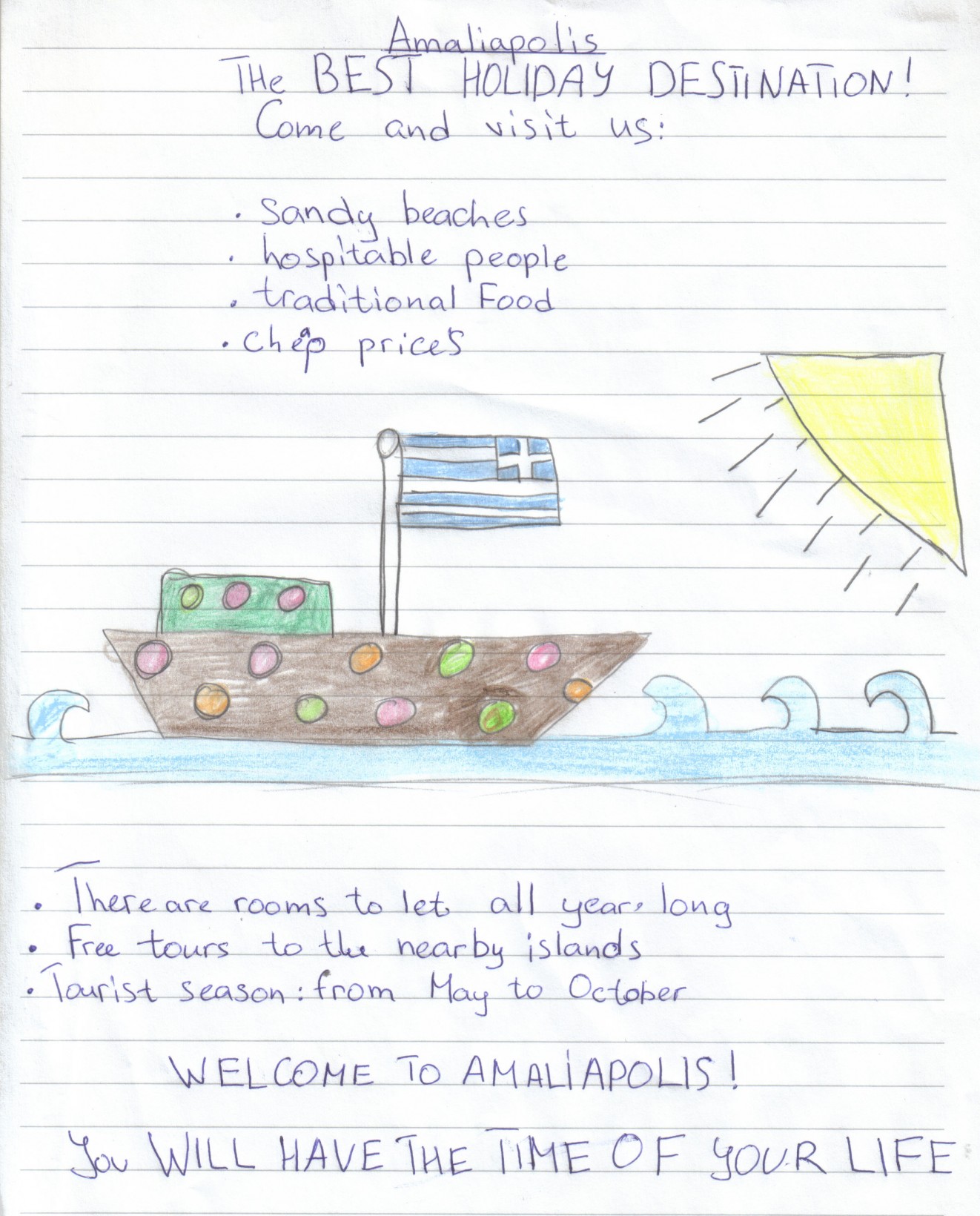
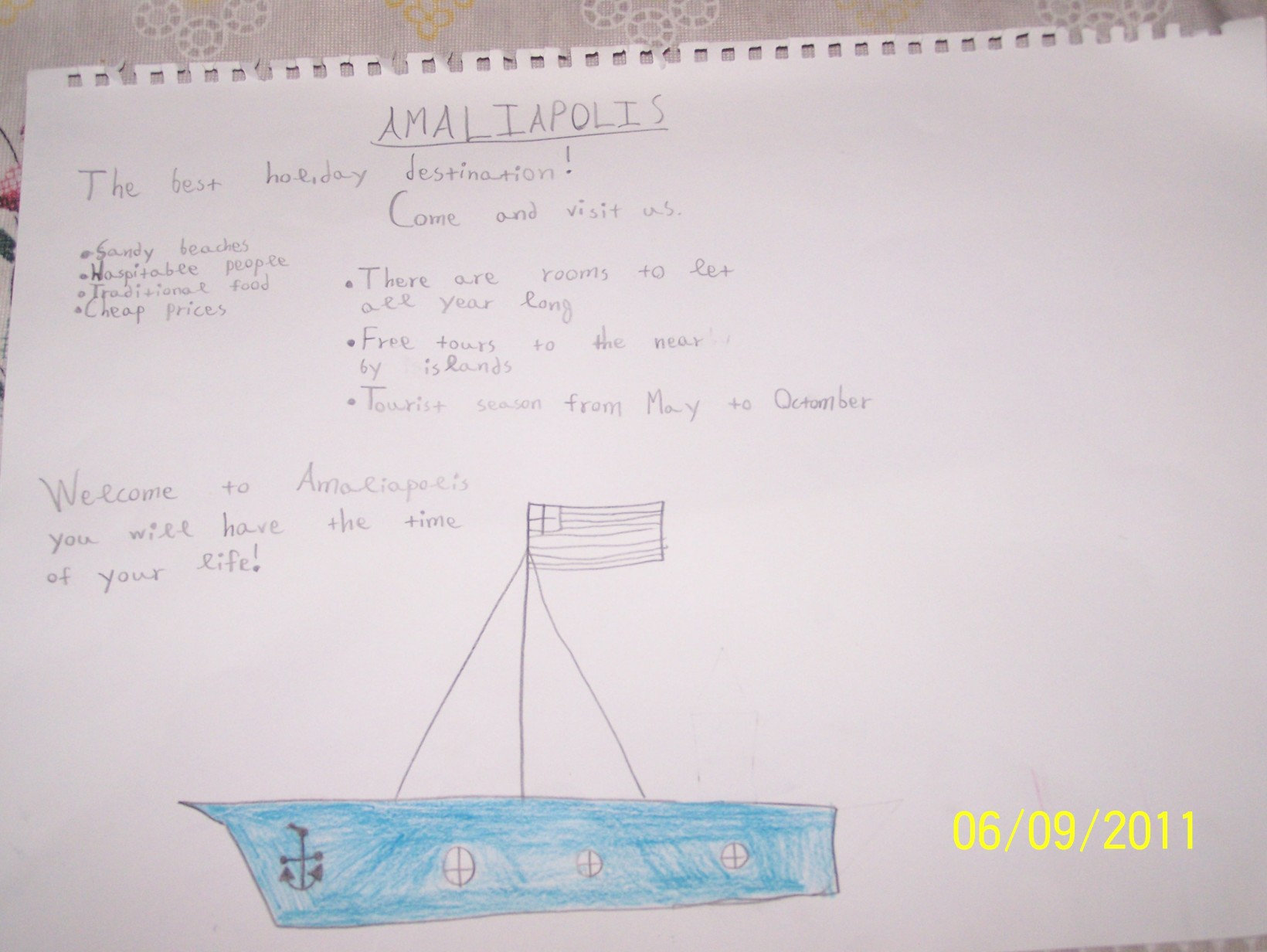
Learners at the Primary School of Amaliapolis have created posters that advertise their village! Here is a sample of their work!

Our 6th grade English coursebook introduces – or, even better, brings back to our memory – the myth of Daedalus and Icarus (Unit 4).
On p. 46, learners are invited to make their own painting of the fall of Icarus, having first commented on Pieter Brueghel’s painted landscape with the fall of Icarus, which was created in 1558 (oil on canvas, Musées Royaux des Beaux-arts de Belgique, Brussels), as well as a related poem.
Here are our learners’ pieces of art (Primary School of Pteleos)!