Press Release
DR ROBERTO CAVALLO INTERVIEW
DR ROBERTO CAVALLO INTERVIEW Environmental Activist and Founder of the social cooperative ERICA
QUESTIONS ASKED BY THE STUDENTS OF
GALILEO GALILEI TECHNICAL HIGH SCHOOL
AFTER THE MARATHON “KEEP CLEAN AND RUN
How was the “Keep Clean And Run” project born?
Thank you for the question. In 2014 the European Commissioner for the Environment Janez Potočnik asked me how to launch the European Clean-Up Day which is held on the 10th of May. Meanwhile I met a friend, Oliviero Alotto, who was used to run on the mountains, and that had just finished a trail between Aosta and Ventimiglia. I thought that our seas were increasingly full of waste, that the 75% of the waste (that ends up in the sea) is land-based. And, once finished into the sea, the waste degrades and it enters the food chain. I thought that I could do a similar race, like a waste: collecting the waste I would have found on the path and telling how bad that abandoned waste is for us. What are the keys to success? I think that the keys to success are two: first of all, the story telling and, secondly, the direct participation. In fact, since the first edition of “Keep Clean and Run” thousands of students have welcomed me, running from Aosta to Ventimiglia, for a meeting in front of their schools. And why were they waiting for me? They had cleaned their courtyards and the public space close to their schools from waste. When I finally met them, I told them about the waste and the items I found during the trail, which were often products they even didn’t know because much older than them. And these items were useful for me to explain the damage that people’s waste can do to the humans and how long they stay in the environment. Why is it so important? Because now we eat waste, we breathe it. According to the WWF research of the University of Newcastle in Australia, we ingest five grams of plastic per week. The link between mortality caused by the recent Corona Virus and pollution must warn us. I am afraid that the next pandemic will be caused by a virus of the intestinal system.
What are the main environmental problems today, in addition to waste and plastics in the oceans?
The various environmental crisis are connected between. Everything in nature is connected. One crisis makes another one happen. Climate change is an emergency because it causes the loss of biodiversity, it increases desertification, and makes the world population abandon their lands. In the coming years one billion people will be forced to migrate. What do you think it is important to do for the new generations in order to reverse the trend?
I’ll answer with just one word: to collaborate. In my opinion, this will be the verve for a future collaboration economy, and a culture of collaboration and cooperation. A cooperation between human beings but also between man and nature, that is what I wish to new and further generations.
ROBERTO CAVALLO – BIOGRAPHY
In 1994 he got a university degree at the Faculty of Agricultural Science at the University of Turin.
From 1994 to 1997 he was nominated Professor of Oenological Microbiology for the course of Viticulture and Oenology at the University of Turin.
From 1997 to 1999 he was elected Councilor for the environment, agriculture and civil protection at the Municipality of Alba.
He is the founder and CEO of the social cooperative ERICA leading company in technical consultancy and environmental communication with over 2,000 public administrations served in Italy, France, Spain, Belgium, Central and South America and Africa.
From 2002 to 2017 he was the President of AICA (International Association for Environmental Communication).
Since June 2003 he has been a member of the board of directors of the ACR + (Association Cities and Regions for Recycling and Sustainable Management of Resources in Brussels) of which he was Vice-President from 2011 to 2015.
He is the author of over 70 publications and books on environmental and naturalistic issues, in particular on integrated waste management and environmental communication, including some essays selected and awarded in more than 15 national and international literary competitions (including ”Minus 100 kilos – diet recipes of our bin”, Edizioni Ambiente, the Bible of Ecology, Elledici).
He has lectured at over 300 national and international conferences.
He was the protagonist of the films “Minus 100 kilos – recipes for the diet of our bin” by Emanuele Caruso and “Immondezza – beauty will save the world” by Mimmo Calopresti.
He is the consultant, author and presenter of some national radio and television broadcasts on environmental issues, on RAI Geo & Geo, Ambiente Italia, Chetempochefa, Unomattina, ScalaMercalli, Petrolio, Nemo.
He is also the author and presenter of the #envinews daily live on personal social profiles and of the radio broadcast “La Goccia del Colibrì – instructions for a sustainable future” broadcast on Radio Beckwith Evangelica and on the main social channels.
Publications
1. AA.VV., 1994 – Le Langhe in “reteiter. Il Piemonte come ambiente, 1”, pp. 209-233 Scholè Futuro – Torino.
2. AA.VV., 1994 – Gli stagni Mogliasso. Sequenze per un’oasi. Amici del Museo “Federico Eusebio” – Alba.
3. AA.VV., 1995 – Bra e Roero, Monregalese e Alpi Liguri in “reteiter. Il Piemonte come ambiente, 2”, pp. 745 – 786 Scholè Futuro – Torino.
4. AA.VV., 1996 – Novembre 1994 l’alluvione. Le radici di una catastrofe; pp. 192. Amici del Museo “F. Eusebio” e Gruppo Fotografico Albese – Alba.
5. AA.VV., 1997 – Internet & Environmental Education in Europe. An Open and Distance Learning Action: Eurosymbioses, pp. 34 Réseau Idée – Brussels.
6. AA.VV., 1999 – Rivermed, programma europeo per imparare a convivere con i corsi d’acqua e prevenire le alluvioni. Atti del convegno, 6 novembre 1999 – Alba.
7. Abele L., Cavallo R., Ghilardi S., 1997 – Gruppo di lavoro e di coordinamento dei poli della Rete Regionale di Servizi per l’Educazione Ambientale. Regione Piemonte Laboratorio di Pracatinat – Torino
8. Cavallo O., Cavallo R., 1990 – I Coleotteri Buprestidi del Museo Civico “F.Eusebio”. Alba Pompeia, n.s. XI/I: 27 – 38.
9. Cavallo O., Cavallo R., 1992 – I Coleotteri Cerambicidi del Museo Civico “F.Eusebio”. Alba Pompeia, n.s. XIII/I: 5 – 25.
10. Cavallo O., Cavallo R., Dellapiana G., 1993 – Guida alle Orchidee spontanee delle Langhe, pp. 264. Amici del Museo “Federico Eusebio” – Alba.
11. Cavallo O., Cavallo R., Enrico D., 1999 – Le Langhe. Escursioni, pp. 176. Itinerari fuori porta, Cierre Edizioni – Verona.
12. Cavallo R. Gandini A., Gerbi V., 1995 – Influenza dell’utilizzo di tre ceppi diversi di lieviti selezionati sulla degradazione dell’acido malico nei vini. Tesi di Laurea. Università degli Studi Facoltà di Agraria. Torino
13. Cavallo R., 1995 – Il controllo della sterilità nelle linee di imbottigliamento, Imbottigliamento, 18: 1, 114 – 118.
14. Cavallo R., 1996 – Riconoscimento di un ceppo di lievito in seno ad una popolazione eterogenea, atti del convegno “Biotecnologie per l’enologia i microrganismi selezionati” Alba 30 aprile 1996, 17 – 18.
15. Nyr L., Gandini A., Cavallo R., 1997 – Confronto tra ceppi di Saccharomyces cerevisiae da impiegare per la spumantizzazione in bottiglia. Facoltà di Agraria Diploma Universitario in Viticoltura ed Enologia – Torino
16. Cavallo R., Marengo A., 1992 – Itinerari didattici: 1. Il Tanaro: Amici del Museo “Federico Eusebio” – Alba.
17. Cavallo R., Rosso C., 1995 – Come farsi un vino spumante o frizzante, Vita in campagna, 4, 69 – 73.
18. Picasso M., Dansero E., Cavallo R., 2000 – La raccolta dei rifiuti nell’astigiano. Tesi di Laurea. Università degli Studi Facoltà di Scienze Politiche. Torino
19. Tortia C., Gandini a., Gerbi v., Minati J.L., Zeppa G., Cavallo R., Grando M.S., 1995 – Prove di vinificazione con Saccharomyces cerevisiae in forma secca attiva dotati di diverso potere maloalcolico, annali di Microbiologia ed Enzimologia, 45, 129 – 150.
20. Cavallo R., Rosio E. – Indagine socio-ambientale per definire un piano di comunicazione e potenziare la raccolta differenziata dei rifiuti nel Comune di Villarbasse. Provincia di Torino, 2001.
21. Cavallo R. – La gestione dei rifiuti tra costi e benefici: le scelte della pubblica amministrazione. Convegno RiForma – Centro Incontri Provincia di Cuneo, febbraio 2002.
22. Cavallo R. Rosio E. – La progettazione integrata dei sistemi di raccolta rifiuti: l’importanza della comunicazione. Presentazione di 3 casi esemplari in Piemonte. Atti convegno Regione Piemonte, Torino Incontra, 27 febbraio 2002.
23. Cavallo R., Rosio E., Terzolo D. – La progettazione integrata tecnicocomunicativa e i capitolati di appalto nel servizio di raccolta rifiuti. Atti convegno Oltre il Ronchi. Ridurre o differenziare?, Asti, Hotel Salera, 11 ottobre 2002.
24. Cavallo R., Rosio E., Gianolio F. – La progettazione integrata dei sistemi di raccolta rifiuti, l’importanza della comunicazione: il caso Marene (CN) Italia. Atti convegno Comune di Marene- Proteo, Provincia di Cuneo Sala Falco, 13 giugno 2003.
25. Tibaldi G.L., Mondini G., Cavallo R., 2002 – Applicazione dell’analisi di gerarchia per la valutazione di un sistema di gestione integrato di RSU: il caso del bacino astigiano. Tesi di Laurea. Politecnico di Torino Facoltà di Ingegneria Corso di Laurea in Ingegneria Ambiente e Territorio.
26. Cavallo R., Rosio E., 2003 – Waste minimisation in Italy. Warmer bulletin, Residua.com, 2/2003.
27. Cavallo R., 2003 – Verso una scienza della comunicazione ambientale. Envi.info 1/2003 pagg. 3-7.
28. Cavallo R., Rosio E., Roubertou D., 2004 – Progetto Re.Re.: comunicare la riduzione dei rifiuti. Regioni & Ambiente, 2/2004, pagg. 54-56
29. Cavallo R., ERICA Comunicazione, 2004 – Prodotti di nicchia di Langhe e Roero. L’Artistica editrice. 168 pagg.
30. Cavallo R., Tibaldi G., 2004 – Applicazione dell’analisi di gerarchia per la valutazione di un sistema di gestione integrato di rsu: il caso del bacino astigiano. L’Ambiente 5/04 pagg. 7-8.
31. Tornavacca A., Valle M., Stevanato P., Cavallo R., 2004 – L’evoluzione delle raccolte porta a porta in relazione alla qualità e comodità del servizio: cosa ne pensano gli utenti ? Rifiutioggi, ottobre 2004.
32. Della Croce C., Badino G., Cavallo R., 2004 – La raccolta differenziata nella città di Alba dal 1999 al 2004. Tesi di Laurea Università degli Studi di Torino, Facolta di S.M.F.N. corso di laurea in Scienze Biologiche.
33. Cavallo R., 2005 – Waste reduction in Italy: four Piedmont case-studies. Warmer Bulletin, 100, june 2005, pp. 16-19.
34. Cavallo R., Rosio E., Pavan D., Toniolo N., 2006 – La riduzione dei rifiuti una sfida possibile. L’ambiente, 2/06, pp 42-45.
35. Cavallo R., Bertoluzzo M., 2006 – il ruolo della comunicazione nella gestione dei conflitti. ARPA Emilia Romagna informa.
36. Cavallo R., Bertoluzzo M., Scatolero D. – 2006 I microconflitti ambientali e la comunicazione, L’Ambiente n. 4/2006, pp. 22-25. Ranieri Editore. Milano
37. Cavallo R., Gianolio U., 2006 – Un decreto in revisione, una nuova direttiva comunitaria: quale futuro per i rifiuti? L’Ambiente n. 5/2006, pp. 30-34. Ranieri Editore. Milano.
38. Cipriano V., Cavallo R., 2006 – Economical Instruments on waste management in Compedium ACR+ 2006 Annual anthology of diverse papers on key contemporary issues in European policies on wastes, products & resources. Pagg 141 – 153. ACR+ Bruxelles.
39. Cavallo R., Del Buono C., Gianolio U., Reviglio P., Stupino F., Visentin C., 2007 – La gestione dei Rifiuti Urbani Biodegradabili. L’Ambiente n.2/2007, pp 25-29. Ranieri Editore. Milano
40. Cavallo R., Rosio E., Raia S., Rasero F., Stupino F., 2007 – Il sistema COVAR14 (TO):
oltre il 60% di raccolta differenziata in area urbana e rurale. L’ambiente n. 3/2007, in corso di pubblicazione. Ranieri Editore. Milano.
41. Cavallo R., Raia S., Stupino F. Visentin C., 2007 – Prevenzione dei rifiuti e gestione integrata. L’ambiente n. 4/2007, pp 26-31. Ranieri Editore. Milano.
42. Cavallo R., Favoino E., Mercalli L., 2007 – Rifiuti e cambiamento climatico: dallo smaltimento corretto alla prevenzione. L’ambiente n. 6/2007, pp 8-14. Ranieri Editore. Milano.
43. Cavallo R., 2008 – Implementazione ed ottimizzazione di sistemi innovativi di RD: prevenzione, start-up e comunicazione in La Gestione Integrata dei Rifiuti, IV, 1-29. Politecnico di Milano. 63° Corso di Aggiornamento in Ingegneria Sanitaria-Ambientale.
44. Cavallo R., Filonzi L., 2008 – Il Consorzio CIR33: un’esperienza di successo. L’ambiente n.2/2008, pp 26-31. Ranieri Editore. Milano.
45. Cavallo R., Rasero F., 2008 – La gestione integrata dei rifiuti nelle isole minori: buone pratiche, progetti e proposte. L’ambiente n.5/2008, pp 54-59. Ranieri Editore. Milano.
46. Cavallo R., 2008 – Politica Europea dei rifiuti: verso una società del riciclo. L’Ambiente n.6/2008, pp 24-28. Ranieri Editore. Milano.
47. Cavallo R., Stupino F., 2009 – L’ecocentro (centro di raccolta): aspetti normativi e gestionali. L’ambiente n.2/2009, pp 8-15. Ranieri Editore. Milano.
48. Cavallo R., Gianolio U., 2009 – Tariffa per la gestione dei rifiuti urbani: si potrà ripartire dal 2010. L’ambiente n.4/2009, pp 1-7. Ranieri Editore. Milano.
49. Musso S., Padovan D., Cavallo R., 2009 – Quanto costa la comunicazione ambientale? Tesi di master. Master Universitario in Sviluppo Sostenibile e Promozione del Territorio. Università degli Studi di Torino – COREP. Ottobre 2009
50. Montoneri E., Boffa V., Cavallo R., – Progetto Biochemenergy – Poster session della XI Conferenza Nazionale sul Compostaggio: Produzione di compost e biogas da biomasse – Ecomondo, Rimini ottobre 2009.
51. Cavallo R., 2009 – Strategie europee per la riduzione dei rifiuti. Dalle esperienze di successo alla settimana europea della prevenzione dei rifiuti. In “Produrre meno rifiuti” a cura di Emanuele Burgin e Pinuccia Montanari. Edizione Ambiente. Milano pp. 11-18.
52. Cavallo R., 2010 – La prevenzione, il riuso e il recupero di materia: le prime tre priorità della gerarchia europea per la gestione integrata dei rifiuti. Pagg. 145-146. In Studi di Museologia Agraria. N. 49. Speciale Atti seminari “Cascine e Territorio”. ISSN 1724-0298.
53. Cavallo R., Musso S., Rosio E., 2010 – Quanto costa la comunicazione ambientale? L’ambiente n.2/2010, pp 1-4. Ranieri Editore. Milano.
54. Cavallo R., Rosio E., Rasero F., Musso S., 2011 – Comunicare i rifiuti. In ”Secondo rapporto sulla comunicazione sociale in Italia” a cura di Enzo Cucco, Rosaria Pagani, Maura Pasquali, Antonio Soggia. Carocci Editore, Roma. Pp 345 – 369.
55. Cavallo R., Gianolio U., Bosio L., Pavan A., 2012 – I costi della gestione dei rifiuti urbani e spending review L’ambiente n.5/2012, pp 15-19. Ranieri Editore. Milano.
56. Cavallo R., Biestro E., 2012 – Meno 100 chili. Ricette per la dieta della nostra pattumiera in “Green 3.0” 261-273. Mondadori Editore. Milano
57. Cavallo R., – L’Europa che Riduce. RifiutiOggi anno 22, numero 2-2012, pp 6-10
58. Cavallo R., 2012 – Il Compostaggio locale in Europa e nel mondo, Atti convegno ENEA in Ecomondo Rimini, novembre 2012.
59. Cavallo R. – una pattumiera più leggera per la salute del pianeta. ecoscienza Numero 1 • Anno 2013, pp 26-27
60. Cavallo R., 2013 – La prevenzione Europea. Quale Energia. pp. 77-79. Aprile 2013.
61. Cavallo R., 2013 – il futuro dello sviluppo passa per l’economia ambientale. Quale Impresa, Maggio-Giugno 2013, pp 18-21
62. Cavallo R., 2013 – Il recupero dei resti. Un’arte con la “A” maiuscola. Contro lo spreco. Barilla Center for Food&Nutrition. Parma. pp. 52-54. Giugno 2013.
63. Cavallo. R., 2013 – Elogio della prevenzione. La Nuova Ecologia. pp. 52-54. Giugno 2013.
64. Cavallo R., 2015 – Le città che si bio-degradano pp. 253 – 264. in Made in ItalyGreen Food&Sharing Economy. Mondadori Università a cura di Maurizio Guandalini e Victor Uckmar. 513 pagg.
65. Cavallo R., 2015 – Il pensiero circolare nell’economia del riciclo, pp. 20-21, ECOSCIENZA Rivista di Arpa – Agenzia regionale prevenzione e ambiente dell’Emilia-Romagna N° 5 Novembre 2015, Anno VI
66. M. Bonelli, L. Bosio, R. Cavallo, U. Gianolio and P. Marengo, 2016 – Waste prevention impacts on small municipalities: Three experiences from northern Italy, pp. 1.014-1.025 Waste Management & Research August 17, 2016
67. Cavallo R., 2017 – La mia corsa contro i rifiuti, pp 68-71- inNatura Anno III, n. 2 giugno-agosto 2017, Roma
68. Cavallo R., 2017 – PAYT (Pay as You Throw) schemes – a key step for a circular economy and citizens involvement, 4th World Congress and Expo on Recycling, Rome 27-29 July, International Journal of Waste Resources ISSN: 2252-5211 July 2017 – Volume 7 – Issue 3
69. Cavallo R., 2017 – Ecolotor, il Tor-des-Geants si tinge di verde, in TOR numero unico agosto 2017, Aosta.
70. Cavallo R., Rosio E., Bosio L., Bina S., Viglietta A., Montanari G., 2017 – La progettazione partecipata nei sistemi di raccolta rifiuti. L’esempio delle utenze non domestiche di Roma. pp. 18-22 – L’Ambiente Anno XXIV n. 3 maggio-giugno 2017, Ranieri Editore Milano.
71. Roberto Cavallo, Emanuela Rosio, Luigi Bosio, Paolo Marengo, Lorenzo Ardito, Francesco Rasero, La tecnologia RFID per prevenire l’abbandono dei rifiuti. La prima esperienza al mondo in Valle d’Aosta, pp. 17-22 Anno XXIV, n. 5 settembre-ottobre, Ranieri Editore, Milano.
72. Roberto Cavallo, Correre in montagna, avvicinare la natura, pp. 54-57, inNatura, Anno III, n. 3 settembre-dicembre 2017, Roma.
73. Cavallo R., Rasero F., Rosio E., 2018 – Vetro ed Enologia, un rapporto duraturo. Economia circolare, pp. 45-47, Anno XXXVI, 02/2018 Barolo&Co.
74. M. Monti, M. T. Scrivani, R. Cavallo, G. Fenocchio, Il riciclo della plastica: quale futuro? Proplast ha organizzato, nell’ambito delle attività del Polo Regionale Piemontese di Innovazione CGREEN, un tavolo tecnico sul tema del riciclo della plastica, pp. 18-21 – L’Ambiente Anno XXV, n. 3 maggio-giugno 2018, Ranieri Editore, Milano.
75. Cavallo R., 2019 – La Sostenibilità nei programmi amministrativi, in Ripartire dalle comunità per una crescita sostenibile, Confartigianato Veneto, pp. 48-53.
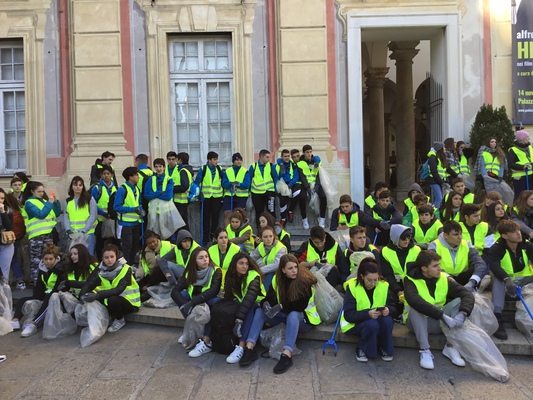
Clean and Run Marathon – Genova
Supervised by the teachers Mr Gianluca Litterio, Mr Francesco Santoro and Ms Franca
Monzeglio, our students, divided into several teams, according to the different collection of
material (paper, plastic, glass and aluminium), worked together to collect the waste they
found around.
The marathon started from Piazza delle Feste, and offered a tour in the
historical centre of Genoa. Some info-points were located in the most important sites of the
city, such as Piazza De Ferrari, Via Garibaldi and Piazza Don Andrea Gallo. The initiative,
promoted by AMIU, the company of the Genoese municipality in charge of managing the
wastes in town, was intended to raise awareness in as many young people as possible.
The students of Galileo Galilei Technical High School together with young people from other
schools have worked today and will work tomorrow to respect the planet through recycling.
The “Tilos Project” study : the advantage of the renewable energy sources and the use of battery storage in the energy production sector
The “Tilos Project” study :
Students of the Erasmus team of 2nd Junior High School of Amaliada studied and present “Tilos Project” ,
“the advantage of the renewable energy sources and the use of battery storage in the energy production sector”

DR WALTER RIVA INTERVIEW
DR WALTER RIVA INTERVIEW
Director of the Astronomical Observatory in Righi, Genoa
Erasmus Programme European Schools Go Green
INTERVIEW TO DR WALTER RIVA Director of the Astronomical Observatory in Righi, Genoa
QUESTIONS ASKED BY THE STUDENTS OF
GALILEO GALILEI TECHNICAL HIGH SCHOOL
AFTER A WORKSHOP ON THE SOLAR SYSTEM
DOCTOR WALTER RIVA – BIOGRAPHY
Walter Riva has been dealing with science publications, especially astronomy, for ages.
He has been invited to lecture at many conferences and guided observations of the sky, both with
the naked eye and the telescope.
He got a University Degree at the Faculty of Economics and Business with a final thesis on
Geography (1997), he got a Master in New Media and Communication at the University of Rome
Tor Vergata (2000) and a Master in Communication of Science of SISSA in Trieste (2004), getting
the highest score, with a final thesis on Planetaria entitled “The communication of science in the
world of Planetaria”. He has collaborated with the Observatory of Saint Barthélemy for the
construction of a 10 meters Planetarium in Valle d’Aosta.
He is the Director of the Astronomical Observatory of Righi and the President of the Planetarium of
Righi (Genoa) by managing the organization of all the public activities and the implementation of
the permanent didactic exhibition “The Garden of the Sun”.
He is a freelance journalist and one of the partners of UGIS (Unione Giornalisti Italiani Scientifici)
and has collaborated with some scientific magazines like “La Macchina del Tempo” (“The Time
Machine”) and “Astronomia” (“Astronomy”), and also with the De Agostini publishing house for
the encyclopedic work “Star Observer”.
He writes articles and news on astronomy for the Genoese newspaper “Il Secolo XIX”.
He is the author of the book “Breve storia dell’Universo” (“A short outline of the Universe”)
published by CUEN in Naples, of the children book “Dentro lo Spazio” (“Inside Space”) edited by
La Biblioteca, and the book “Storia di un raggio di luce” (The story of a sun beam”) issued by the
Gruppo B publishing house.
He coordinated and trained the scientific animators of the Festival of Science in Genoa in 2003, he
was in charge of organizing the inauguration of the Festival in 2004, and managed the activities
about astronomy of the Festival editions of 2003, 2004 and 2005; in 2006 he organized the cycle of
conferences “Dai confini del Sistema Solare all’Antartide” (“From the borders of the Solar System
to Antarctica”) held at the Aquarium of Genoa and the scientific exhibition “Mondi di ghiaccio”
(“Worlds of Ice”) at the National Museum of Antarctica; for the Festival edition of 2008 he set a
cycle of meetings “C’era una volta l’Universo” (“Once upon a time the Universe”) held at the
Aquarium of Genoa, and the cycle “Orizzonti dello spazio-tempo” (“Horizons of spacetime”) in
collaboration with the Faculty of Mathematics Physics and Natural Sciences in 2010.
He coordinated the participation of the University of Genoa in the 2010, 2011, 2012, 2013, 2014
editions of the Festival of Science.
In collaboration with the Aquarium of Genoa he organizes cycles of public conferences about
scientific topics on astronomy and related subjects every year.
Since March 2008 he has been the editorial coordinator of the science publication “Le Stelle” (The
Stars”), a monthly magazine dealing with astronomic culture, issued by the Gruppo B publishing
house, being its editorial director from February 2018 to October 2019.
Since November 2019 he has been the director of the magazine “Cosmo” (“Cosmos”), born from
the fusion of “Le Stelle” (“The Stars”) and “Nuovo Orione” (“New Orion”).
He is the manager of the events and communication department of the University of Genoa, for
which he also organizes scientific conferences and public engagement events.
“European Schools Go Green” DECEMBER 2019 PRESS RELEASE – 2nd Junior High School of Amaliada
DECEMBER 2019 PRESS RELEASE
With intensive preparations, activities, work, hospitality and endless creativity we are continuing enthousiasticly the third and final year of the European Erasmus + Programme / KA2 Key Action / “Collaboration for Innovation and Exchange of Good Practices” 2017-2020 entitled “European Schools Go Green” 2017-2020 at the 2nd Junior High School of Amaliada!
After two exceptionally creative years, we reached the third and final year of this European collaboration, having already exchanged visits and hosted students and teachers from both schools abroad with success and excellent results. Our students and teachers have already also traveled and have been warmly hosted in Genoa, Italy, and in Kassel, Germany, returning with life experiences and spiritual and mental resources. A collaboration with great dissemination of our work and a particularly warm response from the local community, the school and family environment of the students, the numerous collaborators and local authoritiew and many institutions we are working with, with publications and extensive articles in print and digital Greek, Italian and German Press, a tribute from local television, the website of the Directorate of Education of Western Greece which posted articles about our collaboration and our digital products on the “best practices” website and more.
Even before the schools opened we started with excitement. Since August, the teachers’ pedagogical team has been preparing our partners hosting for October. Also, our digital journal was published with the presentation of work and products from all three schools of the second year “Science Year” 2018-2019.
In September before our students came to school for the new school year the first harvest was made by the Photocycling company of small appliances and lamps that we collect in our school’s special bins. After our first year in this important recycling network, it was a great pleasure to see the full bins emptied and sent where everything the pupils, educators and sensitized citizens collected would be recycled safely.
As Mrs Salvanou, the IT teacher and member of our school’s Erasmus + pedagogical team that has been in charge of organizing the small appliances recycling, writes :
“We all can!!! Small daily habits change, recycle with us starting from home and school … One by one, class after class, home after home ! At our school we already recycled 82kg of electrical appliances and 3.2kg of lamps . Through Photocycling SA actions (approved of the Greek Ministry of Education, Research & Religions) at the 2nd Junior High School of Amaliada pupils and teachers collect old – damaged electrical appliances in special bins. The company cooperates with the Greek factory – recycler Eco Circle so that the appliances are not disposed of in an environmentally unfriendly manner, but undergo a special withdrawal process. Only 65% of the devices disposed in Greece are recycled, mainly through hospitals, companies, municipalities or affiliates, motivated by other financial or planning objectives. In schools this action is still rare, which does not mean it cannot be expanded. ” says Mrs Salvanou.
At the beginning of October we completed the mural “Erasmus + – European Schools Go Green 2017-2020” which will now adorn the multipurpose room “Erasmus” that has been designed and equipped by our program, and will remind us of our experience over the years and how much Erasmus has changed us and connects Europe’s students , schools and local communities.
In front of the mural are also displayed the models of our school created last year by our students under the guidance of their teacher Mr. Spyropoulos Professor of Technology, with modifications to the energy profile of the building and the addition of renewable energy sources, together with the energy study they did with their professor Mr. Vassilopoulos Professor of Physics for a more “green European school” as is the goal and title of all our cooperation with schools abroad.
During the week of October 21st – 25th 2019, our school enthusiastically welcomed the Italian delegation of teachers of our partner school Galileo Galilei Technical High School (5 Italian teachers, also having the great honour of having here Mrs Monteforte Headmaster of Galileo Galilei Technical Genoa High School) for a week of conferences, work and cultural visits and activities.
That week we had a series of meetings in our school’s specially designed Erasmus multipurpose room, we evaluated the second year of collaboration and organized this year’s work and final products.
With our guests we visited the City Hall of Ilida where gifts and souvenirs were exchanged. The Italian teachers expressed their joy for the cooperation and their thanks and greetings by presenting gifts to the Mayor of Ilida Mr. Yiannis Lymberis, while receiving warm welcome from Mr. Kapsis, Counselor of Culture of the Municipality of Ilida, Mr. Ioanna Stavropoulou, Chairman of the School Committee for Secondary Education of the Municipality of Ilida, Mr. Christos Nikolopoulos Chairman of the School Committee for Primary Education Chairman of the Public Council “Elios”, Mr. Eugenios Asteris, in a ceremony relayed by local television and has been published in print and online media. The Municipality of Ilida also culminated hospitality by offering a working dinner in the town of Amaliada.
We also visited the city of Pyrgos as well, where on Wednesday, October 23, 2019 we were guided to the Archaeological Museum of Pyrgos, the Merkouri estate, and finally the historical Katakolo Lighthouse having a special permit from the Hellenic (Greek) Navy Military Office.
It was a great pleasure and honour for us to have lunch with Head of Directorate of Secondary Education of Ilia, Mr.Vasileios Dimitrellos, who warmly congratulated the participants on the successful course and results of the cooperation. He exchanged gifts and souvenirs with the visitors and discussed many educational issues of our schools in both countries with our Headmasters and olus schools’ teachers.
We were also honoured to be accompanied by Mrs Tita Terzi, who as a School Activities and Culture Officer in previous years has supported our partnership, as well as all the activities of our school morally and practically, Mrs Harbali Iulia, a representative of the European Programmes Group of the Directorate of Secondary Education of Ilia, who was also close to us from the start of the programme, our eTwinning’s Ambassador awarded with 1st European eTwinning and other educational prizes Mrs Sofia Kouzouli, who warmly welcomed our guests and donated to our guests important works of Greek literature in English translation.
In Ancient Ilida, the ancient town which organized the Olympic Games in Ancient Greece, on the morning of Thursday, October 24, 2019 we all enjoyed the magnificent archaeological site and Museum with a guided tour by the archaeologist in charge Mrs Panagodimou.
All the above important representatives of the Educational Community and the State, despite their overwhelming workload, were extremely welcoming hosts and gladly participated in the organizational meeting work with the Italian colleagues and as a result our guests returned excited about their welcoming by the representatives of Greek authorities.
At the end of the week’s work, the conclusions and timetables were finalized and details were discussed about the upcoming trip of the Greek and Italian students to Kassel, Germany, hosted this time by the German Goethe Gymnasium.
Finally, the certificates of attendance were awarded and commemorative gifts were offered to Italian colleagues and their school. In the Erasmus Room of our school, the guests as well as the students and teachers of the Erasmus team left their message and signature in our mural so that the wall of the room would be filled with the positive emotions that brought us close.
In November and December informative and presentational meetings with the parents of our students took place, as well as a special briefing for the parents of the students who will be travelling to Kassel, Germany in April 2020.
Informing parents of Erasmus students.
The last year of cooperation is already in the middle! For two and a half years, during which we have had the great pleasure of meeting and collaboration of the students of the three schools, the
satisfaction and pride of our best ambassadors, who linked Amaliada with Genoa, Italy, and Kassel, Germany, we are glad we are building a strong and productive bridge of communication between our educational communities, families, cities and countries. But it is also important the fact that we have been able to reflect, inform, inspire first mentality changes and promote ideas and present the work of the students who have communicated with perseverance and enthusiasm, creating products by studying renewable energy, sustainable development, climate change and cultivating the social consciousness of the modern citizen.
Students are leading and continuing to zealously promote the change of our mentality and daily life, enriching it with the use of new technologies with low energy footprint and a more established ecological consciousness. We have come to this third and final year to complete our programme, which seems to be also successful.
Our project on Twinspace: https://twinspace.etwinning.net/34044
Highlights Website with selected products and activities: https://europeanschoolsgogreen.wordpress.com/
Our digital magazines: https://issuu.com/europeanschoolsgogreen
Our programme in various articles in Greek and foreign press:
Dissemination and promotion page updated! Press Releases and public Presentations about our work since the start of our project!
Visit our page ” Dissemination and promotion of our project” to see how our project is presented in numerous press releases and public presentations.
Follow the link to visit our ” Dissemination and promotion” pages
https://blogs.sch.gr/samiamidi/?page_id=504


Galileo Galilei Erasmus team at the Marathon “Clean and Run” in the historical centre of Genoa
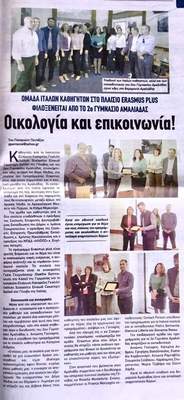
The Galileo Galilei participation at the marathon in the historical centre of Genoa “Clean and Run!” on the local press:
Article in greek in local Newspaper about our Third and Last Organisational Transnational Meeting in Amaliada, Greece, 22-23-24 October 2019
Articles in greek digital and printed Press about our Third and Last Organisational Transnational Meeting in Amaliada, Greece, 22-23-24 October 2019
Our third and last transnational organisational meeting in Amaliada, Greece
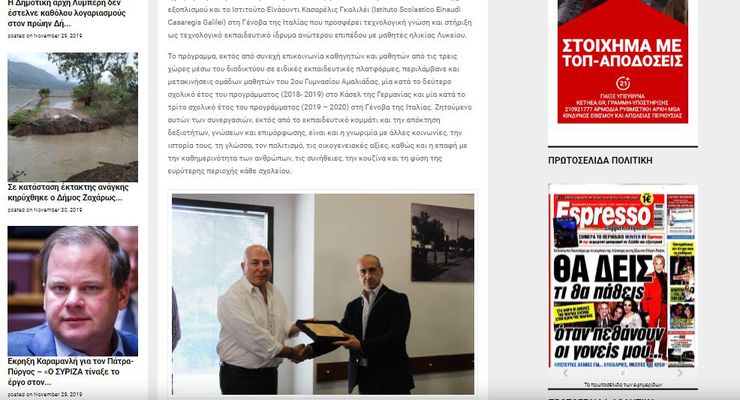
Local Press articles about the visit of the Greek and Italian teachers in Amaliada Town Hall and gifts exchange between our visitors and Municipality authorities repsesentatives
Στο Δήμο Ήλιδας καθηγητές από το πρόγραμμα Erasmusplus που υλοποιεί το 2ο Γυμνάσιο Αμαλιάδας
https://ermisilias.gr/index.php/epikerotita/19-ilia/3791-erasmus-plus-2


Our second year project e-magazine is available on slideshare too!
You can view, read, share and download the file on slideshare!
Follow the link!
- Home
- PUZZLE ! Erasmus+ , first transnational meeting, Kassel October 2017!
- Our Erasmus+ Work Calendar
- Our First Renewable Energy Quiz! How much do you know?
- Weebly Greek mini blog
- 2nd Junior High School of Amaliada – Galileo Galilei Technical High School of Genova : Work Progress September 2017 – January 2019
- ” European Schools Go Green” Erasmus+ Project 2019 printable Calendar
- our published e-magazines link on ISSUU
- Our European Schools Go Green site on wordpress!
- DISSEMINATION AND PROMOTION OF OUR PROJECT !!! 2017-2020
- "Climate Change" Newspaper – articles collection for our climate study research!
- "The Renewable energy Daily" Articles daily collection about Renewable Energy for our Erasmus + "European Schools Go Green" Project study and research
- 2nd Junior High School of Amaliada , Greece
- All Renewable Types of Energy World Map by National Geographic
- Biomass Biowaste Energy World Map by National Geographic
- European Schools Go Green Highlights Site on Wordpress
- European Schools Go Green Youtube channel !!!
- Geothermal Energy World Map by National Geographic
- Goethe Gymnasium , Kassel , Germany
- Greek Ministry of Enviroment and Energy – usefull links
- Greek newspaper article about our trip to Genova and the presents offered to Mayor of Amaliada by Galileo Galilei and Genova Mayor
- Greek press article about the week in Amaliada , April 2018
- Hydroelectric Energy World Map by National Geogrpahic
- Istituto Scolastico Einaudi Casaregis Galilei , Genova , Italy
- Newspaper "The Ecology Daily" – Articles daily collection for our Erasmus Project study
- Our Project on Etwinning!
- Our weebly highlights mini greek blog!
- SHOW YOUR STRIPES – GLOBAL WARMING – CLIMATE CHANGE – visual representations of the change in temperature over the past 100+ years
- Solar, Tidal, and Wave Energy World Map by National Geographic
- Wind Energy World Map by National Geographic!

Recent Comments