My Deepest Condiments
Συντάκτης: Κων/νος Βούλγαρης | Κάτω από: Εκπαίδευση στον 21ο αιώναcondiments (καρυκεύματα) λέξη που γράφτηκε κατά λάθος αντί για condolences (συλλυπητήρια), με αποτέλεσμα ο ποιητής να αντλήσει έμπνευση για το ποίημά του
Taylor Mali (born March 28, 1965) is an American slam poet, humorist, teacher, and voiceover artist, a 12th-generation native of New York City.
I send you my deepest condiments
was in no way what my old friend
meant to say or write or send
the night she penned a note to me
one week after my father died.
Not condolences, or sentiments,
she sent me her deepest condiments
instead, as if the dead have need
of relish, mustard, and ketchup
on the other side.
O, the word made me laugh
so hard out loud it hurt!
So wonderfully absurd,
and such a sweet relief
at a time when it seemed
only grief was allowed in
after my father’s death,
sweet and simple laughter,
which is nothing more than
breath from so far deep inside
it often brings up with it tears.
And so I laughed and laughed
until my sides were sore.
And later still, I even cried
a little more.
Τα πιο βαθιά μου καρυκεύματα
Σου στέλνω τα πιο βαθιά μου καρυκεύματα
δεν ήταν σε καμία περίπτωση αυτό που η παλιά μου φίλη
ήθελε να πει ή να γράψει ή να στείλει
το βράδυ που μου έγραψε ένα σημείωμα
μία εβδομάδα αφότου ο πατέρας μου είχε πεθάνει.
Όχι συλλυπητήρια ή συναισθήματα:
μου έστειλε αντιθετως τα πιο βαθιά της καρυκεύματα,
σαν να χρειάζονται οι νεκροί
ψιλοκομμένο τουρσί, μουστάρδα και κέτσαπ
στον άλλο κόσμο.
Ω, αυτή η λέξη με έκανε να γελάσω
τόσο πολύ και δυνατά που άρχισα να πονάω!
Τι υπέροχα παράλογη,
αλλά και πόσο γλυκά ανακουφιστική,
την ώρα που φαινόταν
πως μόνο το πένθος επιτρεπόταν
μετά το θάνατο του πατέρα μου—
γλυκό κι απλό γέλιο,
που είναι απλώς μια ανάσα,
βγαλμένη όμως από τόσο βαθιά μέσα μας
που φέρνει συχνά μαζί της και δάκρυα.
Κι έτσι γέλασα και ξαναγέλασα
μέχρι που πόνεσαν τα πλευρά μου.
Κι ωστόσο αργότερα έκλαψα,
λιγάκι πιο πολύ.
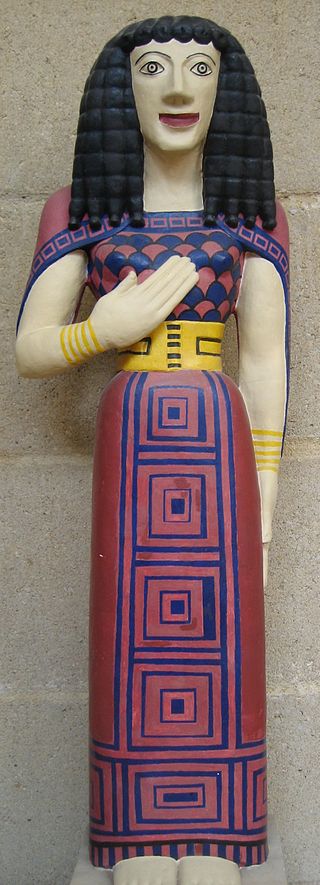
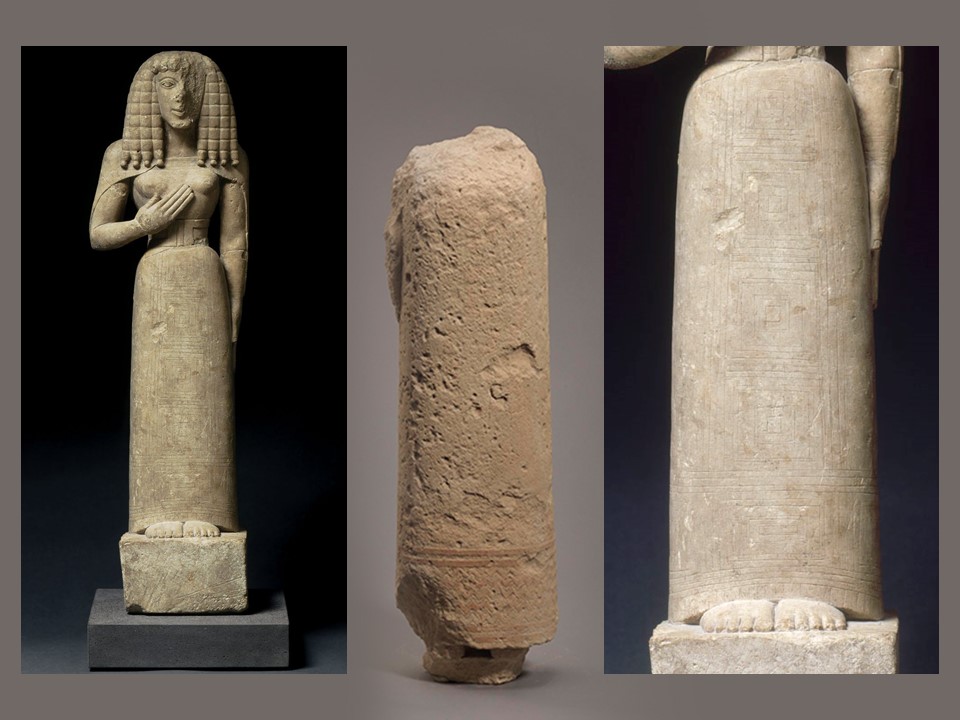
The relatively small (75 cm high) limestone Cretan sculpture called the Lady of Auxerre at the Louvre Museum in Paris depicts an archaic Greek goddess of c. 650 – 625 BC. It is a Kore (“maiden”), perhaps a votary rather than the maiden goddess Persephone herself, for her right hand touches her solar plexus and her left remains stiffly at her side.

It is also possible that the Kore is a depiction of a deceased individual, possibly in a position of prayer.
A Louvre curator found the sculpture in a storage vault in the Museum of Auxerre, a city east of Paris, in 1907.
Excavations in the 1990s by Nikolaos Stampolidis in Crete have helped establish more precisely a date and place of origin for the Lady of Auxerre, in the region of Eleutherna and Gortyna, with the recovery from gravesites of very similar carved ivory faces and other objects.

Cast of the Lady of Auxerre sculpture,
with putative colour reconstructed,
at the Museum of Classical Archaeology,
Cambridge
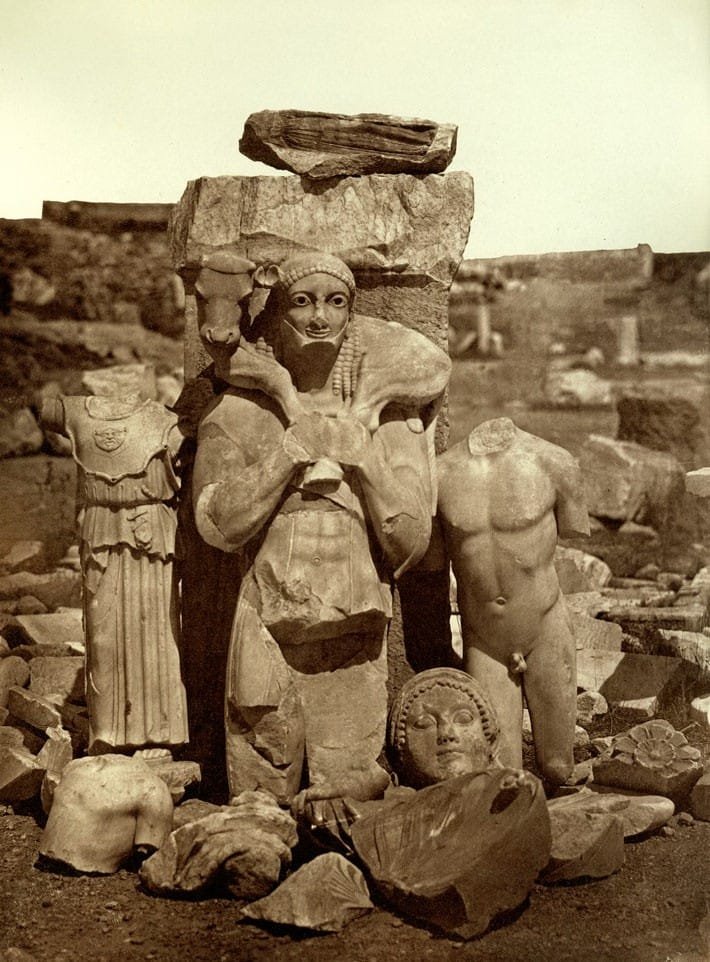
Statue of a man named Rhombos, son of Palos. It was excavated in fragments. The body was found in 1864 during construction works for the old Acropolis Museum, while the base and the feet were discovered in the same area in 1887.
calf μοσχάρι
(δεν προφέρεται το γράμμα l)
The theremin (originally known as the ætherphone) is an electronic musical instrument controlled without physical contact by the thereminist (performer).
A purely melodic instrument of the electronic family typically played by moving the right hand between two projecting electrodes with the left hand controlling dynamics and articulation.
It is named after its inventor, Leon Theremin, who patented the device in 1928.
“Over the Rainbow” is a ballad by Harold Arlen with lyrics by Yip Harburg. It was written for the 1939 film The Wizard of Oz, in which it was sung by actress Judy Garland.
The sound of the instrument is often associated with eerie situations.
In the song, Joan Baez recounts an out-of-the-blue phone call from Bob Dylan, which sends her a decade back in time, to a “crummy” hotel in Greenwich Village (a neighbourhood in New York City) in about 1964 or 1965.
She recalls giving him a pair of cufflinks, and surmises that memories bring “diamonds and rust”.
Sad-Eyed Lady of the Lowlands
Συντάκτης: Κων/νος Βούλγαρης | Κάτω από: Εκπαίδευση στον 21ο αιώναThe technique employed by Bob Dylan to write the song was to construct the verses as a series of “lists” of the attributes of the eponymous Sad-Eyed Lady.
These “lists” are complemented by a sequence of rhetorical questions about the Lady which are never answered within the song.
The lyrics are glorious. The repeated long vowels give it a sonorous, romantic sound. The biblical images of lowlands, prophets, and the offering of gifts to a god-like creature give the song a hymnal quality.
The song was written about Dylan’s first wife, Sara Lownds.
It is like a dream, a riddle and a prayer.
The Flame Trees of Thika
Συντάκτης: Κων/νος Βούλγαρης | Κάτω από: Εκπαίδευση στον 21ο αιώνα
The Flame Trees of Thika is a British television serial of seven 50-minute episodes made by Euston Films for Thames Television in 1981. It was adapted by John Hawkesworth from the 1959 book of the same title by Elspeth Huxley, and is set in and around the town of Thika in Kenya‘s Central Province. The story deals with the lives of British settlers in this part of East Africa in 1913, when the country was a British colony, up to the start of World War One.
The series stars Hayley Mills (in her first starring role after a six-year performing hiatus), Holly Aird, David Robb and Ben Cross.
Sir Edward William Elgar, 1st Baronet, (2 June 1857 – 23 February 1934) was an English composer, many of whose works have entered the British and international classical concert repertoire.
Although Elgar is often regarded as a typically English composer, most of his musical influences were not from England but from continental Europe.
He felt himself to be an outsider, not only musically, but socially. In musical circles dominated by academics, he was a self-taught composer.
Elgar has been described as the first composer to take the gramophone seriously. Between 1914 and 1925, he conducted a series of acoustic recordings of his works.
Cajun: The American English “Cajun” is derived from Acadian French Cadien.
The Cajuns Γάλλοι άποικοι που εκτοπίσθηκαν από τους Βρετανούς και κατέβηκαν από τον Καναδά στη Λουιζιάνα των ΗΠΑ, συχνά έχοντας γυρίσει πρώτα στη Γαλλία. Στη συνέχεια, αναμείχθηκαν με τους ιθαγενείς Ινδιάνους και άλλους λαούς.
shrimp, prawn γαρίδα
scampi γαρίδες πανέ
(prawns fried in breadcrumbs)
Ο Ντέιβιντ Ταλαμάντεζ την τελευταία μέρα στη Β′ Δημοτικού
Συντάκτης: Κων/νος Βούλγαρης | Κάτω από: Εκπαίδευση στον 21ο αιώναΣαν Αντόνιο, Τέξας 1988
Ο Ντέιβιντ Ταλαμάντεζ, του οποίου η μητέρα είναι στη δουλειά, αφήνει το χαρακτηριστικό στίγμα του παντού στην αυλή του σχολείου. Έχει ένα χοντρό πάκο από χαρτιά με γραμμές και πετάει ένα-ένα τα φύλλα ψηλά στον αέρα, τα παρακολουθεί
να πιάνονται στους προφυλακτήρες των αυτοκινήτων των δασκάλων, να παρασύρoνται και να καταλήγουν στην υπόλευκη, στενόμακρη σκιά της βρύσης. Μια τελευταία δεσμίδα με συρραμμένα φύλλα, τα τυλίγει σφιχτά σε ένα αυτοσχέδιο χωνί και φωνάζει μ’ αυτό:
Ντέιβιντ! και Ντέιβιντ, ΝΑΙ! προτού το εκσφενδονίσει με δύναμη στην οδό Μπράζος κόντρα στο φως, με ελαφρά σκυφτό το κεφάλι και τους ώμους όταν απέναντι, ασφαλής πια, κλωτσάει ένα κονσερβοκούτι
στο ρείθρο του πεζοδρομίου και περιπλανιέται μέχρι να φτάσει σπίτι. Ο Ντέιβιντ Ταλαμάντεζ πιστεύει ότι τα πουλιά είναι θερμόαιμα επειδή πετούν γρήγορα στον αέρα και βγάζουν μακρόσυρτες και πολύπλοκες μελωδίες, πάντα διαφορετικές,
όχι σαν τις γάτες και τους σκύλους. Γι’ αυτό και πήρε χαμηλό βαθμό στη Μελέτη Περιβάλλοντος, αλλά κι επειδή έγραψε το όνομά του σε λάθος σημείο, στα δεξιά με την ημερομηνία αντί να το γράψει αριστερά εκεί που λέει Ερωτήσεις Mελέτης Περιβάλλοντος
κι επειδή δεν άφησε μια γραμμή ανάμεσα στον τίτλο και τις απαντήσεις του. Τα Χ για τα λάθη του είναι μεγάλα, πολύ μεγαλύτερα από τα μικροσκοπικά γραμματάκια του Ντέιβιντ Ταλαμάντεζ. Κάνε μεγαλύτερα γράμματα! του λέει η δασκάλα του
με κόκκινο μελάνι πάνω-πάνω σε πολλές απ’ τις κόλλες του. Ακατάστατος! του γράφει σε άλλα σημεία, εκεί όπου είχε σβήσει και ξαναρχίσει και ξανασβήσει και ξαναγράψει. Ορθογραφία, Γλώσσα, Έκφραση, Γράψτε προτάσεις χρησιμοποιώντας
τις παρακάτω λέξεις: «Υποκοριστικό». Έχω ένα υποκοριτ̶σ̶ι̶στικό. ΟΧΙ! Βαθμολογία; 2άρια, 3άρια. Συκεντρώσου! Είναι όμως καλός στα Εικαστικά, πήρε 7 την ώρα της ανάγνωσης στην καλλιτεχνική γωνιά, όπου ξεπατίκωσε και χρωμάτισε
μια εικονογράφηση από το παραμύθι Η Μικρή Κοτούλα: Μια χήνα με ασπροκόκκινο ριγέ πουκάμισο, μια κότα με τιρκουάζ φόρεμα. Του αφαιρέθηκαν βαθμοί για τα πουλιά, το σύννεφο και την πεταλούδα που σχεδίασε από μόνος του. Δεν υπάρχουν στο πρωτότυπο!
Μείον 2,5 γιατί δεν έγραψες τίποτα στο κενό, εκεί που λέει «Αυτή είναι η αγαπημένη μου σκηνή στο βιβλίο διότι…» Υπάρχει μια σελίδα που ονομάζεται Κανόνες. Ακούμε! Δουλεύουμε πάντοτε! Μένουμε στη θέση μας!
Σηκώνουμε το χέρι μας πριν μιλήσουμε! Δεν τσακωνόμαστε! Κάνουμε ησυχία! Αντιγραφή των κανόνων από τον πίνακα, δεν μπήκε βαθμός, μόνο ένα τεράστιο κόκκινο νι. Αργότερα, τα παιδιά έγραψαν κι ένα τεστ πάνω στους Κανόνες. Αοκύμε! Δολέβουμε πανττε! μέννουμε στι θεσι αμς!
σικώνουμε το έχρι μας πρνι μιλίσουμε! Δεν τσακονόματσε! κανουμε ισιχία! Παίρνει 7 στους Κανόνες, 1 στην Ορθογραφία. Ένας ηλικιωμένος σκύβει να σηκώσει μία τσαλακωμένη ζωγραφιά. Δείχνει μία πολυμελή οικογένεια, στριμωγμένη γύρω από ένα τραπέζι, σε ένα διαμέρισμα
με κάγκελα στα παράθυρα, στη συνοικία Αλαζάν με τις εργατικές πολυκατοικίες και, σε μια γωνιά, έναν τεράστιο ήλιο που λέει: πολλύ φαασρία! Οι λέξεις έχουν διορθωθεί και ο βαθμός είναι 9. Ωραίες λεπτομέρειες! Υπάρχει ακόμα κάτι χαρακτηριστικό πάνω σε αυτό το χαρτί
και σε όλα τα άλλα, αυτό στην είσοδο του ινστιτούτου αισθητικής La Rosa, αυτό που ο άνεμος το φύσηξε κάτω από το τραπέζι του μπιλιάρδου στο La Tenampa, αυτά τα χαρτιά με τα οποία τα μεγαλύτερα παιδιά έχουν φτιάξει μεγάλες σαλιωμένες μπαλίτσες, αυτά τα χαρτιά που τα πατούν
τα αυτοκίνητα. Σε κάθε σελίδα, ο Ντέιβιντ Ταλαμάντεζ έχει διαγράψει την κόκκινη βαθμολογία της δασκάλας κι έχει σημειώσει με δικά του γιγάντια μπλε γράμματα: Ναι! Ντέιβιντ, ΝΑΙ!
David Talamántez on the Last Day of Second Grade
San Antonio, Texas 1988
David Talamántez, whose mother is at work, leaves his mark everywhere in the schoolyard,
tosses pages from a thick sheaf of lined paper high in the air one by one, watches them
catch on the teachers’ car bumpers, drift into the chalky narrow shade of the water fountain.
One last batch, stapled together, he roles tight into a makeshift horn through which he shouts
David! and David, yes! before hurling it away hard and darting across Brazos Street against
the light, the little sag of head and shoulders when, safe on the other side, he kicks a can
in the gutter and wanders home. David Talamántez believes birds are warm blooded,
the way they are quick in the air and give out long strings of complicated music, different
all the time, not like cats and dogs. For this he was marked down in Science, and for putting
his name in the wrong place, on the right with the date instead of on the left with Science
Questions, and for not skipping a line between his heading and answers. The X’s for wrong
things are big, much bigger than David Talamántez’s tiny writing. Write larger, his teacher says
in red ink across the tops of many pages. Messy! she says on others where he’s erased
and started over, erased and started over. Spelling, Language, Expression, Sentences Using
the Following Words. Neck. I have neck name. No! 20’s, 30’s. Think again! He’s good
in Art, though, makes 70 on Reading Station Artist’s Corner, where he’s traced and colored
an illustration from Henny Penny. A goose with red-and-white striped shirt, a hen in a turquoise
dress. Points off for the birds, cloud and butterfly he’s drawn in freehand. Not in the original
picture! Twenty-five points off for writing nothing in the blank after This is my favorite scene
in the book because…. There’s a page called Rules. Listen! Always working! Stay in your seat!
Raise your hand before you speak! No fighting! Be quiet! Rules copied from the board, no grade,
only a huge red checkmark. Later there is a test on Rules. Listen! Alay ercng! Sast in ao snet!
Rars aone bfo your spek! No finagn! Be cayt! He gets 70 on Rules, 10 on Spelling. An old man
stoops to pick up a crumpled drawing of a large family crowded around a table, an apartment
with bars on the windows in Alazán Courts, a huge sun in one corner saying, To mush noys!
After correcting the spelling, the grade is 90. Nice details! And there’s another mark, on this paper
and all the others, the one in the doorway of La Rosa Beauty Shop, the one that blew under
the pool table at La Tenampa, the ones older kids have wadded up like big spit balls, the ones run
over by cars. On every single page David Talamántez has crossed out the teacher’s red numbers
and written in giant letters, blue ink, Yes! David, yes!
This poem celebrates the life-affirming exuberance of an irrepressible seven-year-old child while, at the same time, suggest that the pedagogic principles that teachers often apply may tend to stifle creative energy. The teachers apparently propose that “rules,” not creative impulse or the emotional energy of a child’s observations of the world around him, dominate one’s early education.
You can probably provide your own anecdotes of deadly repressive teachers; and perhaps remember the exciting teachers who rewarded exuberance, and encouraged students to create outside the lines. In any case, the language of this poem is clearly designed to defend David’s position.
American poet Rosemary Catacalos
(1943/1944 – June 17, 2022)
Born in St Petersburg, Florida, during World War II to parents from San Antonio, Texas, she returned to San Antonio when she was three years old, where she spent most of her childhood on the east side. Rosemary Catacalos was of Greek and Mexican heritage.
(1988)
Each day I live
I want to be
A day to give
The best of me
I’m only one
But not alone
My finest day
Is yet unknown
I broke my heart
Fought every gain
To taste the sweet
I face the pain
I rise and fall
Yet through it all
This much remains
I want one moment in time
When I’m more than I thought I could be
When all of my dreams are a heartbeat away
And the answers are all up to me
Give me one moment in time
When I’m racing with destiny
Then in that one moment of time
I will feel
I will feel eternity
I’ve lived to be
The very best
I want it all
No time for less
I’ve laid the plans
Now lay the chance
Here in my hands
Give me one moment in time
When I’m more than I thought I could be
When all of my dreams are a heartbeat away
And the answers are all up to me
Give me one moment in time
When I’m racing with destiny
Then in that one moment of time
I will feel
I will feel eternity
You’re a winner for a lifetime
If you seize that one moment in time
Make it shine
Give me one moment in time
When I’m more than I thought I could be
When all of my dreams are a heartbeat away
And the answers are all up to me
Give me one moment in time
When I’m racing with destiny
Then in that one moment of time
I will be
I will be
I will be free
I will be
I will be free!
As American as Apple Pie
Συντάκτης: Κων/νος Βούλγαρης | Κάτω από: Εκπαίδευση στον 21ο αιώναEver heard of the saying “as American as apple pie”?
Baseball is as American as apple pie.
Even though every American probably has their favorite way to make apple pie, the traditional apple pie is a double-crust pie, with a filling of thin slices of apples, sugar, a small amount of flour, bits of butter, and spices such as cinnamon in the middle. Alternatively, the filling can be precooked to prevent a soggy crust and to intensify the flavors and can include additional spices such as allspice, nutmeg, and lemon juice. Also, some recipes call for tapioca or cornstarch instead of flour to thicken the filling. If the pie does not have a decorative latticework top, is essential to make vents in the top crust so that steam can escape during baking. Before baking, the assembled apple pie is brushed with an egg wash and sprinkled with sugar. It is served warm, usually topped with a scoop of ice cream or with a slice of cheddar on top or the side.

«Φρύνος (είδος βατράχου) μέσα στην τρύπα»
The unusually named toad in the hole is a traditional British delicacy consisting of a number of sausages baked in a Yorkshire pudding batter. The dish is traditionally served with vegetables, mashed potatoes, and onion gravy on the side.
It was invented in the 18th century, when batter puddings first became popular. The name of the dish comes from its visual appearance—the sausages are reminiscent of frogs which are peering out from a crevice. Originally, toad in the hole was considered a vulgar dish, and over time it slid down the social scale and became a staple of workers’ diet.
batter κουρκούτι
Yorkshire pudding batter: pancake mix cooked in the oven
Εισαγωγή της Αγγλικής Γλώσσας στο Νηπιαγωγείο (ΕΑΝ)
Συντάκτης: Κων/νος Βούλγαρης | Κάτω από: Εκπαίδευση στον 21ο αιώναMon esprit vagabondait, ici et ailleurs, porté par les notes cristallines qui me parvenaient du salon. Mon passage préféré de l’adagio. Le dialogue entre le cor anglais et le piano.
Το μυαλό μου περιπλανιόταν, εδώ κι εκεί, παρασυρμένο από τις κρυστάλλινες νότες που έφταναν σ’ εμένα μέσα από το σαλόνι. Το αγαπημένο μου κομμάτι από το αντάτζο. Ο διάλογος ανάμεσα στο αγγλικό κόρνο και το πιάνο.
Guillaume Musso | La vie est un roman (2020)
cor anglais αγγλικό κόρνο
Στην Αγγλία χρησιμοποιείται η γαλλική ονομασία και προφέρεται περίπου σαν /κοορ όνγκλεϊ/.
Φωνητική απόδοση: /ˌkɔːr ˈɒŋɡleɪ/.
Στην Αμερική λέγεται συνήθως English horn.
Joseph Maurice Ravel (7 March 1875 – 28 December 1937) was a French composer, pianist and conductor. He is often associated with Impressionism along with his elder contemporary Claude Debussy, although both composers rejected the term. In the 1920s and 1930s Ravel was internationally regarded as France’s greatest living composer.