15/10/2025 – 15/05/2026


15/10/2025 – 15/05/2026
Juneteenth, officially Juneteenth National Independence Day, is a federal holiday in the United States. It is celebrated annually on June 19 to commemorate the end of slavery in the United States. The holiday’s name, first used in the 1890s, is a portmanteau of June and nineteenth, referring to June 19, 1865, the day when Major General Gordon Granger ordered the final enforcement of the Emancipation Proclamation in Texas at the end of the American Civil War.

As another wonderful school year comes to an end, I would like to wish you a happy, sunny, and relaxing summer!
May your holidays be filled with laughter, adventures, games, and special moments with your family and friends. Take time to explore, create, read, play, and enjoy the beautiful days ahead.

The quokka (Setonix brachyurus) is a small marsupial about the size of a large cat.
Like other animals in the macropod family, such as kangaroos and wallabies, the quokka eats grass and small plants, and is mainly nocturnal. It lives on some small islands off the coast of Western Australia, mainly on Rottnest Island near Perth, and Bald Island near Albany. A small number live on the main land in the protected area of Two Peoples Bay, which they share with Gilbert’s Potoroo.
The quokka is the only member of the genus Setonix.
The quokka is a social animal and lives in large groups. They eat grass, sedges, succulents and leaves. They can become very sick if fed with things like bread, given to them by visitors to Rottnest Island. Visitors are now told not to feed them.
Quokkas breed at any time on the mainland, but usually in late summer on Rottnest. The female quokka has two babies (called joeys) in a year.
The quokka moves in the same way as a kangaroo, using both small and large hops.
Quokkas are not scared of people, so you are able to get quite close to them, particularly on Rottnest Island. It is against the law on Rottnest Island to handle or touch the animals in any way. A $100 fine can be given by the Rottnest Island Authority for picking up a quokka.
The word quokka comes from a Nyungar word, which was probably gwaga.

Zwischen 1933 und 1945 wurden zahlreiche
Leipziger Sinti und Roma nach Auschwitz und in
andere Vernichtungslager deportiert und ermordet.
Außerdem wurden Sinti und Roma aus Deutschland
und dem besetzten Europa als Zwangsarbeiter
in Leipziger Rüstungsbetriebe verschleppt.
Viele kamen dort um.
Between 1933 and 1945, numerous
Sinti and Roma from Leipzig were deported to Auschwitz
and other extermination camps, where they were murdered.
What’s more, Sinti and Roma from Germany
and occupied Europe were forcibly brought to work as slave labourers
in Leipzig’s armaments factories.
Many died there.


This memorial commemorates the deported and murdered Romani and Sinti people of Leipzig, Germany.
It features a bronze sculpture by artist Wieland Förster titled “The Beaten One,” depicting a crouching, broken figure. It pays tribute to those deported from Leipzig to camps like Auschwitz and those forced to work in local armaments factories.
Location: Goethe Street (Goethestraße) green belt, in the heart of Leipzig.

Leipzig is a city where history and creativity walk hand in hand.
Johann Sebastian Bach is strongly associated with Leipzig because he spent the last 27 years of his life there, serving as the cantor of St Thomas Church. During his time in Leipzig, he composed many of his greatest works, including the St Matthew Passion and the Mass in B minor.
Leipzig is not only a place of the past—it is a city of ideas, innovation, and fresh beginnings. It inspires visitors with its vibrant cultural scene, beautiful parks, and welcoming atmosphere.


Johann Wolfgang von Goethe arrived in Leipzig in 1765 at the age of 16 to study law at Leipzig University. He remained there until 1768. Although he was enrolled in law, he also attended lectures in literature, philosophy, and the arts. His years in Leipzig had a profound influence on his intellectual and artistic development.
The city continues to honour him today with the Goethe Monument, which depicts Goethe as a young student, and through exhibitions, archives, and the local Goethe Society.


Ultra cool, dass du
an Haltestellen nicht rauchst!
Leipziger
Verkehrsbetriebe
Ιt’s super cool that you don’t smoke at bus and tram stops!
— Leipzig Public Transport


IN DER
STADT LEIPZIG
FIELEN 14000
BÜRGER
JÜDISCHEN
GLAUBENS DEM
FASCHISTISCHEN
TERROR
ZUM OPFER
In the city of Leipzig, 14,000 citizens of the Jewish faith
fell victim to fascist terror.


The Leipzig Synagogue Memorial commemorates the Great Synagogue, a Moorish Revival landmark built in 1855 and destroyed during Kristallnacht in November 1938. It stood on the corner of Gottschedstraße and Zentralstraße in Leipzig.
The memorial, designed by architects Anna Dilengite and Sebastian Helm, was inaugurated in 2001 on the original site of the synagogue. It consists of a field of 140 empty bronze chairs arranged to trace the footprint of the former building, creating a stark visual reminder of the loss of the Jewish community and its place of worship.


Young Couple, 1970
by Günter Glombitza
This painting has sparked discussions among viewers about the socialist ideal of humanity.


Young Woman Reading a Prayer Book
Painting, 1828, by Friedrich Wilhelm von Schadow
Oil on canvas, 46 × 37 cm

Portrait of the Painter Paul Christian Zink While Drawing
Painting, 1755, by Christian Friedrich Reinhold Lisiewski
Oil on canvas, 95 × 121 cm

The children in Spino d’Adda, Italy, a town near Milan, have received our drawings.


Axolotls are famous for:
• their permanent “smiles”
• their feathery external gills
• their ability to regenerate limbs and even parts of their hearts and brains
• staying in their larval form for life
They originally come from lakes near Mexico City and are critically endangered in the wild.


https://www.youtube.com/watch?v=xnls0LHAJLg
[Verse 1]
So sick of doing the whole 9 to 5
I pay my dues, I’m just stayin’ alive
And I’m so bored of it, bored of it
Oh, what’s the point of it, point of it? (Oh, ja, ja, ja)
A paracetamol to quench the pain
The office cubicle has trapped me again
Am I a mouse in a cage, am I
D-d-d-demotivational?
[Pre-Chorus]
Ah, if only there was a language that I could count in
That would make me feel better (Oh, ja, oh, ja)
[Chorus]
Eins, zwei, drei
Darlin’, I need something salty
Eins, zwei, drei
With a slice of pepperoni
I’ll pay, you can owe me
That’ll be a pony
Eins, zwei, drei
I’m comin’ back to life
Eins, zwei, drei
Got me feeling okеy-dokey
Eins, zwei, drei
Goodbyе drudgery, hello me
So light you can throw me
Kill at karaoke
Eins, zwei, drei
I’m comin’ back to life
[Verse 2]
Countin’ in English doesn’t cut the mustard
So sick of munching roly-poly with custard
I’m so bored with it, bored with it
Oh, what’s the point of it, point of it? (Oh, ja, ja, ja)
I’ve always been a fan of aviation
I’m jumpin’ on a plane to another nation
And all my pounds, they feel counterfeit
I need some euros to counter it
[Chorus]
Eins, zwei, drei
Darlin’, I need something salty
Eins, zwei, drei
With a slice of pepperoni
I’ll pay, you can owe me
That’ll be a pony
Eins, zwei, drei
I’m comin’ back to life
Eins, zwei, drei
Got me feeling okey-dokey
Eins, zwei, drei
Goodbye drudgery, hello me
So light you can throw me
Kill at karaoke
Eins, zwei, drei
I’m comin’ back to life
[Bridge]
Eins
Zwei
Drei
Eins, zwei
Eins, zwei, drei
[Chorus]
Eins, zwei, drei
Darlin’, I need something salty
Eins, zwei, drei
With a slice of pepperoni
I’ll pay, you can owe me
That’ll be a pony
Eins, zwei, drei
I’m comin’ back to life
Eins, zwei, drei
Darlin’, I need something salty
Eins, zwei, drei
With a slice of pepperoni
I’ll pay, you can owe me
That’ll be a pony
Eins, zwei, drei
I’m comin’ back to life
[Outro]
Eins, zwei, drei
Eins, zwei, drei
I’m comin’ back to life


We were delighted to receive beautiful drawings today from the Istituto Comprensivo “Luigi Chiesa,” a school in the town of Spino d’Adda, near Cremona, Italy.


The greater area of Heraklion has been continuously inhabited since at least 7000 BC, making it one of the oldest inhabited regions in Europe. Heraklion is a vibrant and charming city, home to Minoan palaces, Venetian fortresses, crystal-clear beaches, luxurious hotels where visitors can unwind, and fascinating museums. What’s more, the city is renowned for its excellent local cuisine.


During my trip to Heraklion, the weather wasn’t exactly the best. It was very mixed—sometimes gloomy and rainy, then cloudy, and later sunny again. But despite the changing weather, I loved this place like I always have. Walking through the streets, feeling the sea breeze, and enjoying the atmosphere made every moment special. Heraklion has a unique charm that always makes me feel happy and connected to Crete.


Δήμος Αθηναίων
Κέντρο Πρόληψης των Εξαρτήσεων
και Προαγωγής της Ψυχοκοινωνικής Υγείας
«Αθηνά Υγεία»
«Αθηνά Αφαία», 4η Δημοτική Κοινότητα
Αθανάτων 35 & Δυρραχίου, Σεπόλια
4/3/2026 – 1/4/2026


 Cottbus is the largest bilingual city in Germany. Signage is mostly in German and Lower Sorbian. The city is the political and cultural centre of the Lower Sorbian-speaking Sorbs, who are also known as the Wends in Lower Lusatia, Brandenburg.


The Wassermann (water goblin) is a mystical figure who plays his mischievous tricks in the waters of the Spreewald (Spree Forest). Today, he adorns the forecourt of the Sorbian Museum and invites visitors to discover the fascinating Sorbian/Wendish history and culture.
This impressive sculpture, created by Peter Buth in 2005, reflects the richness of Sorbian/Wendish folktales. These are deeply rooted in Lusatia and, therefore, also in Cottbus.


ΠΕ06 Αγγλικής Φιλολογίας
eTwinning


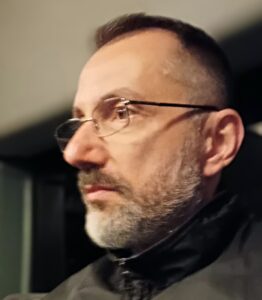
Hi, I’m Kostas, short for “Constantine.”
Born and raised in Athens, Greece,
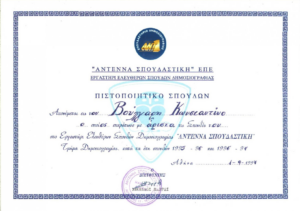
I have studied English and Journalism
(Σχολή Δημοσιογραφίας ANT1)
and I teach English at a state primary school in the Greek capital.
Wishing to provide my students with a wider view of the world, I am searching for interesting international opportunities to learn about different cultures and global issues.
Επιθυμώντας να προσφέρω στους μαθητές και τις μαθήτριές μου μία ευρύτερη θεώρηση του κόσμου, αναζητώ ευκαιρίες συνεργασίας στην Ελλάδα/Κύπρο και το εξωτερικό προκειμένου να μάθουμε μαζί για διαφορετικούς πολιτισμούς και να ενημερωθούμε για παγκόσμια θέματα.












Με κέρδισε όμως η Εκπαίδευση. 🙂




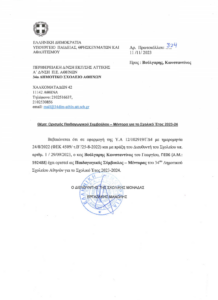

Η χρήση της Τεχνητής Νοημοσύνης
στο μάθημα της Αγγλικής
στην Α/βάθμια Εκπαίδευση

1. Teach.in.G. | Εκπαίδευση εκπαιδευτικών: Γλωσσική και ψυχοπαιδαγωγική διαχείριση πολύγλωσσων και πολυπολιτισμικών τάξεων
2. Ειδική Αγωγή: Διεπιστημονικές πρακτικές σύγκλισης
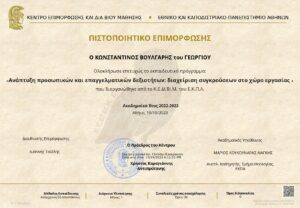
3. Ανάπτυξη προσωπικών και επαγγελματικών δεξιοτήτων: Διαχείριση συγκρούσεων στο χώρο εργασίας
4. Διαπροσωπικές σχέσεις: Το φαινόμενο της μοναξιάς στη σύγχρονη εποχή
Διαχείριση και αντιμετώπιση
5. Από τη μία στην άλλη πλευρά του Αιγαίου:
Η εγκατάσταση των Μικρασιατών προσφύγων στην Ελλάδα μέσα από τη λογοτεχνία
6. Θρησκεία και Ψυχανάλυση
7. Παραπληροφόρηση ή αληθινές ειδήσεις; Μάθετε να τα ξεχωρίζετε
8. Σπουδή στην Ορθόδοξη Θεολογία
9. Τα δικαιώματα του παιδιού
10. Philosophical Life Coaching

1. Εκπαιδευτικός στον 21ο αιώνα: Πώς να ξεχωρίσω
2. Διαχείριση της πολυπολιτισμικότητας στην εκπαίδευση και κοινωνική ένταξη μεταναστών /προσφύγων
3. Σχολική Ψυχολογία
4. Ενδοσχολική βία και εκφοβισμός: Πρόληψη και αντιμετώπιση
5. Μέθοδοι της Μετασχηματίζουσας Μάθησης στο πλαίσιο της Διά Βίου Μάθησης

Σύγχρονες αρχές και πρακτικές στην Ειδική Αγωγή και Εκπαίδευση

1. Σχολική Νοσηλευτική και Ψυχική Υγεία
2. Πρόληψη και αντιμετώπιση της επιθετικότητας στο σχολικό περιβάλλον: Εργαλεία και στρατηγικές διαχείρισης
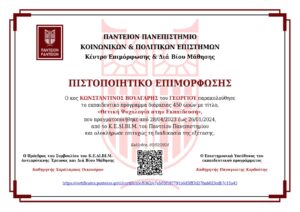
1. Πρόληψη και αντιμετώπιση ρατσισμού
στα δημοτικά σχολεία
2. Θετική Ψυχολογία στην Εκπαίδευση
3. Ενισχύστε την εκπαίδευσή σας με τη δύναμη
της Τεχνητής Νοημοσύνης (AI)

Διαχείριση σχολικής ζωής: Ηγεσία, κρίσεις, διαφορετικότητα, συμπερίληψη

Αγωγή και ετερότητα: Αξιοποιώντας την Τέχνη
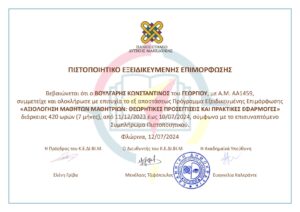
1. Αξιολόγηση μαθητών/μαθητριών: Θεωρητικές προσεγγίσεις και πρακτικές εφαρμογές
2. Έμφυλες σχέσεις και ενδυνάμωση μέσα από αφηγηματικές τεχνικές
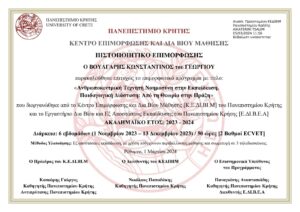
1. Ο/Η άνθρωπος-πολίτης/πολίτιδα
απέναντι στο θάνατο και την απώλεια:
Παιδαγωγικές και κοινωνικές προσεγγίσεις
2. Ανθρωποκεντρική Τεχνητή Νοημοσύνη στην Εκπαίδευση: Παιδαγωγική διάσταση
Από τη θεωρία στην πράξη
3. Γνωριμία με το Magic School στην εκπαιδευτική πράξη
4. LIFE on mARTs
5. Ανθρωποκεντρική Τεχνητή Νοημοσύνη στην Εκπαίδευση: Μετασχηματίζοντας τον τρόπο με τον οποίο διδάσκουμε και μαθαίνουμε

1. Επιμορφώνοντας τους εκπαιδευτικούς στο Ολοκαύτωμα: Ανθρωπολογικές αναγνώσεις
του κινηματογράφου
2. Εισαγωγή στην αλβανική γλώσσα

1. Σπουδές στον Ποντιακό Ελληνισμό
2. STEAM Education for All Learners: Incorporating STEAM and Inclusive Education Practices in Everyday Teaching
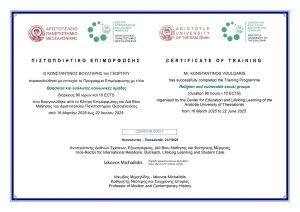
Θρησκεία και ευάλωτες κοινωνικές ομάδες
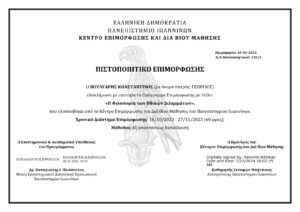
1. Ψυχολογικές προσεγγίσεις του παιδικού σχεδίου
2. Η Φιλοσοφία των Ηθικών Διλημμάτων

Προαγωγή ψυχικής υγείας και ευεξίας
στα σχολεία: Well@School Project
Αξιολόγηση του σχολείου, των εκπαιδευτικών
και ανάπτυξη βέλτιστων λεκπαιδευτικών πρακτικών

1. Επιμόρφωση των Εκπαιδευτικών
στις Δεξιότητες μέσω Εργαστηρίων
2. Εισαγωγή της Αγγλικής Γλώσσας
στο Νηπιαγωγείο (ΕΑΝ)
3. Αναπηρία και διαφορετικότητα,
αυτιστικό φάσμα,
προβλήματα προσοχής και συγκέντρωσης
4. Εκπαίδευση για την Ιδιότητα
του Παγκόσμιου Πολίτη
Ευρωπαϊκό Έργο GENE
(Global Education Network Europe)
5. Διαφοροποιημένη Διδασκαλία:
Πρακτικές υποστήριξης
των μαθητών και των μαθητριών
6. Πρόληψη και αντιμετώπιση περιστατικών ενδοσχολικής βίας και εκφοβισμού

1. Ανάπτυξη δεξιοτήτων των Παιδαγωγικών Συμβούλων-Μεντόρων
2. Ενεργητική ακρόαση και αποτελεσματική επικοινωνία
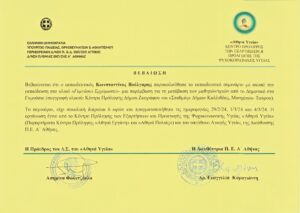
1. Peer Support / Συμβουλευτική Ομηλίκων
2. Εκπαιδευτικός στην τάξη ξανά:
Ενδυναμώνοντας τον εαυτό μου
και το ρόλο μου
3. — Γυμνάσιο, ερχόμαστε!
Μία παρέμβαση για τη μετάβαση
των μαθητών/-τριών
από το Δημοτικό στο Γυμνάσιο
4. Τεχνικές πρόληψης για παιδιά
Neuro-Linguistic Programming
Νευρογλωσσικός Προγραμματισμός

1. Εκμάθηση βασικών τεχνικών NLP
2. Εκμάθηση προχωρημένων τεχνικών NLP
3. NLP – Ο Νευρογλωσσικός Προγραμματισμός στην Ψυχολογία

Δημιουργική γραφή
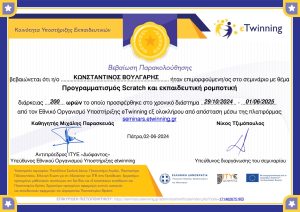
Προγραμματισμός Scratch και εκπαιδευτική ρομποτική

eTwinning και Εργαστήρια Δεξιοτήτων:
Συνεργατικές Δράσεις για την Καλλιέργεια
Γνώσεων, Δεξιοτήτων και Ικανοτήτων
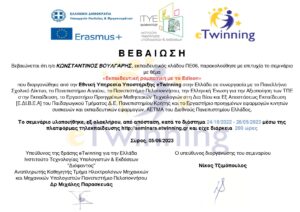
Εκπαιδευτική ρομποτική με το Edison

και για τις μικρότερες τάξεις:
Bee-Bot

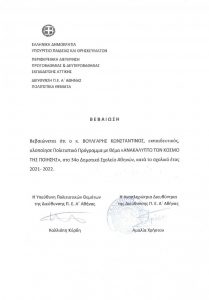
1. Το δικό μας όνειρο
2. Αληθινή φιλία
3. Δύο ευγενικοί άνθρωποι
4. Ανακαλύπτω τον κόσμο της Ποίησης
5. Φύγε άγχος, γίνε χρώματα!

1. True Friends Forever
2. True Friends Forever | France and Greece
3. Be a European Star for a European Christmas
4. Comment fait-on la paix ?
5. Μαθαίνω να βλέπω τον Άνθρωπο | Learning to See the Person #SkillsLabs