Where is south Aegean volcanic arc?
What is a volcanic arc?
Natural Disasters through History Συνέχεια ανάγνωσης
Μάι 03
Active South Aegean volcanic arc and natural disasters through history by Alexandros Chatzipetros, assistant professor, Department of Geology A.U.Th., eHAND project “Enceladus” meeting in Oreokastro, 23-27 April 2018
Μάι 03
Minerals: the gifts of the earthquakes and the volcanoes in Aegean by Vasilios Melfos, Assistant Professor, eHAND project , “Enceladus” meeting in Oreokastro, 23-27 April 2018
 Minerals: the gifts of the earthquakes and the volcanoes in Aegean
by Vasilios Melfos, Assistant Professor
melfosv@geo.auth.gr
School of Geology, Aristotle University of Thessaloniki
Mineral raw materials are crucial for the development of the modern societies, the environmentally friendly technologies and the Hi-Tech industrial products. Without them, there wouldn’t be any smartphones, laptops, or cars. They are extracted from large open pits or underground mines. Greece has a very unique geological history! The subduction of Africa beneath Eurasia is one of the most important geological phenomena in the world accompanied by volcanoes and earthquakes. Volcanoes in Aegean did not bring only disasters. Their action caused numerous mineral deposits, which have been used by the inhabitants since the Prehistoric times. Many Aegean islands were very wealthy thanks to the mineral raw materials. Συνέχεια ανάγνωσης
Μάι 03
Earthquake safety tips’ lesson during the eHAND Erasmus+ “Enceladus” meeting in Oreokastro 23-27 April 2018, by Georgios Chatzigeorgiou

“Earthquake Safety Tips”, Georgios Chatzigeorgiou, biology teacher, 2nd General Lyceum of Oreokastro
What is an earthquake? Do all earthquakes cause problems? What do we need to do to be prepared to deal with an earthquake?
An earthquake is a natural phenomenon that often affects Greece and other countries on the planet. Most earthquakes that occur in our country do not cause any particular problems, but some are very strong and have an impact on humans and buildings.
The Earthquake Planning and Protection Agency recommends that we be prepared to be able to protect ourselves during an earthquake and also to have the appropriate anti-earthquake behavior after the vibration.
Μάι 01
“Getting ready for an earthquake” students booklet during the eHAND Erasmus+ “Enceladus” meeting in Oreokastro – Greece, by Christos Alexakis, Georgios Chatzigeorgiou & Alexia Fragkouli
 “Getting ready for an earthquake” students booklet during the eHAND Erasmus+ “Enceladus” meeting in Oreokastro – Greece,
by Christos Alexakis, Georgios Chatzigeorgiou & Alexia Fragkouli Συνέχεια ανάγνωσης
Απρ 30
STEM & IBSE in action: earthquakes and engineering in the classroom (Erasmus+ eHAND meeting at the 2nd General Lyceum of Oreokastro – Greece), by Eftychia Karagianni & Christos, Alexakis

STEM & IBSE in action: earthquakes and engineering in the classroom.
Eftychia Karagianni, Science teacher-Physicist,,& Christos, Alexakis, Mathematician, 2nd General Lyceum of Oreokastro
As concerning the European Erasmus+ Programme, our school, the 2nd General Lyceum of Oreokastro is planning to run a STEM lesson titled “Earthquakes & Engineering in the classroom”. Although we cannot escape earthquakes, as they can happen in any unpredictable time, we can resist them by designing anti-seismic buildings (hospitals, houses, skyscrapers, bridges, roads etc).
Engineers use small or full-scale models to investigate a structure’s response to an earthquake: how safe would the building be in an earthquake and how could it be improved. The STEM lesson that we’ll be carried out in our school is based upon the above idea and it includes 3 activities.
Απρ 27
«Enceladus» eHAND meeting in Oreokastro – 5th Day report
 5th Day Report
Students worked in international teams on creating a leaflet/booklet about the most important tips/pieces of advice on what to do Before, During and After an earthquake. They also took their own pictures depicting those tips and then presented their work to the whole e-HAND team.
After the presentation of Alexandros Terzopoulos’s scientific paper “Nitrates…”, the teachers of the seven schools had a meeting to evaluate the meeting and plan the next steps of the project.
Απρ 26
«Enceladus» eHAND meeting in Oreokastro – 4th Day report

4th Day Report
On Thursday 26th April we had an educational trip to Mount Olympus and the Centre of Environmental Education of Eastern Olympus. We were informed about the activities and all the projects the centre is involved in and then enjoyed a few kilometers’ hike in the woods of the notorious mountain.
In the afternoon, we visited and were guided through the treasures of the Museum of Vergina and the Ancient Macedonian Royal Tombs of Aiges.
Απρ 25
«Enceladus» eHAND meeting in Oreokastro – 3rd Day report
 3rd Day Report
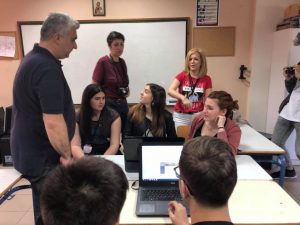
3rd Day’s activities started with a CLIL Lesson titled “Are you playing games with me? Are you serious? A different approach to environmental awareness.” Students in mixed teams played an environmental online game created by the Danish government and one of our teams even won a certificate!
We then visited an exhibition about the great earthquake of Thessaloniki in 1978 at Islahane organized by the Department of Geology of Aristotle University of Thessaloniki and also participated in the Festival of Environmental Education of Western Thessaloniki with a presentation of e-HAND by an international team of students.
Απρ 25
«Enceladus» eHAND meeting in Oreokastro – 2nd Day report
Day 2 of t he Greek Erasmus+ meeting ‘Enceladus’
The day started off with the STEM & IBSE classes regarding earthquakes and engineering, taught by Science teacher and Physicist Eftychia Karagianni, and ,Mathematician, Christos Alexakis. Συνέχεια ανάγνωσης
Απρ 24
“Enceladus” eHAND meeting in Oreokastro – 1st Day report

E-hand report 23.04.18
Our first day started with some ice-breaking activities when the students were given posters with a short description of each student’s hobbies and interests and our task was to find a person who the paper belonged to by talking to each other and communicating.
The second activity was based on team building and trust. We all had to stand in two lines holding hands with our eyes closed while the teacher was flipping a coin (either heads or tails) to the first person and depending on that we had to squeeze the person on the right’s hand in order to pass “the electricity” to the last student to, once again, squeeze a toy. The team with the most points was the winner. Συνέχεια ανάγνωσης
Ηλεκτρονικές Τάξεις

“δεύτερη γνώμη”, η e-εφημερίδα μας

facebook page

WIN!
SUI PALCHI DI SCUOLA
Erasmus+

etwinning

Ομάδα Διαμεσολάβησης

G.A.M.E.

eHAND

Διάχυση Ersmus+ projects

Εθνικές & Ευρωπαικές Ετικέτες Ποιότητας etwinning

Εκδήλωση 30 Χρόνια Erasmus+

G.A.M.E. Erasmus+ TPM in Oreokastro – Greece

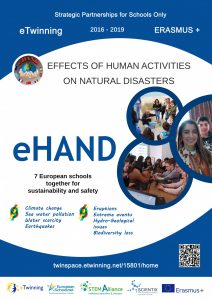
eHAND Erasmus+ «Enceladus» meeting in Oreokastro – Greece

το eHAND project στο 3rd Scientix Conference
Συγκέντρωση καπακιών για την προμήθεια ηλεκτρικού αμαξιδίου
2η αφίσα
Scientix

Εσωτερικός Σχολικός Κανονισμός 2ου ΓΕΛ Ωραιοκάστρου
ΑΡΚΑΣ