Unit 5 Travelling Through Time
Lesson 1 Diaries
Listen to the song and fill in the gaps in the exercise that follows.
Lesson 1 Diaries
Listen to the song and fill in the gaps in the exercise that follows.
6th grade
Let’s watch a video, listen carefully and do the worksheet
Liveworksheet –Notting Hill Carnival
1st and 2nd class
3rd and 4th class
https://www.youtube.com/watch?v=4m4u44YAl6c
Crossword fun!
More fun –Memory Game
Play a kahoot game after you read the text about Caretta – caretta. Click the link to play: Play kahoot game!
or
Step 1: Go to kahoot.it (on your tablet, computer or smartphone)
Step 2: Write the Game pin: 09182011
Step 3: Write your name and start the game
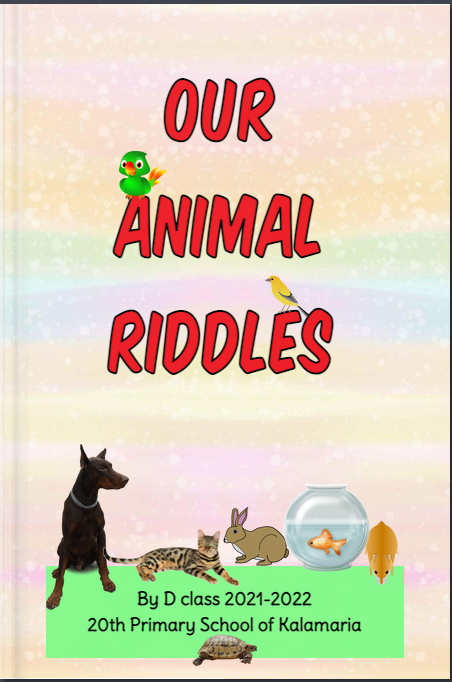
Διαβάστε το βιβλίο της Δ’ τάξης με αινίγματα ζώων στα αγγλικά. Πατήστε στο παρακάτω σύνδεσμο:
What are some problems our planet, Earth is facing?
Watch this video carefully to learn what you can do to help:
Credits: Ariadne Dimitraka


e.g. I’m flying to Paris at the weekend. (I have packed my suitcase and I have bought my plane ticket.)
Example:
I’m going to visit my relatives in America next year.
(The date of travel has not been decided or arranged nor have I bought my flight ticket yet.)
Example:
– What are you going to do to save the planet? (What do you intend to do?)
– I am going to reduce my rubbish and recycle.
Example:
Look at those clouds! It’s going to rain!
(Prediction based on what we can see)
Χρησιμοποιούμε ” will”
e.g. The room is cold! I will close the window.
e.g. I will recycle all my rubbish from now on.
e.g. I think he will become a famous artist one day.
e.g. I believe we will all try to protect our environment.
LYRICS:
The wheels on the bus go round and round.
Round and round. Round and round.
The wheels on the bus go round and round. Round and round.
The door on the bus goes open and shut. Open and shut. Open and shut.
The door on the bus goes open and shut. Open and shut.
The wipers on the bus go swish swish swish. Swish swish swish. Swish swish swish.
The wipers on the bus go swish swish swish. Swish swish swish.
The horn on the bus goes beep beep beep. Beep beep beep. Beep beep beep.
The horn on the bus goes beep beep beep. Beep beep beep.
The people on the bus go up and down. Up and down. Up and down.
The people on the bus go up and down. Up and down.
The engine on the bus goes, “Vroom vroom vroom. Vroom vroom vroom. Vroom vroom vroom.”
The engine on the bus goes, “Vroom vroom vroom. Vroom vroom vroom.”
The bell on the bus goes, “Ding ding ding. Ding ding ding. Ding ding ding.”
The bell on the bus goes, “Ding ding ding. Ding ding ding.”
Baby Shark doo doo, doo doo, doo doo (x3) Baby shark!
Mommy Shark doo doo, doo doo, doo doo (x3) Mommy Shark!
Daddy Shark doo doo, doo doo, doo doo (x3) Daddy shark!
Grandma Shark doo doo, doo doo, doo doo (x3) Grandma Shark!
Grandpa Shark doo doo, doo doo, doo doo (x3) Grandpa Shark!
Let’s go hunt doo doo, doo doo, doo doo (x3) Let’s go hunt!
Run away doo doo, doo doo, doo doo (x3) Run away!
Safe at last doo doo, doo doo, doo doo (x3) Safe at last!
It’s the end doo doo, doo doo, doo doo (x3) It’s the end!
Now, let’s make a Baby Shark headband

from: simpleeverydaymom.com
Now, we can sing!
We use the Present Simple to talk about states, routines, habits and customs.
e.g. I usually read a book before I fall asleep.
Keywords for Present Simple: every day, always, usually, often. sometimes, rarely/seldom, never
We use the Present Continuous to talk about things that are happening now, at the time of speaking or around now.
e.g. I am planning my mum’s surprise birthday party which is in two days time.
We can have both tenses in one sentence to express two different situations.
e.g. I usually make a sandwich for lunch but today I’m making a fruit salad.
Keywords for Present Continuous: now, at the moment, right now, at present, today, these days, this week/month/year etc.
Liveworksheets Present simple/Present Continuous
Liveworksheets Present Simple or Present Continuous?
We describe our feelings through verbs of sense (feel, taste, look, smell, sound). They don’t go in continuous tenses because they describe a state, not an action. They are followed by an adjective.
e.g. Roses smell lovely.
e.g. This music sounds fantastic!

Στα Αγγλικά εκφράζουμε τα αισθήματα με ρήματα αισθήσεως (feel, taste look, smell, sound). Αυτά τα ρήματα συνήθως δεν μπαίνουν σε continuous χρόνο επειδή περιγράφουν μία κατάσταση και όχι πράξη.
Βιβλίο Μαθητή σελ. 151
| 5.1a O χρόνος Present Simple
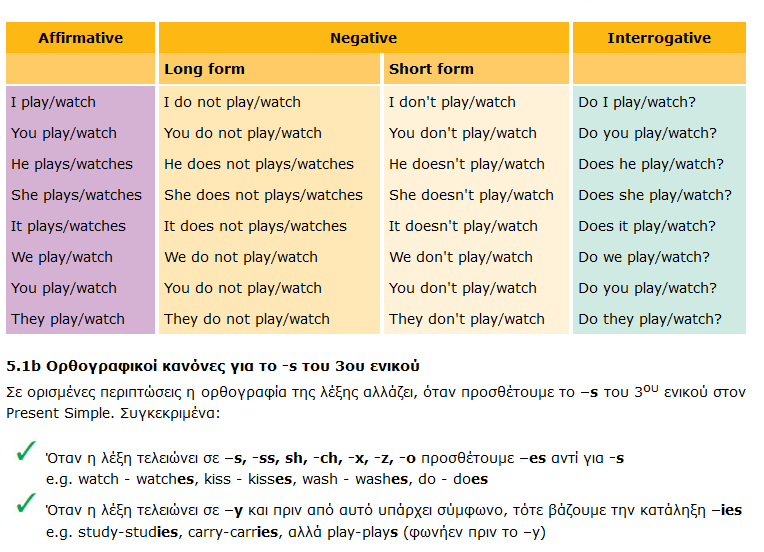
O Present Simple είναι ο χρόνος που εκφράζει κάτι μόνιμο, μια αλήθεια ή μια συνήθεια. Η συνήθεια αυτή μπορεί να είναι προσωπική ή να είναι εθνική, να είναι δηλαδή ένα έθιμο. Όταν εκφράζει μια συνήθεια ή ένα έθιμο, πολλές φορές “πάει παρέα” με λέξεις ή φράσεις που μας πληροφορούν για το πόσο συχνά γίνεται αυτή η συνήθεια ή αυτό το έθιμο. Τέτοιες λέξεις ή φράσεις είναι τα επιρρήματα συχνότητας-adverbs of frequency (δες στο 5.1c) ή/και οι φράσεις με τη λέξη every (e.g. every day, every week, every Monday). O Present Simple αλλάζει μορφή στο 3ο ενικό πρόσωπο (he, she, it). Μπαίνει στο τέλος της λέξης ένα –s. Κάποιες φορές γίνονται ορθογραφικές αλλαγές, όταν προστίθεται αυτό το –s (δες στο 5.1b). Δες στον πίνακα δύο παραδείγματα για το πώς κλίνεται: |
 |
Greek Christmas Customs eBook by D1
WORDWALL – ADVERBS OF FREQUENCY
Do you know which was the first flight accident ever?

Liveworksheet Past Simple or Past Continuous?
You need a computer and a tablet and enter the Game Pin, then watch the computer screen for the questions and answer on the tablet.