UNIT 8
Elmer, the Patchwork Elephant
Europe Day – May 9th
To celebrate Europe Day on May 9th 2022, an eTwinning event was created to share our work in eTwinning TwinSpaces which involves the differences in the European family that unite us. The day is dedicated to solidarity to Ukraine in this terrible time of the country’s history.
Mother’s Day
    Lyrics

I love my mommy
I love my mommy
I love my mommy
Yes I do!

Here's a kiss and a hug for you
Thank you mommy for all you do

Happy Mother's Day!
Happy Mother's Day!
Happy Mother's Day!
I love you!
Unit 6 Me, Myself and my Future Job
Lesson 1 Talking about Jobs and Careers
Reading texts
Vocabulary Exercise
Grammar
Modal Verbs: can / should / may
Modal verbs (ελλειπτικά ρήματα) είναι ρήματα που δεν σχηματίζουν όλους τους χρόνους.
- Τα περισσότερα ακολουθούνται από απαρέμφατο χωρίς “tο”
- Σχηματίζουν την ερώτηση και την άρνηση χωρίς βοηθητικό ρήμα
- Είναι ίδια σε όλα τα πρόσωπα ενικού και πληθυντικού αριθμού.
Can is used to express: ability, possibility and permission (informal)
e.g. I can swim. (Ability)
e.g. Wild animals can be dangerous. (Possibility)
e.g. You can wear my jacket. (Permission)
May is used to express possibility, permission (and polite request)
e.g. It may rain today. (Possibility)
e.g. You may open the window. (Permission)
e.g. May I go to the bathroom? (Polite request)
Should is used to express advice
e.g. We should all eat healthy food and avoid junk food
Exercise
Exercise
Future tenses
Be going to (am/is/are + going to)
- We use «Be going to» to talk about what we plan or intend to do but no arrangements have been made. So, the action is not as certain to happen as it is with the Present Continuous where arrangements for the action have been made.
Example:
I’m going to visit my relatives in America next year.
(The date of travel has not been decided or arranged nor have I bought my flight ticket yet.)
Example:
– What are you going to do to save the planet? (What do you intend to do?)
– I am going to reduce my rubbish and recycle.
- We also use «be going to» to make a prediction based on what we can see or what we know
Example:
Look at those clouds! It’s going to rain!
(Prediction based on what we can see)
Future Simple “will”
(Appendix page 154)
Form:
I will play Will I play? I will not (won’t) play
We have learned in 5th class that we use the Future Simple tense
- when we make a general prediction and we can use verbs like think, believe etc. :
e.g. The weather tomorrow will be warm and sunny.
e.g. I don’t think they will win.
- when we decide to do something at the time of speaking:
e.g. – I will bring the drinks!
– O.K! I will bring the food.
We now learn that we also use the Future Simple tense to express: prediction, offer, promise, warning, threat, on – the – spot decision and request
Uses:
We use the Future Simple tense to show:
- Prediction
e.g. It will rain tomorrow
- Offer
e.g. I will bring it for you!
- Promise
e.g. I will bring you a souvenir from Paris when I return.
- Warning / Threat
e.g. You will get hit by a car if you don’t look before you cross the road.
e.g. If you don’t study for the test, I will not let you go to the party.
- On the spot decision
e.g. – There’s no bread left.
– I’ll go and buy some.
- Request
e.g. Will you bring me a glass of water, please?
ESCAPE GAME
Unit 7 What are you doing?
Lesson 1 Helping around the house
Study the vocabulary and read the text in your Pupil’s book, then play the games.
Vocabulary Unit 7 Lesson 1
beat = χτυπώ
need = χρειάζομαι
by the way = παρεμπιπτόντως
washing machine = πλυντήριο ρούχων
housework = δουλειές του σπιτιού
sweep = σκουπίζω
make the bed = στρώνω το κρεβάτι
water the plants = ποτίζω τα φυτά
wash up = πλένω (τα πιάτα)
set the table = στρώνω το τραπέζι
cook = μαγειρεύω
wash/mop the floor = σφουγγαρίζω το πάτωμα
iron = σιδερώνω
Play the spelling game
Play the game find the word
Study the grammar in the Appendix in Pupil’s book page 152-153
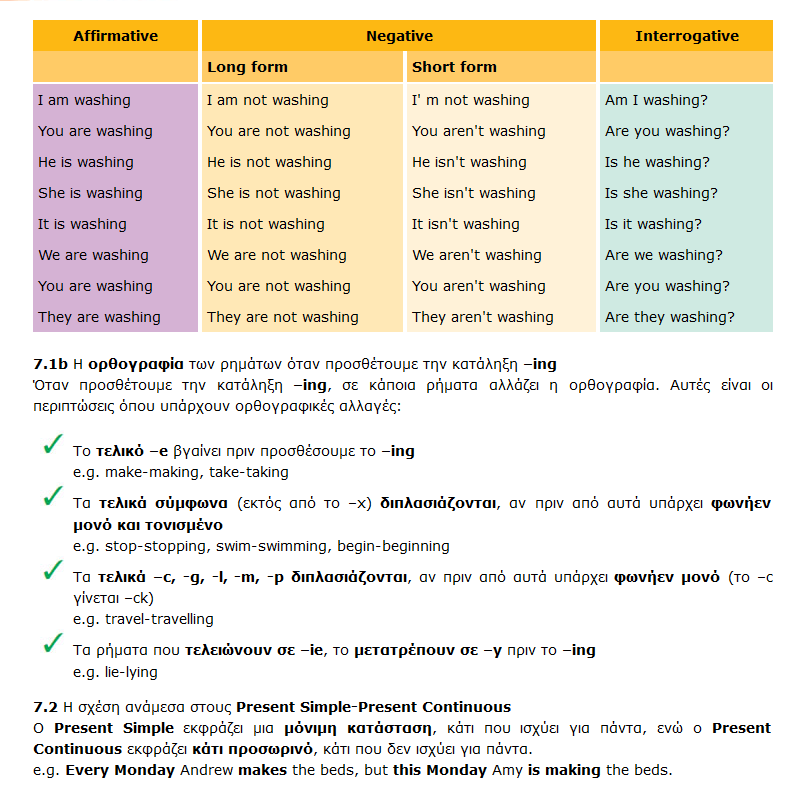
Spelling rules
Present Continuous
Present Continuous Exercise
Lesson 2 What do you do?
Exercise
Unit 7 What are you doing?
Lesson 1 Helping around the house
Unit 6 GOOD, BETTER, BEST
COMPARISONS
Χρησιμοποιούμε comparative για να συγκρίνουμε δύο πρόσωπα, ζώα, αντικείμενα, μέρη, κλπ.

e.g. Obelix is taller and stronger than Asterix
Χρησιμοποιούμε superlative για να συγκρίνουμε ένα πρόσωπο, ζώο, αντικείμενο, μέρος, κλπ., με πολλά της ίδιας ομάδας.
 e.g. The cheetah is the fastest animal in the world
Τα μονοσύλλαβα επίθετα σχηματίζουν τον Συγκριτικό βαθμό με την κατάληξη –er και τον Υπερθετικό βαθμό με την κατάληξη –est
e.g. tall – taller – the tallest
e.g. nice – nicer – the nicest
Tα δισύλλαβα επίθετα που τελειώνουν σε –y, –ly, –w παίρνουν καταλήξεις –er / –est ή –ier /-iest. Τα υπόλοιπα δισύλλαβα επίθετα παίρνουν more / most.
e.g. busy – busier – the busiest
e.g. silly – sillier – the silliest
e.g. careful – more careful – the most careful
Τα πολυσύλλαβα επίθετα σχηματίζουν τον συγκριτικό και υπερθετικό βαθμό με τις λέξεις more και the most.
e.g. beautiful – more beautiful – the most beautiful
Ορθογραφικές Δυσκολίες:
Τα επίθετα που τελειώνουν σε –y, παίρνουν –ier / –iest
e.g. pretty – prettier – the prettiest
Τα επίθετα που τελειώνουν σε σύμφωνο- φωνήεν που τονίζεται – σύμφωνο, διπλασιάζουν το τελευταίο σύμφωνο
e.g. thin- thinner- the thinnest
Irregular comparatives and superlatives
| Adjective | Comparative | Superlative |
| good | better | the best |
| bad | worse | the worst |
| little | less | the least |
| much/many/a lot of | more | the most |
| far | further / farther | the furthest / farthest |
Examples
Today is the worst day I’ve had in a long time.
You play tennis better than I do.
This is the least expensive sweater in the store.
This sweater is less expensive than that one.
I ran quite far yesterday, but I ran even farther today.
There are many books in my bookcase but there are more books in the school library.
Image credits: Free clipart Library
Comparative and_Superlative Presentation
Credits Zoe Makaridou
Easter
Colour the letters and fold each letter back as you sing

Colour and cut out the bunny and then fold on the dotted lines

Credits: krokotak.com
C class