Closing the gap between family and school –The role of digital technologies
The Professional Development Workshop “Closing the gap between family and school – The role of digital technologies” intended to present software, online tools and applications of digital technologies and to highlight their role in the framework of efforts to achieve effective cooperation between the family and the school. The cases that were presented demonstrate the multifaceted dimension of the issue and are a repository of best practices that can be used by teachers in accordance with the possibilities and the context of the various European systems. Working in teams after each presentation in the laboratories activated and strengthened our skills on both a professional and intercultural level.
The program between Thursday 6/11 and Friday morning 7/11 included plenary sessions, and was structured in four different parallel workshops attended by all four (4) transnational groups in which the participant teachers had been divided. The final activity was designed to involve us in an information recovery process using tools that we had learned in the workshops, from theory to practice, simulating situations that we can plan and execute with our students.
The program of the workshop was the following:
Thursday, November 6th, 2014
After the arrival of the national teams Rita Zurrapa gave a welcoming speech with a presentation of the organizers and participants and a succinct reference to the objectives of the PDW. The performance of three Portuguese students who sang and played music was a pleasant welcoming surprise which made us foresee the fascinating experience that would follow.
Rute Baptista followed with the plenary session “eTwinning: a new way to look at school”. After we talked about the image of schools today, she urged us to focus our attention on specific skills, to change and to help our students develop European skills. Referring to the current reality where technology and the media play an important role, she developed the qualities that should distinguish teachers and citizens of the 21st century in general. She then stressed the fact that eTwinning offers multiple opportunities for teachers to implement a different pedagogical approach by using ICT in the classroom, collaborative learning and intercultural dialogue to create an authentic learning environment. She also highlighted that eTwinning provides a variety of ways and opportunities for professional development. Finally, she presented the three gradations of the eTwinning portal and emphasized the character of the eTwinning community that connects people with common interests and goals.
The evening ended with a dinner during which, we played a collaborative introductory game and had the opportunity to get to know the participating teachers better and begin to build relationships based on cooperative, communicative and appreciative skills.
Friday, November 7th, 2014
The first plenary session was about a particularly very important current issue, internet safety. Martin Schmalzried presented the European project “#DeleteCyberbulling”. It is a program which was carried out by eight partners from 7 countries from February 2013 to July 2014 and which through transnational cooperation aimed to inform students, parents and teachers on the safe use of the internet and combat cyberbullying through many video applications, a questionnaire and a teacher’s manual. Then João Grácio, Director at school in Portugal, with the speech “Connecting school to families through social media” presented an innovative action implemented in schools in order to bring the school closer to the family. The creation of a Facebook page of the school, Escola Secundária Poeta Joaquim Serra, as well as a closed group on Facebook, which was made after discussions with parents and regular face to face meetings, managed to involve the whole family in school activities and broadened the dissemination of the results of the school.
Then, Rute Baptista during the plenary session “School & family collaboration examples” explored the multiple benefits achieved by eTwinning and the need to strengthen collaborative skills, use of language and communication. The presentation of two programs that have helped to bring the family closer to school and highlighted that school and family cooperation can help to achieve the educational goals of the school and to strengthen emotional bonds between family members caused a sensation to all of us. After that Maria da Luz Borges told us about the program she implemented «Kindergarten without Toys» during which the grandfathers and grandmothers of students visited the kindergarten and actively participated in the activities of young students. The expression of satisfaction and joy reflected in their faces in the photographs was really characteristic. Betina Santos followed with a presentation named “Facing Gaps” about a project on recycling she implemented with her students during which she informed the family with the help of a secret group on Facebook and of course the students themselves.
After lunch the parallel workshops started. All teachers had been divided into four transnational groups. I participated in group 2 which started with the workshop W4 “Students’ response tools for mobile age” with Adelina Moura. The purpose of this workshop was to inform us about the potential of mobile devices such as tablets and smartphones in education. We became acquainted with two applications, Kahoot and GoSoapBox, which with a pupil response system allow collection of responses in the form of quizzes – discussion or survey and are an innovative pedagogical practice; provided that the class is supported by web connection, the lesson is transformed into play !
The next workshop, W1, concerned the dissemination of the results of their eTwinning projects. Claire Morvan stirred up the participants with a bold and relatively unknown to us topic “Making Ripples: Creating more impact with your eTwinning projects”, the development of a specific plan of action for better dissemination of the results of programs materialized. She noted that eTwinning is about developing both students’ and teachers’ skills, the community at large, the recognition of the projects and, above all, students. She continued by identifying four stages which an action plan should include – planning, communication, dissemination and exploitation. We worked in groups to develop a strategic plan which would involve the school principal, teachers, parents and the wider community, policy makers and teachers from other schools. This workshop helped us to focus our attention on the essential need to disseminate the results of our projects and realize the multiple recipients of their impact . It will certainly be an integral part of the design and implementation of future collaborative projects.
The second day ended with an evening visit to the city of Porto, a tour coach, an official dinner with traditional Portuguese cuisine, traditional songs Fado and lots of fun.
Saturday, November 8th, 2014
We started with the workshop W2, “Learning Science in Secondary Education using ‘Flipped Learning‘ methodology and tablets”, where João Carlos Sousa and Fernando Franco presented us with an innovative methodological practice in the context of differentiated teaching, application of reverse instruction by using the online tool blendspace. After an introductory reference to the flipped classroom project he implemented in physics with the use of tablets , we were divided into small groups and created a lesson with this application. We were also informed about the implementation of classflow. It was a very interesting workshop which will help us create a digital lesson thanks to attractive educational material we were provided.
After a short break we continued to the next and final workshop, W3 “QR code an easy way to collect history to your mobile device”, with Miguela Fernandes, Marco Neves and Teresa Lacerda. The QR Codes are a smart, easy and effective way to connect via a mobile tool, the offline environment with links and information stored online. We were also informed about the data – text, photos and video – on mobile devices using the interactive map thinkgLink an online platform where we can turn a simple, static image into a complex, interactive and multimedia picture and give it a completely different dimension. We had the opportunity to familiarize ourselves largely to these applications as we were going to use them later.
After lunch, although the weather was rainy, we participated in an activity organized in the city, “Outdoors activity with mobile devices”. Having a map of the city we went out with our team guided by local students, followed a path, which was different for each group, and visited landmarks of the city, looking for the QR codes kept by students and revealing our mission at every stop. In this imaginative way, “QRcode Hunting”, we had the opportunity to work creatively, practice what we learned in workshop W3 and tour the city. On our return to the hotel, we worked with the data we had collected and created an interactive map thingLink that was presented in the closing ceremony
The professional development workshop ended with the presentation of interactive thingLink posters prepared by all four groups . The Kahoot quizzes prepared by two groups highlighted the joy and satisfaction that all participants shared during all events. The closing ceremony ended with speeches by the mayor of the town, the general secretary of the ministry and the organizing committee and the thankful comments of the members of the national delegations.
The professional development workshop PDW Etwinning was well organized and extremely successful as it has enriched our knowledge, strengthened our skills and helped us get to know teachers who love collaborative learning, imagination in teaching and innovation in educational practices. The collaborative actions of the PDW and the networking enhanced the European dimension of education and strengthened our belief that we are members of a large European creative team that redefines its training role and actions in accordance with the challenges and needs of modern society .
I was lucky enough to be with three amazing people, exceptional teachers and distinguished eTwinning Ambassadors; Ms Maria Sourgiadaki, Mr Petros Michailides and Socratis Vasiopoulos.
If you want to have a look at the workship visit here .
It was a unique experience for me and I would like to express my sincere and heartfelt thanks to eTwinning for offering me the opportunity to participate in such a high-level professional development workshop.


 The European Schools Newspaper
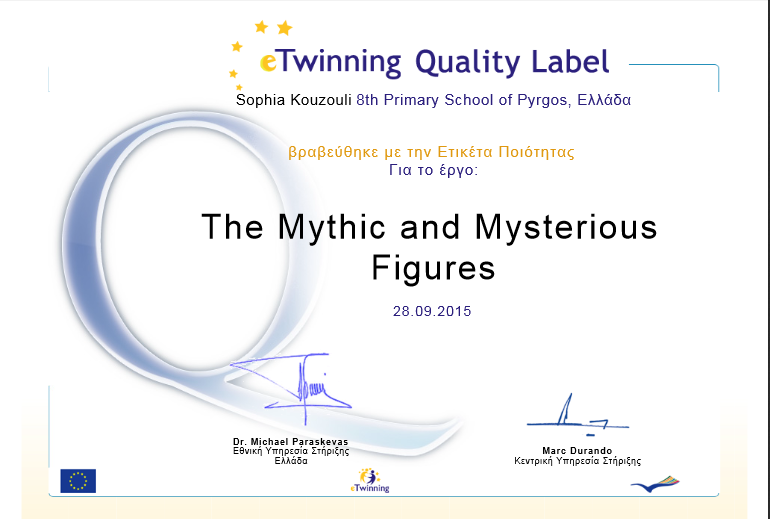
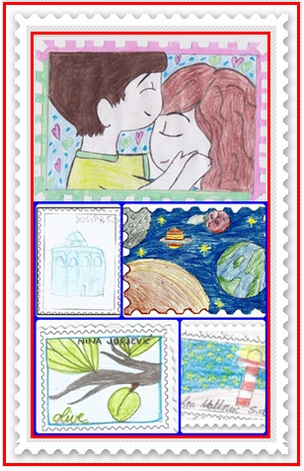
 The Mythic and Mysterious Figures, which got a European Quality Label as well