Δήμος Αθηναίων
Κέντρο Πρόληψης των Εξαρτήσεων
και Προαγωγής της Ψυχοκοινωνικής Υγείας
«Αθηνά Υγεία»
«Αθηνά Αφαία», 4η Δημοτική Κοινότητα
Αθανάτων 35 & Δυρραχίου, Σεπόλια
4/3/2026 – 1/4/2026


Δήμος Αθηναίων
Κέντρο Πρόληψης των Εξαρτήσεων
και Προαγωγής της Ψυχοκοινωνικής Υγείας
«Αθηνά Υγεία»
«Αθηνά Αφαία», 4η Δημοτική Κοινότητα
Αθανάτων 35 & Δυρραχίου, Σεπόλια
4/3/2026 – 1/4/2026
Κύκλος ασύγχρονης επιμόρφωσης
13/02/2026 – 20/02/2026

Εκφοβισμός, εξαναγκασμός, εθισμός
και κακόβουλη χρήση της Τεχνητής Νοημοσύνης

Jugendstil (“Youth Style”) was an artistic movement, particularly in the decorative arts, that was influential primarily in Germany, Austria, and elsewhere in Europe to a lesser extent from about 1895 until about 1910. It was the German and Austrian counterpart of Art Nouveau.
The Darmstadt Artists’ Colony was a group of Jugendstil artists who lived and worked near Rosenhöhe Park in Mathildenhöhe, Darmstadt, in the late nineteenth and early twentieth centuries. Supported mainly by patrons, they collaborated closely with one another whenever their artistic tastes aligned.
The artists’ colony was founded in 1899 by Ernest Ludwig, Grand Duke of Hesse.
UNESCO recognised the Mathildenhöhe artists’ colony in Darmstadt as a World Heritage Site in 2021, because of its testimony to early modern architecture and landscape design, and its influence in the reform movements of the early 20th century.


Michel, listen, the sea wind is whistling.
An engraved verse from Gottfried Schwab’s poem Genius des Gesangs (Genius of Song).


The Waldspirale is a residential complex in Darmstadt, Germany, built in the 1990s. Its name means “forest spiral” in English, referring both to the building’s curved layout and its green roof. It was designed by the Austrian artist Friedensreich Hundertwasser, planned and realised by the architect Heinz M. Springmann, and constructed by the company Bauverein Darmstadt. The project was completed in 2000.
From the outside, the typical elements of Hundertwasser’s personal style attract attention: the gilded onion domes, the absence of straight lines and sharp corners, the multicoloured painting of the building in earth tones and the colourful ceramic columns.


18 years old

HIER WOHNTE
JOSEF STRAUSS
JG: 1924
FLUCHT 1938 HOLLAND
INTERNIERT WESTERBORK
DEPORTIERT 1942
AUSCHWITZ
ERMORDET 16.8.1942
Here lived
Josef Strauss
Born in 1924
Fled to Holland in 1938
Interned in Westerbork
Deported to Auschwitz in 1942
Murdered on 16 August 1942
This is the text from a Stolperstein (“stumbling stone”)—a small memorial plaque placed in the pavement outside the last freely chosen home of a Holocaust victim.
The Stolpersteine project was created by the German artist Gunter Demnig and commemorates individuals who were persecuted and murdered by the Nazis.
Auschwitz was a Nazi concentration and extermination camp where over a million people were murdered during the Holocaust.
Westerbork was a transit camp in the Netherlands from which many Jewish people were deported to extermination camps in occupied Poland.


Darmstadt has around 160,000 inhabitants, making it the fourth largest city in the state of Hesse, Germany, after Frankfurt am Main, Wiesbaden, and Kassel.
In the twentieth century, industry—particularly the chemical sector—became increasingly important to the city’s economy, alongside major developments in science, electronics, and later information technology. These sectors continue to play a key role today.

The city is home to the football club SV Darmstadt 98.


For years, Carla waited at the edge of the rink, dreaming of her moment to shine. One frosty morning, she was finally pushed onto the ice. Instead of feeling scared, she felt brave. She slid smoothly, spinning just right, and landed perfectly in the centre of the house!
From that day on, Carla always smiles as she glides across the ice, reminding everyone that with courage and confidence, we can all reach our goals.
In curling, a house is the circular target on the ice that players aim for with their stones. It consists of three concentric rings, usually coloured blue, white, and red. The centre of the house is called the button.
Points are scored based on which stones are closest to the button after all stones in an end have been thrown. Only stones within the house (or touching it) are eligible to score.

Carl isn’t just any broom—he’s the fastest sweeper on the ice! With his bright bristles and big happy smile, Carl loves helping his team glide smoothly towards victory. While the stones get the spotlight, Carl knows his job is just as important. With every quick sweep, he clears the path, making the ice perfect and the shots even better.
Carl believes that teamwork makes the dream work. He cheers for his friends, works hard, and never gives up—even during the toughest matches. And no matter the score, Carl always finishes with a smile, because for him, the best part of curling is being part of the team.

Who said that the Greeks only shine under the sun? These two decided to swap the Aegean breeze for a freezing rink and prove that passion travels well—even on ice!
With the precision of ancient mathematicians and the focus of Olympic heroes, they glide, sweep, and shout, “Έλα!” as the stone slides towards glory. If we can invent philosophy, democracy, and the Olympic Games, we can definitely master curling too.
Because being Greek isn’t about the temperature—it’s about the fire inside. 🔥
Dream big. Slide boldly. And if life gets slippery… sweep harder!


Prince Hamlet

Ophelia

King Claudius

Queen Gertrude

Laertes

Horatio

Polonius

King Hamlet’s Ghost

Hamlet—A Simple Version for Children
Monologue is the umbrella term.
It’s any long speech by one character.
Soliloquy is a specific type of monologue.
It’s when a character speaks their thoughts out loud, usually alone on stage, and the audience gets a peek inside their mind.
So:
🗣️ Monologue → talking at length (to others or the audience)
🤔 Soliloquy → talking to oneself (inner thoughts revealed)
Θεωρητικές προσεγγίσεις και παιδαγωγικά ερωτήματα


Borys Mykolaiovych Lyatoshynsky (3 January 1895 [O.S. 22 December 1894] – 15 April 1968) was a Ukrainian composer, conductor, and teacher. A leading member of the new generation of 20th-century Ukrainian composers, he received numerous accolades, including the honorary title of People’s Artist of the Ukrainian SSR.
Λογοτεχνία και Ολοκαύτωμα


Τα παιδιά του Aspley Guise Village School μας έστειλαν ευχές και υπέροχες ζωγραφιές!
To Άσπλι Γκάιζ βρίσκεται πολύ κοντά στο Λούτον και το Λονδίνο. Η τάξη τους, Year 4, αποκαλείται Cedar (κέδρος).
“At our school, each class is named after a tree.
The Reception class (4–5-year-olds) is called Oak.
Year 1 (5–6-year-olds) is called Ash.
Year 2 (6–7-year-olds) is called Elm.
Year 3 (7–8-year-olds) is called Willow.
My Year 4 class (8–9-year-olds) is called Cedar.
The classes are named after trees because our school is surrounded by fields and a well-known wooded area called The Spinney, which is also the emblem on the school uniform.
This is the view from our classroom window. ❤️ We are very lucky.”
— Sammy Kirby


Οι κάρτες που έφτασαν από το Spino d’Adda είχαν θέμα την παγκόσμια ειρήνη.


pace: «ειρήνη» στα ιταλικά


Potsdam was a residence of the Prussian kings and the German emperor until 1918. Its urban planning embodied the ideals of the Age of Enlightenment: through a careful balance of architecture and landscape, Potsdam was conceived as “a picturesque, pastoral dream” that reminded its residents of their relationship with nature and reason.


Sanssouci is a historical building in Potsdam, near Berlin. Built by Prussian King Frederick the Great as his summer palace, it is often counted among the German rivals of Versailles. The palace was designed and built by Georg Wenzeslaus von Knobelsdorff between 1745 and 1747 to meet Frederick’s need for a private residence where he could escape the pomp and ceremony of the royal court. The palace’s name is a French phrase (sans souci) meaning “without worries” or “carefree,” emphasizing that the palace was meant as a place of relaxation rather than a seat of power.


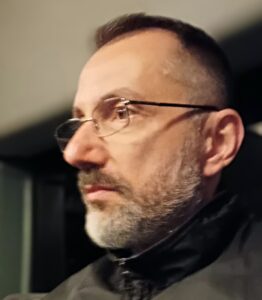
ΠΕ06 Αγγλικής Φιλολογίας
eTwinning


Hi, I’m Kostas, short for “Constantine.”
Born and raised in Athens, Greece,
I have studied English and Journalism
(Σχολή Δημοσιογραφίας ANT1)
and I teach English at a state primary school in the Greek capital.
Wishing to provide my students with a wider view of the world, I am searching for interesting international opportunities to learn about different cultures and global issues.
Επιθυμώντας να προσφέρω στους μαθητές και τις μαθήτριές μου μία ευρύτερη θεώρηση του κόσμου, αναζητώ ευκαιρίες συνεργασίας στην Ελλάδα/Κύπρο και το εξωτερικό προκειμένου να μάθουμε μαζί για διαφορετικούς πολιτισμούς και να ενημερωθούμε για παγκόσμια θέματα.













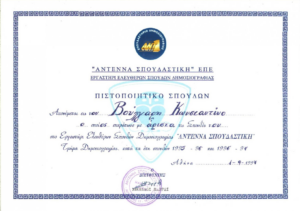
Με κέρδισε όμως η Εκπαίδευση. 🙂






Η χρήση της Τεχνητής Νοημοσύνης
στο μάθημα της Αγγλικής
στην Α/βάθμια Εκπαίδευση

1. Teach.in.G. | Εκπαίδευση εκπαιδευτικών: Γλωσσική και ψυχοπαιδαγωγική διαχείριση πολύγλωσσων και πολυπολιτισμικών τάξεων
2. Ειδική Αγωγή: Διεπιστημονικές πρακτικές σύγκλισης
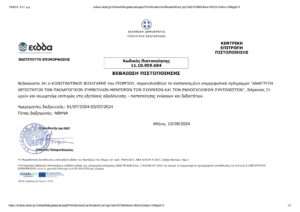
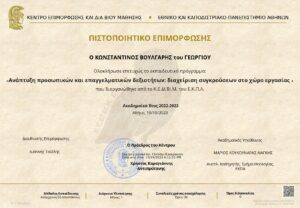
3. Ανάπτυξη προσωπικών και επαγγελματικών δεξιοτήτων: Διαχείριση συγκρούσεων στο χώρο εργασίας
4. Διαπροσωπικές σχέσεις: Το φαινόμενο της μοναξιάς στη σύγχρονη εποχή
Διαχείριση και αντιμετώπιση
5. Από τη μία στην άλλη πλευρά του Αιγαίου:
Η εγκατάσταση των Μικρασιατών προσφύγων στην Ελλάδα μέσα από τη λογοτεχνία
6. Θρησκεία και Ψυχανάλυση
7. Παραπληροφόρηση ή αληθινές ειδήσεις; Μάθετε να τα ξεχωρίζετε
8. Σπουδή στην Ορθόδοξη Θεολογία
9. Τα δικαιώματα του παιδιού

1. Εκπαιδευτικός στον 21ο αιώνα: Πώς να ξεχωρίσω
2. Διαχείριση της πολυπολιτισμικότητας στην εκπαίδευση και κοινωνική ένταξη μεταναστών /προσφύγων
3. Σχολική Ψυχολογία
4. Ενδοσχολική βία και εκφοβισμός: Πρόληψη και αντιμετώπιση
5. Μέθοδοι της Μετασχηματίζουσας Μάθησης στο πλαίσιο της Διά Βίου Μάθησης

Σύγχρονες αρχές και πρακτικές στην Ειδική Αγωγή και Εκπαίδευση

1. Σχολική Νοσηλευτική και Ψυχική Υγεία
2. Πρόληψη και αντιμετώπιση της επιθετικότητας στο σχολικό περιβάλλον: Εργαλεία και στρατηγικές διαχείρισης
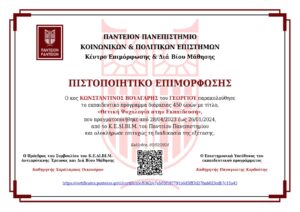
1. Πρόληψη και αντιμετώπιση ρατσισμού
στα δημοτικά σχολεία
2. Θετική Ψυχολογία στην Εκπαίδευση
3. Ενισχύστε την εκπαίδευσή σας με τη δύναμη
της Τεχνητής Νοημοσύνης (AI)

Διαχείριση σχολικής ζωής: Ηγεσία, κρίσεις, διαφορετικότητα, συμπερίληψη

Αγωγή και ετερότητα: Αξιοποιώντας την Τέχνη
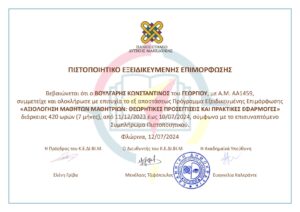
1. Αξιολόγηση μαθητών/μαθητριών: Θεωρητικές προσεγγίσεις και πρακτικές εφαρμογές
2. Έμφυλες σχέσεις και ενδυνάμωση μέσα από αφηγηματικές τεχνικές
1. Ο/Η άνθρωπος-πολίτης/πολίτιδα
απέναντι στο θάνατο και την απώλεια:
Παιδαγωγικές και κοινωνικές προσεγγίσεις
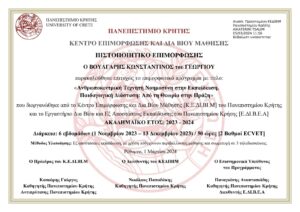
2. Ανθρωποκεντρική Τεχνητή Νοημοσύνη στην Εκπαίδευση: Παιδαγωγική διάσταση
Από τη θεωρία στην πράξη
3. Γνωριμία με το Magic School στην εκπαιδευτική πράξη
4. LIFE on mARTs
5. Ανθρωποκεντρική Τεχνητή Νοημοσύνη στην Εκπαίδευση: Μετασχηματίζοντας τον τρόπο με τον οποίο διδάσκουμε και μαθαίνουμε
1. Ψυχολογικές προσεγγίσεις του παιδικού σχεδίου
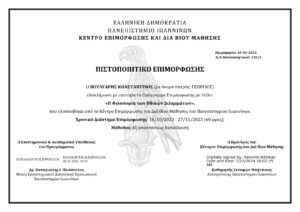
2. Η Φιλοσοφία των Ηθικών Διλημμάτων
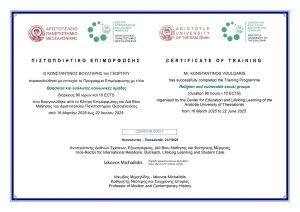
Θρησκεία και ευάλωτες κοινωνικές ομάδες

1. Σπουδές στον Ποντιακό Ελληνισμό
2. STEAM Education for All Learners: Incorporating STEAM and Inclusive Education Practices in Everyday Teaching

Επιμορφώνοντας τους εκπαιδευτικούς στο Ολοκαύτωμα: Ανθρωπολογικές αναγνώσεις
του κινηματογράφου

Προαγωγή ψυχικής υγείας και ευεξίας
στα σχολεία: Well@School Project
Αξιολόγηση του σχολείου, των εκπαιδευτικών
και ανάπτυξη βέλτιστων λεκπαιδευτικών πρακτικών

1. Επιμόρφωση των Εκπαιδευτικών
στις Δεξιότητες μέσω Εργαστηρίων
2. Εισαγωγή της Αγγλικής Γλώσσας
στο Νηπιαγωγείο (ΕΑΝ)
3. Αναπηρία και διαφορετικότητα,
αυτιστικό φάσμα,
προβλήματα προσοχής και συγκέντρωσης
4. Εκπαίδευση για την Ιδιότητα
του Παγκόσμιου Πολίτη
Ευρωπαϊκό Έργο GENE
(Global Education Network Europe)
5. Διαφοροποιημένη Διδασκαλία:
Πρακτικές υποστήριξης
των μαθητών και των μαθητριών

1. Ανάπτυξη δεξιοτήτων των Παιδαγωγικών Συμβούλων-Μεντόρων
2. Ενεργητική ακρόαση και αποτελεσματική επικοινωνία
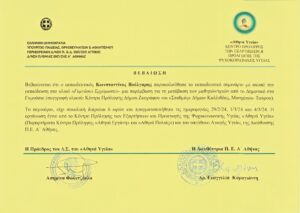
1. Peer Support / Συμβουλευτική Ομηλίκων
2. Εκπαιδευτικός στην τάξη ξανά:
Ενδυναμώνοντας τον εαυτό μου
και το ρόλο μου
3. — Γυμνάσιο, ερχόμαστε!
Μία παρέμβαση για τη μετάβαση
των μαθητών/-τριών
από το Δημοτικό στο Γυμνάσιο
Neuro-Linguistic Programming
Νευρογλωσσικός Προγραμματισμός

1. Εκμάθηση βασικών τεχνικών NLP
2. Εκμάθηση προχωρημένων τεχνικών NLP
3. NLP – Ο Νευρογλωσσικός Προγραμματισμός στην Ψυχολογία

Δημιουργική γραφή
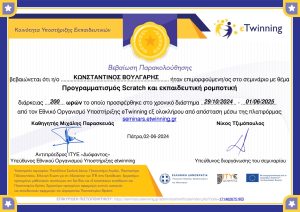
Προγραμματισμός Scratch και εκπαιδευτική ρομποτική

eTwinning και Εργαστήρια Δεξιοτήτων:
Συνεργατικές Δράσεις για την Καλλιέργεια
Γνώσεων, Δεξιοτήτων και Ικανοτήτων
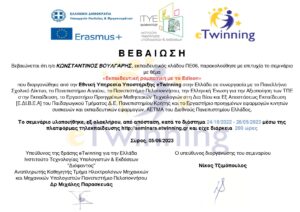
Εκπαιδευτική ρομποτική με το Edison

και για τις μικρότερες τάξεις:
Bee-Bot

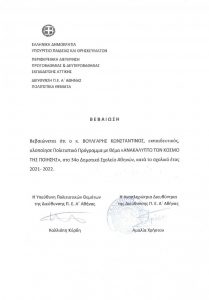
1. Το δικό μας όνειρο
2. Αληθινή φιλία
3. Δύο ευγενικοί άνθρωποι
4. Ανακαλύπτω τον κόσμο της Ποίησης
5. Φύγε άγχος, γίνε χρώματα!

1. True Friends Forever
2. True Friends Forever | France and Greece
3. Be a European Star for a European Christmas
4. Comment fait-on la paix ?
5. Μαθαίνω να βλέπω τον Άνθρωπο | Learning to See the Person #SkillsLabs