Self-reflection on Effective Learning
by Fostering the Use of Innovative Educational Technologies
Individual Survey
Ατομικός αναστοχασμός
Ευρωπαϊκό Πλαίσιο για την Ψηφιακή Ικανότητα των Εκπαιδευτικών


Self-reflection on Effective Learning
by Fostering the Use of Innovative Educational Technologies
Individual Survey
Ατομικός αναστοχασμός
Ευρωπαϊκό Πλαίσιο για την Ψηφιακή Ικανότητα των Εκπαιδευτικών
A Greek Marine Becomes a “Bridge” for Flood-affected Elderly
The Armed Forces personnel have rescued 2,235 people.
Το προσωπικό των Ενόπλων Δυνάμεων έχει διασώσει 2.235 άτομα.

Διεπιστημονικές πρακτικές σύγκλισης
03/07/2023 – 11/09/2023


Προκλήσεις και προοπτικές

ΚΕΑΤ | Κέντρο Εκπαιδεύσεως και Αποκαταστάσεως Τυφλών
Εκπαιδεύοντας το βλέμμα:
Το ζωγραφικό έργο του Χρήστου Μποκόρου 1821, η γιορτή


Γλωσσική και Ψυχοπαιδαγωγική Διαχείριση
Πολύγλωσσων και Πολυπολιτισμικών Τάξεων
Teach.in.G.
Teachers’ Capacity Building
for the Integration of Refugee and Migrant Children
in Greece
Ανάπτυξη δεξιοτήτων των διδασκόντων
για την ένταξη των παιδιών προσφύγων και μεταναστών
στην Ελλάδα
25/11/2022 – 31/08/2023



28/11/2022 – 28/08/2023


Cognitive Behavioural Therapy

rêverie
reverie / daydreaming
ονειροπόληση
Composer: Claude Debussy (1862-1918)

Mark Strand (1934-2014) was a Canadian-born American poet, essayist and translator from Summerside, Prince Edward Island. He was a professor of English and Comparative Literature at Columbia University from 2005 until his death in 2014.
Η μετάφραση που έκανα σε αυτό το ποίημα αποτελεί ταυτόχρονα και μία αυθαίρετη ερμηνεία, καθώς δεν είναι σαφές εάν μιλάει ο άντρας ή η γυναίκα.
Answers
Why did you travel?
Because the house was cold.
Why did you travel?
Because it is what I have always done between sunset and sunrise.
What did you wear?
I wore a blue suit, a white shirt, yellow tie, and yellow socks.
What did you wear?
I wore nothing. A scarf of pain kept me warm.
Who did you sleep with?
I slept with a different woman each night.
Who did you sleep with?
I slept alone. I have always slept alone.
Why did you lie to me?
I always thought I told the truth.
Why did you lie to me?
Because the truth lies like nothing else and I love the truth.
Why are you going?
Because nothing means much to me anymore.
Why are you going?
I don’t know. I have never known.
How long shall I wait for you?
Do not wait for me. I am tired and I want to lie down.
Are you tired and do you want to lie down?
Yes, I am tired and I want to lie down.
Απαντήσεις
Γιατί ταξίδεψες;
Γιατί το σπίτι ήταν κρύο.
Γιατί ταξίδεψες;
Γιατί είναι αυτό που έκανα πάντοτε, ανάμεσα στο ηλιοβασίλεμα και την ανατολή.
Τι φόρεσες;
Μπλε κοστούμι, λευκό πουκάμισο, κίτρινη γραβάτα και κίτρινες κάλτσες.
Τι φόρεσες;
Δεν φόρεσα τίποτα. Με κράτησε ζεστή ένα μαντήλι πόνου.
Με ποιαν κοιμήθηκες;
Κοιμήθηκα με άλλη γυναίκα κάθε βράδυ.
Με ποιον κοιμήθηκες;
Κοιμήθηκα μόνη. Πάντα κοιμόμουν μόνη.
Γιατί μου είπες ψεματα;
Κάθε φορά νόμιζα πως έλεγα την αλήθεια.
Γιατί μου είπες ψεματα;
Γιατί η αλήθεια ψεύδεται όσο τίποτε άλλο κι εγώ αγαπώ την αλήθεια.
Γιατί φεύγεις;
Γιατί τίποτα πια δεν έχει νόημα για μένα.
Γιατί φεύγεις;
Δεν ξέρω. Ποτέ δεν ήξερα.
Πόσο να σε περιμένω;
Μην με περιμενεις. Είμαι κουρασμένη και θέλω να ξαπλώσω.
Είσαι κουρασμένη και θες να ξαπλώσεις;
Ναι, είμαι κουρασμένη και θέλω να ξαπλώσω.

Macbeth is an opera in four acts by Giuseppe Verdi, based on William Shakespeare’s play of the same name. The warrior Macbeth fights on the side of the King of Scotland—but when a coven of witches prophesy that he shall become king himself, a ruthless ambition drives Macbeth and his wife to horrific acts.
La luce langue, il faro spegnesi
Ch’eterno corre per gli ampi cieli!
Notte desiata, provvida veli
La man colpevole che ferirà.
Nuovo delitto! E necessario!
Compiersi debbe l’opra fatale.
Ai trapassati regnar non cale;
A loro un requiem, l’eternità!
O voluttà del soglio!
O scettro, alfin sei mio!
Ogni mortal desio
Tace e s’acqueta in te.
Cadrà fra poco esanime
Chi fu predetto re.
The light is fading out, the beacon that eternally
Moves in the vast heavens is dying away!
Desired night, providentially veil
The guilty hand which is going to strike the blow.
A new crime! It’s necessary!
The fatal deed must be done.
The dead do not care to reign;
For them, there is a requiem, and eternity!
Oh voluptuousness of the throne!
Oh sceptre, finally you are mine!
Every mortal desire
Is silenced and stilled by you.
He who was predicted to become king
Will soon fall lifeless.
Το φως ξεθωριάζει, ο φάρος σβήνει,
αυτός που αιώνια διατρέχει τους απέραντους ουρανούς!
Πολυπόθητη νύχτα, προνόησε και κρύψε
το ένοχο χέρι που θα επιφέρει το χτύπημα.
Ένα νέο έγκλημα! Είναι απαραίτητο!
Η μοιραία πράξη πρέπει να ολοκληρωθεί.
Οι νεκροί δεν ενδιαφέρονται να βασιλέψουν.
Για αυτούς υπάρχει η νεκρώσιμη ακολουθία, η αιωνιότητα!
Ω απολαυστική πολυτέλεια του θρόνου!
Ω σκήπτρο, επιτέλους είσαι δικό μου!
Κάθε θνητή επιθυμία
σιγά και καταπνίγεται από σένα.
Aυτός για τον οποίο προφήτευαν πως θα γινόταν βασιλιάς
θα πέσει σύντομα άψυχος.

Η Νίκη μαθαίνει στο αγόρι τα έπη των ηρώων
Μαρμάρινο γλυπτό του Emil Wolff (1847), τοποθετημένο στη γέφυρα Schlossbrücke στο Βερολίνο.
Η Νίκη κρατά ασπίδα με τα ονόματα ΑΛΕΞΑΝΔΡΟΣ, ΚΑΙΣΑΡ, ΦΡΕΙΔΕΡΙΚΟΣ.
Nike Instructs the Boy in Heroic History is an outdoor marble sculpture by Emil Wolff (1847), installed on Schlossbrücke in Berlin, Germany.
Nike holds a shield with the names ALEXANDER, CAESAR, FRIEDRICH.
Πατέρα μας, δηλ. το Πάτερ ημών στα σουαχίλι
από τη χορωδία του Πανεπιστημίου του Stellenbosch,
σε μουσική σύνθεση του Christopher Tin.
Διευθύνει ο André van der Merwe.
Baba yetu, yetu uliye
Mbinguni yetu, yetu amina!
Baba yetu yetu uliye
M Jina lako e litukuzwe.
Utupe leo chakula chetu
Tunachohitaji, utusamehe
Makosa yetu, hey!
Kama nasi tunavyowasamehe
Waliotukosea usitutie
Katika majaribu, lakini
Utuokoe, na yule, muovu e milele!
Ufalme wako ufike utakalo
Lifanyike duniani kama mbinguni.
(Amina)
Παιδαγωγικές και κοινωνικές προσεγγίσεις
02/06/2023 – 07/07/2023

 H Connie Converse εξαφανίστηκε μυστηριωδώς τον Αύγουστο του ’74 σε ηλικία 50 ετών.
Elizabeth Eaton Converse (born August 3, 1924 – disappeared August 1974), was an American singer-songwriter and musician, best known under her professional name Connie Converse. She was active in New York City in the 1950s, and her work is among the earliest known recordings in the singer-songwriter genre of music.
In 1974, Converse left her family home in search of a new life and was not seen or heard from again. Despite the obscurity of her music during her lifetime, her work gained posthumous recognition after it was featured on a 2004 radio show. In March 2009, a compilation album of her work, How Sad, How Lovely, was released.
In between two tall mountains
There’s a place they call Lonesome
Don’t see why they call it Lonesome;
I’m never lonesome when I go there
See that bird sittin’ on my windowsill?
Well, he’s sayin’ whip-poor-will
All the night through
See that brook runnin’ by my kitchen door?
Well, it couldn’t talk no more
If it was you
Up that tree there’s sort of a squirrel thing
Sounds just like we did when we were quarrelling
In the yard I keep a pig or two
They drop in for dinner like you used to do
I don’t stand in the need of company
With everything I see
Talkin’ like you
Up that tree there’s sort of a squirrel thing
Sounds just like we did when we were quarrelling
You may think you left me all alone
But I can hear you talk without a telephone
I don’t stand in the need of company
With everything I see
Talkin’ like you
See that bird sittin’ on my windowsill?
Well, he’s sayin’ whip-poor-will
All the night through
Just, whip-poor-will
All the night through
In between two tall mountains
There’s a place they call Lonesome
Don’t see why they call it Lonesome;
I’m never lonesome now I live there

και κοινωνική ένταξη μεταναστών/προσφύγων

Weekend ahead!  The World Championship Dainty Contest and Festival kicks off in the Schnitzelburg neighborhood this weekend with days of fun, food, and events! This decades-old Louisville tradition will include two days of pre-celebration activities on July 29 & 30, with the Championship event taking place at Hauck’s Corner on Monday, July 31.
Οι πρόγονοί τους ήταν Γερμανοί μετανάστες και έφεραν στο Κεντάκι το dainty. Xτυπούν το ξυλάκι με ένα σκουπόξυλο, πρώτα για να το σηκώσουν από το έδαφος και μετά για να φύγει μακριά. Πρέπει να είσαι άνω των 45 για να έχεις δικαίωμα συμμετοχής. Ο καλύτερος παίρνει το τρόπαιο και ο χειρότερος… ένα καλαθάκι λεμόνια! Είναι πιο δύσκολο από όσο φαίνεται, αλλά φέρνει την κοινότητα ακόμα πιο κοντά.



ΠΕ06 Αγγλικής Φιλολογίας
eTwinning


Hi, I’m Kostas, short for “Constantine.”
Born and raised in Athens, Greece,
I have studied English and Journalism
(Σχολή Δημοσιογραφίας ANT1)
and I teach English at a state primary school in the Greek capital.
Wishing to provide my students with a wider view of the world, I am searching for interesting international opportunities to learn about different cultures and global issues.
Επιθυμώντας να προσφέρω στους μαθητές και τις μαθήτριές μου μία ευρύτερη θεώρηση του κόσμου, αναζητώ ευκαιρίες συνεργασίας στην Ελλάδα/Κύπρο και το εξωτερικό προκειμένου να μάθουμε μαζί για διαφορετικούς πολιτισμούς και να ενημερωθούμε για παγκόσμια θέματα.














Με κέρδισε όμως η Εκπαίδευση. 🙂










Η χρήση της Τεχνητής Νοημοσύνης
στο μάθημα της Αγγλικής
στην Α/βάθμια Εκπαίδευση


1. Teach.in.G. | Εκπαίδευση εκπαιδευτικών: Γλωσσική και ψυχοπαιδαγωγική διαχείριση πολύγλωσσων και πολυπολιτισμικών τάξεων
2. Ειδική Αγωγή: Διεπιστημονικές πρακτικές σύγκλισης
3. Ανάπτυξη προσωπικών και επαγγελματικών δεξιοτήτων: Διαχείριση συγκρούσεων στο χώρο εργασίας
4. Διαπροσωπικές σχέσεις: Το φαινόμενο της μοναξιάς στη σύγχρονη εποχή
Διαχείριση και αντιμετώπιση
5. Από τη μία στην άλλη πλευρά του Αιγαίου:
Η εγκατάσταση των Μικρασιατών προσφύγων στην Ελλάδα μέσα από τη λογοτεχνία
6. Θρησκεία και Ψυχανάλυση
7. Παραπληροφόρηση ή αληθινές ειδήσεις; Μάθετε να τα ξεχωρίζετε
8. Σπουδή στην Ορθόδοξη Θεολογία
9. Τα δικαιώματα του παιδιού
10. Philosophical Life Coaching

1. Εκπαιδευτικός στον 21ο αιώνα: Πώς να ξεχωρίσω
2. Διαχείριση της πολυπολιτισμικότητας στην εκπαίδευση και κοινωνική ένταξη μεταναστών /προσφύγων
3. Σχολική Ψυχολογία
4. Ενδοσχολική βία και εκφοβισμός: Πρόληψη και αντιμετώπιση
5. Μέθοδοι της Μετασχηματίζουσας Μάθησης στο πλαίσιο της Διά Βίου Μάθησης

Σύγχρονες αρχές και πρακτικές στην Ειδική Αγωγή και Εκπαίδευση

1. Σχολική Νοσηλευτική και Ψυχική Υγεία
2. Πρόληψη και αντιμετώπιση της επιθετικότητας στο σχολικό περιβάλλον: Εργαλεία και στρατηγικές διαχείρισης

1. Πρόληψη και αντιμετώπιση ρατσισμού
στα δημοτικά σχολεία
2. Θετική Ψυχολογία στην Εκπαίδευση
3. Ενισχύστε την εκπαίδευσή σας με τη δύναμη
της Τεχνητής Νοημοσύνης (AI)

Διαχείριση σχολικής ζωής: Ηγεσία, κρίσεις, διαφορετικότητα, συμπερίληψη

Αγωγή και ετερότητα: Αξιοποιώντας την Τέχνη

1. Αξιολόγηση μαθητών/μαθητριών: Θεωρητικές προσεγγίσεις και πρακτικές εφαρμογές
2. Έμφυλες σχέσεις και ενδυνάμωση μέσα από αφηγηματικές τεχνικές

1. Ο/Η άνθρωπος-πολίτης/πολίτιδα
απέναντι στο θάνατο και την απώλεια:
Παιδαγωγικές και κοινωνικές προσεγγίσεις
2. Ανθρωποκεντρική Τεχνητή Νοημοσύνη στην Εκπαίδευση: Παιδαγωγική διάσταση
Από τη θεωρία στην πράξη
3. Γνωριμία με το Magic School στην εκπαιδευτική πράξη
4. LIFE on mARTs
5. Ανθρωποκεντρική Τεχνητή Νοημοσύνη στην Εκπαίδευση: Μετασχηματίζοντας τον τρόπο με τον οποίο διδάσκουμε και μαθαίνουμε

1. Επιμορφώνοντας τους εκπαιδευτικούς στο Ολοκαύτωμα: Ανθρωπολογικές αναγνώσεις
του κινηματογράφου
2. Εισαγωγή στην αλβανική γλώσσα

1. Σπουδές στον Ποντιακό Ελληνισμό
2. STEAM Education for All Learners: Incorporating STEAM and Inclusive Education Practices in Everyday Teaching
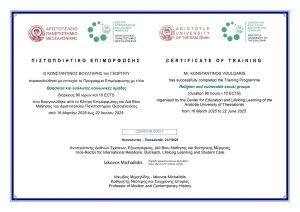
Θρησκεία και ευάλωτες κοινωνικές ομάδες
1. Ψυχολογικές προσεγγίσεις του παιδικού σχεδίου
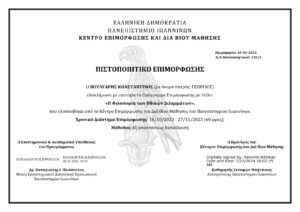
2. Η Φιλοσοφία των Ηθικών Διλημμάτων

Προαγωγή ψυχικής υγείας και ευεξίας
στα σχολεία: Well@School Project

Αξιολόγηση του σχολείου, των εκπαιδευτικών
και ανάπτυξη βέλτιστων λεκπαιδευτικών πρακτικών

1. Επιμόρφωση των Εκπαιδευτικών
στις Δεξιότητες μέσω Εργαστηρίων
2. Εισαγωγή της Αγγλικής Γλώσσας
στο Νηπιαγωγείο (ΕΑΝ)
3. Αναπηρία και διαφορετικότητα,
αυτιστικό φάσμα,
προβλήματα προσοχής και συγκέντρωσης
4. Εκπαίδευση για την Ιδιότητα
του Παγκόσμιου Πολίτη
Ευρωπαϊκό Έργο GENE
(Global Education Network Europe)
5. Διαφοροποιημένη Διδασκαλία:
Πρακτικές υποστήριξης
των μαθητών και των μαθητριών
6. Πρόληψη και αντιμετώπιση περιστατικών ενδοσχολικής βίας και εκφοβισμού

1. Ανάπτυξη δεξιοτήτων των Παιδαγωγικών Συμβούλων-Μεντόρων
2. Ενεργητική ακρόαση και αποτελεσματική επικοινωνία

1. Peer Support / Συμβουλευτική Ομηλίκων
2. Εκπαιδευτικός στην τάξη ξανά:
Ενδυναμώνοντας τον εαυτό μου
και το ρόλο μου
3. — Γυμνάσιο, ερχόμαστε!
Μία παρέμβαση για τη μετάβαση
των μαθητών/-τριών
από το Δημοτικό στο Γυμνάσιο
4. Τεχνικές πρόληψης για παιδιά
Neuro-Linguistic Programming
Νευρογλωσσικός Προγραμματισμός

1. Εκμάθηση βασικών τεχνικών NLP
2. Εκμάθηση προχωρημένων τεχνικών NLP
3. NLP – Ο Νευρογλωσσικός Προγραμματισμός στην Ψυχολογία

Δημιουργική γραφή
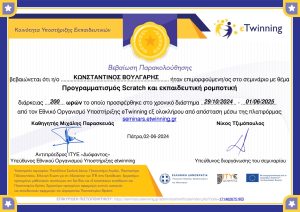
Προγραμματισμός Scratch και εκπαιδευτική ρομποτική

eTwinning και Εργαστήρια Δεξιοτήτων:
Συνεργατικές Δράσεις για την Καλλιέργεια
Γνώσεων, Δεξιοτήτων και Ικανοτήτων

Εκπαιδευτική ρομποτική με το Edison

και για τις μικρότερες τάξεις:
Bee-Bot

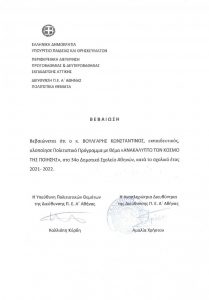
1. Το δικό μας όνειρο
2. Αληθινή φιλία
3. Δύο ευγενικοί άνθρωποι
4. Ανακαλύπτω τον κόσμο της Ποίησης
5. Φύγε άγχος, γίνε χρώματα!

1. True Friends Forever
2. True Friends Forever | France and Greece
3. Be a European Star for a European Christmas
4. Comment fait-on la paix ?
5. Μαθαίνω να βλέπω τον Άνθρωπο | Learning to See the Person #SkillsLabs