Potsdamwas a residence of the Prussian kings and the German emperor until 1918. Its urban planning embodied the ideals of the Age of Enlightenment: through a careful balance of architecture and landscape, Potsdam was conceived as “a picturesque, pastoral dream” that reminded its residents of their relationship with nature and reason.
Sanssouciis a historical building in Potsdam, near Berlin. Built by Prussian King Frederick the Great as his summer palace, it is often counted among the German rivals of Versailles. The palace was designed and built by Georg Wenzeslaus von Knobelsdorff between 1745 and 1747 to meet Frederick’s need for a private residence where he could escape the pomp and ceremony of the royal court. The palace’s name is a French phrase (sans souci) meaning “without worries” or “carefree,” emphasizing that the palace was meant asa place of relaxation rather than a seat of power.
Lübbenau (Lower Sorbian: Lubnjow) is a town in the Upper Spree Forest–Lusatia district of Brandenburg, Germany. It is located in the bilingual German/Sorbian region of Lower Lusatia, on the River Spree, where the river forms a large inland delta surrounded by woodland, known as the “Spree Forest,” about 82 km (51 miles) south-east of Berlin.
The town is best known through the incorporated villages of Lehde/Lědy and Leipe/Lipje, where there are anabranches of the Spree instead of streets.
Υoung Wendish Woman, 1937
Oil on canvas by Elisabeth Wolf (1873-1964)
Ελαιογραφία της Elisabeth Wolf, που αναπαριστά νεαρή γυναίκα της σλαβόφωνης μειονότητας των Wenden/Sorben.
Tucked in and ready to dream: Even teddy bears need their beauty sleep.
Königs Wusterhausen is a town in the Dahme-Spreewald district of the state of Brandenburg in Germany, a few kilometres outside Berlin.
The Schloss: Königs Wusterhausen Hunting Lodge and Garden is known as Prussian King Frederick William’s favourite place to stay. Today, the castle is a museum of the Prussian Palaces and Gardens Foundation Berlin-Brandenburg. Numerous valuable Baroque paintings and handicrafts are on display, including works connected to Frederick William and his family, many pieces of the original interior, as well as a large collection of portraits—mainly of officers—painted by the “Soldier King” himself.
A great swart cheek and the gleam of tears,
The flutter of hopes and the shadow of fears,
And all day long the rub and scrub
With only a breath betwixt tub and tub.
Fool! Thou hast toiled for fifty years
And what hast thou now but thy dusty tears?
In silence she rubbed . . . But her face I had seen,
Where the light of her soul fell shining and clean.
Η πλύστρα
Yπέροχη μελαχρινή παρειά, το φεγγοβόλημα των δακρύων,
το φτεροκόπημα των ελπίδων, η σκιά των φόβων—
κι ολημερίς να τρίβει και πάλι να τρίβει…
ίσα που πρόφταινε να πάρει ανάσα από σκάφη σε σκάφη.
Ανόητη! Πενήντα χρόνια να μοχθείς
και τι έχεις τώρα παρεκτός τα σκονισμένα σου δάκρυα;
Να τρίβει σιωπηλή… Το πρόσωπό της όμως είχα δει,
κει όπου της ψυχής της το φως έπεφτε λαμπερό και καθάριο.
Otto Leland Bohanan (1895-1932) was an African-American poet, composer and singer from Washington, DC. The Book of American Negro Poetry εκδ. Harcourt, Brace and Company, 1922
La Blanchisseuse / La Lavandière The Washerwoman, c. 1863, Paris, Musée d’Orsay
Oil on wood, 49 × 33.5 cm, by Honoré Daumier
The painting highlights the harsh reality of manual labour, the burdens of motherhood, and the quiet dignity maintained in the face of adversity.
Ο πίνακας αναδεικνύει τη σκληρή πραγματικότητα της χειρωνακτικής εργασίας, τα βάρη της μητρότητας και την ήσυχη αξιοπρέπεια που διατηρείται παρά τις αντιξοότητες.
1. Observing the Artwork
What do you see?
What is the woman doing?
What feelings does this painting evoke in you?
How does the woman feel? Is her work easy?
What might she want to do or say?
What do you notice about the child?
Why is the child with her?
2.Acting Out the Characters and Their Inner Voices
Roles(4 children) The Washerwoman(sits on a chair) The Child (sits next to her) The Woman’s Inner Voice(stands behind her) The Child’s Inner Voice (stands behind the Child)
Script Washerwoman:
“We still have a long way to go.”
Child (aloud):
“Mum, I’m tired! My legs hurt.”
Woman’s Inner Voice (behind her):
“I wish I could stop for a moment… This work is so heavy, and I’ve got my son/daughter with me. No one understands what I’m going through!”
Child’s Inner Voice (behind the Child):
“Mum always has to carry everything… Why can’t anyone help her? Where is Dad?”
3.Reflective Discussion—Connecting with Today
What emotions did you notice?
Who has taken on the responsibilities?
Who helps?
How would the scene change if the father were present?
How would this situation look today?
Have things changed at all?
What chores do women and men do at home nowadays?
Is it right to have “jobs for boys” and “jobs for girls”?
How can we all help?
Last night, something magical happened in New York… The Statue of Liberty decided she’d stood still long enough. With a flick of her giant torch and a very dramatic stretch, she stepped off her pedestal and began walking proudly under the stars.
Tourists gasped, taxi drivers nearly fainted, and one seagull demanded to know why nobody had warned him.
But Lady Liberty didn’t mind. She simply marched down the harbour like a supermodel on a cosmic catwalk, her torch shining brighter than the moon, enjoying her well-deserved night out.
Rumour has it she’ll be back by sunrise— even statues need a little stroll sometimes.
Hawaiian pizza is a pizza invented in Canada, topped with pineapple, tomato sauce, mozzarella cheese, and either ham or bacon.
Sam Panopoulos, a Greek-born Canadian, created the first Hawaiian pizza at the Satellite Restaurant in Chatham-Kent, Ontario, Canada, in 1962.
The name of this creation was not directly inspired by the U.S. state of Hawaii at all; Panopoulos chose the name Hawaiian due to using canned pineapple from the Hawaiian Pineapple Company.
The word “poetess” is still understood, but it’s rarely used today.
Here’s why:
• It was once common to use gender-specific forms like poetess, actress, or authoress to refer to women.
• In modern English, most people prefer gender-neutral terms, so both men and women are now simply called poets.
• Poetess can sound old-fashioned or even patronising, depending on context, because it unnecessarily highlights gender.
You might still find poetess in historical writing or when referring to someone from the past (e.g. “Sappho, the ancient Greek poetess”), but in contemporary English, it’s best to use poet for everyone: “I’ve always admired Toni Morrison, a woman writer and poet who speaks so beautifully about life.”
Maria Polydouri(1 April 1902 – 29 April 1930) was a Greek poet who belonged to the school of Neo-romanticism.
She fostered a feeling of dissatisfaction and decline.
Although she wrote poetry from an early age, her most important poems were written during the last four years of her life, when, suffering from tuberculosis, she was secluded in an Athens sanatorium, where she died in 1930.
Diary Monday, 15 June 1925 [adaptation]
The same question fades in our eyes every time we meet by chance in the street. And yet we walk past each other, without any strength to take the road we’ve left behind.
I always turn and look at that road.
Don’t leave me! I would live the most joyless life without you.
But you never turn back.
Who knows in what harbour of happiness you think of me now, and you dare not…
Here I am, waiting.
Don’t leave me!
Ημερολόγιο Δευτέρα 15 Ιουνίου 1925 [διασκευή]
Το ίδιο ερώτημα σβήνει στα μάτια μας κάθε φορά που συναντιόμαστε τυχαία στο δρόμο. Μ’ αντιπερνάμε, χωρίς καμία δύναμη να πάρουμε το δρόμο που αφήσαμε πίσω μας.
Γυρνώ πάντα και τον κοιτάζω αυτόν το δρόμο.
Μη μ’ αφήνεις! Θα ζήσω στην πιο άχαρη ζωή χωρίς εσένα.
Μα δεν γυρνάς καθόλου.
Ποιος ξέρει σε τι ευτυχίας με σκέφτεσαι τώρα λιμάνι και δεν τολμάς…
Εδώ είμαι και καρτερώ.
Μη μ’ αφήνεις!
The Forest
The Forest, look, has leaned into the embrace of the Night.
Redolent of an intoxicating scent,
it is sighing together with the nightingale.
The moon above it
is rising strangely
and—in the mirror of the brook—
is laying down its magic.
Το Δάσος
Το Δάσος, κοίτα, απόγειρε στης Νύχτας την αγκάλη.
Μύρο αποπνέει μεθυστικό,
στενάζει με το αηδόνι.
Το φεγγαράκι πάνω του
περίεργο προβάλλει
και στον καθρέφτη του ρυακιού
τα μάγια του ξαπλώνει.
Spring
Spring has blossomed here as well, on every branch of every tree.
The parks are full of flowers, too.
But their festive joy is telling me just one thing—
that I am far away from you, Athens.
H Άνοιξη
Φούντωσε η Άνοιξη και δω σε κάθε δέντρου κλώνο.
Τα πάρκα λουλουδίσανε και κείνα.
Μα δε μου λέει η γιορτερή χαρά τους, παρά μόνο
πως λείπω μακριά ’πό σέν’ Αθήνα.
Dream
I was gathering flowers for you
on the mountain where I wandered.
A thousand thorns on each one,
and as I held them tight against me, I felt the pain.
Όνειρο
Άνθη μάζευα για σένα
στο βουνό που τριγυρνούσα.
Χίλια αγκάθια το καθένα
κι όπως τα ’σφιγγα, πονούσα.
These puppies are small and cute. 🐶🐶 They have blue fur and are wearing shiny golden helmets and armour. They look happy and brave, standing in an old Greek place with big stone columns.
The 28th of October celebration was heartfelt and full of pride. The children recited poems, sang patriotic songs, and performed short plays that brought to life the heroic moments of 1940. The value of unity and standing together against the invader was highlighted. The people’s brave “No” still inspires us today!
Hi, I’m Kostas, short for “Constantine.” Born and raised in Athens, Greece,
I have studied English and Journalism (Σχολή Δημοσιογραφίας ANT1)
and I teach English at a state primary school in the Greek capital.
Wishing to provide my students with a wider view of the world, I am searching for interesting international opportunities to learn about different cultures and global issues.
Επιθυμώντας να προσφέρω στους μαθητές και τις μαθήτριές μου μία ευρύτερη θεώρηση του κόσμου, αναζητώ ευκαιρίες συνεργασίας στην Ελλάδα/Κύπρο και το εξωτερικό προκειμένου να μάθουμε μαζί για διαφορετικούς πολιτισμούς και να ενημερωθούμε για παγκόσμια θέματα.
Κάποτε ήθελα να γίνω… δημοσιογράφος!
Με κέρδισε όμως η Εκπαίδευση. 🙂
“The time is always right to do what is right.” — Martin Luther King, Jr.
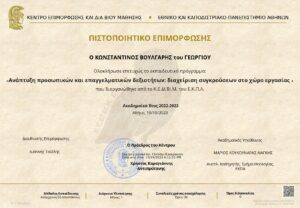
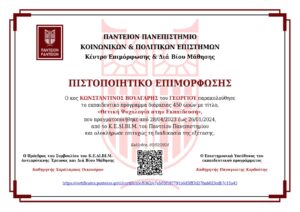
1. Teach.in.G. | Εκπαίδευση εκπαιδευτικών: Γλωσσική και ψυχοπαιδαγωγική διαχείριση πολύγλωσσων και πολυπολιτισμικών τάξεων 2. Ειδική Αγωγή: Διεπιστημονικές πρακτικές σύγκλισης 3. Ανάπτυξη προσωπικών και επαγγελματικών δεξιοτήτων: Διαχείριση συγκρούσεων στο χώρο εργασίας 4. Διαπροσωπικές σχέσεις: Το φαινόμενο της μοναξιάς στη σύγχρονη εποχή Διαχείριση και αντιμετώπιση 5. Από τη μία στην άλλη πλευρά του Αιγαίου: Η εγκατάσταση των Μικρασιατών προσφύγων στην Ελλάδα μέσα από τη λογοτεχνία 6. Θρησκεία και Ψυχανάλυση 7. Παραπληροφόρηση ή αληθινές ειδήσεις; Μάθετε να τα ξεχωρίζετε 8. Σπουδή στην Ορθόδοξη Θεολογία 9. Τα δικαιώματα του παιδιού
Πανεπιστήμιο Αιγαίου
1. Εκπαιδευτικός στον 21ο αιώνα: Πώς να ξεχωρίσω 2. Διαχείριση της πολυπολιτισμικότητας στην εκπαίδευση και κοινωνική ένταξη μεταναστών /προσφύγων 3. Σχολική Ψυχολογία 4. Ενδοσχολική βία και εκφοβισμός: Πρόληψη και αντιμετώπιση 5. Μέθοδοι της Μετασχηματίζουσας Μάθησης στο πλαίσιο της Διά Βίου Μάθησης
Ελληνικό Μεσογειακό Πανεπιστήμιο
Σύγχρονες αρχές και πρακτικές στην Ειδική Αγωγή και Εκπαίδευση
Διεθνές Πανεπιστήμιο της Ελλάδος
1. Σχολική Νοσηλευτική και Ψυχική Υγεία 2. Πρόληψη και αντιμετώπιση της επιθετικότητας στο σχολικό περιβάλλον: Εργαλεία και στρατηγικές διαχείρισης
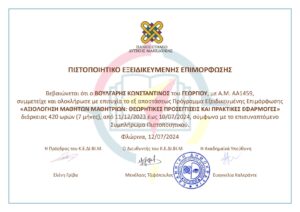
Πάντειον Πανεπιστήμιο Κοινωνικών και Πολιτικών Επιστημών
1. Πρόληψη και αντιμετώπιση ρατσισμού
στα δημοτικά σχολεία 2. Θετική Ψυχολογία στην Εκπαίδευση 3. Ενισχύστε την εκπαίδευσή σας με τη δύναμη
της Τεχνητής Νοημοσύνης (AI)
1. Αξιολόγηση μαθητών/μαθητριών: Θεωρητικές προσεγγίσεις και πρακτικές εφαρμογές 2. Έμφυλες σχέσεις και ενδυνάμωση μέσα από αφηγηματικές τεχνικές
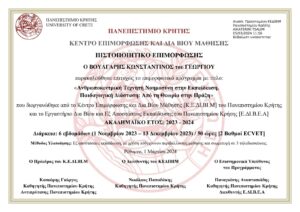
Πανεπιστήμιο Κρήτης
1. Ο/Η άνθρωπος-πολίτης/πολίτιδα απέναντι στο θάνατο και την απώλεια: Παιδαγωγικές και κοινωνικές προσεγγίσεις 2. Ανθρωποκεντρική Τεχνητή Νοημοσύνη στην Εκπαίδευση: Παιδαγωγική διάσταση
Από τη θεωρία στην πράξη 3. Γνωριμία με το Magic School στην εκπαιδευτική πράξη 4. LIFE on mARTs 5. Ανθρωποκεντρική Τεχνητή Νοημοσύνη στην Εκπαίδευση: Μετασχηματίζοντας τον τρόπο με τον οποίο διδάσκουμε και μαθαίνουμε
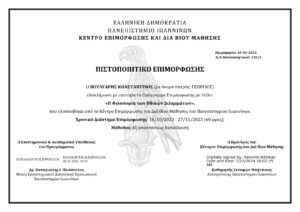
Πανεπιστήμιο Ιωαννίνων
1. Ψυχολογικές προσεγγίσεις του παιδικού σχεδίου 2. Η Φιλοσοφία των Ηθικών Διλημμάτων
Αριστοτέλειο Πανεπιστήμιο Θεσσαλονίκης
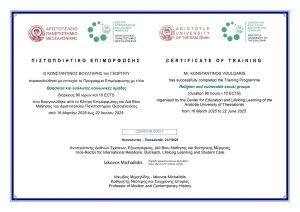
Θρησκεία και ευάλωτες κοινωνικές ομάδες
Ελληνικό Ανοικτό Πανεπιστήμιο
1. Σπουδές στονΠοντιακό Ελληνισμό 2. STEAM Education for All Learners: Incorporating STEAM and Inclusive Education Practices in Everyday Teaching
Δημοκρίτειο Πανεπιστήμιο Θράκης
Επιμορφώνοντας τους εκπαιδευτικούς στο Ολοκαύτωμα: Ανθρωπολογικές αναγνώσεις
του κινηματογράφου
Πανεπιστήμιο Δυτικής Αττικής
Προαγωγή ψυχικής υγείας και ευεξίας
στα σχολεία: Well@School Project
Χαροκόπειο Πανεπιστήμιο
Αξιολόγηση του σχολείου, των εκπαιδευτικών
και ανάπτυξη βέλτιστων λεκπαιδευτικών πρακτικών
Ινστιτούτο Εκπαιδευτικής Πολιτικής
1. Επιμόρφωση των Εκπαιδευτικών
στις Δεξιότητες μέσω Εργαστηρίων 2. Εισαγωγή της Αγγλικής Γλώσσας
στο Νηπιαγωγείο (ΕΑΝ) 3. Αναπηρία και διαφορετικότητα, αυτιστικό φάσμα, προβλήματα προσοχής και συγκέντρωσης 4. Εκπαίδευση για την Ιδιότητα
του Παγκόσμιου Πολίτη Ευρωπαϊκό Έργο GENE
(Global Education Network Europe) 5. Διαφοροποιημένη Διδασκαλία: Πρακτικές υποστήριξης
των μαθητών και των μαθητριών
Εθνικό Κέντρο Δημόσιας Διοίκησης και Αυτοδιοίκησης
1. Ανάπτυξη δεξιοτήτων των Παιδαγωγικών Συμβούλων-Μεντόρων 2. Ενεργητική ακρόαση και αποτελεσματική επικοινωνία
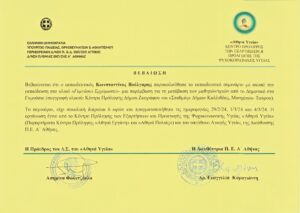
Κέντρο Πρόληψης «Αθηνά Υγεία»
1. Peer Support / Συμβουλευτική Ομηλίκων 2. Εκπαιδευτικός στην τάξη ξανά: Ενδυναμώνοντας τον εαυτό μου
και το ρόλο μου 3. — Γυμνάσιο, ερχόμαστε!
Μία παρέμβαση για τη μετάβαση των μαθητών/-τριών από το Δημοτικό στο Γυμνάσιο
1. Εκμάθηση βασικών τεχνικών NLP 2. Εκμάθηση προχωρημένων τεχνικών NLP 3. NLP – Ο Νευρογλωσσικός Προγραμματισμός στην Ψυχολογία
Ανοιχτή Τέχνη
Δημιουργική γραφή
Εθνική Υπηρεσία Υποστήριξης eTwinning
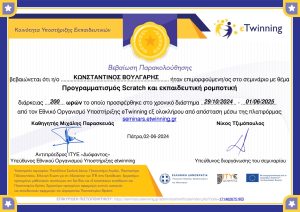
Προγραμματισμός Scratch και εκπαιδευτική ρομποτική
eTwinning και Εργαστήρια Δεξιοτήτων: Συνεργατικές Δράσεις για την Καλλιέργεια Γνώσεων, Δεξιοτήτων και Ικανοτήτων
Εκπαιδευτική ρομποτική με το Edison
και για τις μικρότερες τάξεις:
Bee-Bot
Τα πολιτιστικά μου προγράμματα
1. Το δικό μας όνειρο 2. Αληθινή φιλία 3. Δύο ευγενικοί άνθρωποι 4. Ανακαλύπτω τον κόσμο της Ποίησης 5. Φύγε άγχος, γίνε χρώματα!
Έργα eTwinning
1. True Friends Forever 2. True Friends Forever | France and Greece 3. Be a European Star for a European Christmas 4. Comment fait-on la paix ? 5. Μαθαίνω να βλέπω τον Άνθρωπο | Learning to See the Person #SkillsLabs

 Potsdam was a residence of the Prussian kings and the German emperor until 1918. Its urban planning embodied the ideals of the Age of Enlightenment: through a careful balance of architecture and landscape, Potsdam was conceived as “a picturesque, pastoral dream” that reminded its residents of their relationship with nature and reason.