It’s so interesting how, each time I tend to feel disappointed by a certain class, as a whole, the students often surprise me. Children from different backgrounds, families, cultures, and of course with different personalities, abilities and difficulties come together to learn, in the school environment, which sometimes feels very artificial… Unless one decides to make the most of this “coming together” and try to create something magical…
In this context, and pushed by the fact that, with my E1 class we are participating in a school programme about human rights, I decided to give this group of students the chance to do something memorable, which would in itself create stronger bonds among them. Now, it just so happened that the English coursebook sparked a discussion about Shakespeare and his works, so the students started bringing me summaries of plays, and we soon found ourselves talking about Othello, Ophelia, Titania and the Shrew. One day, I brought to class Sofia Zarambouka’s poster book “The Merchant of Venice”, which is an adaptation of Shakespeare’s play, for young children, in Greek. My students immediately recognized the differences from the original story, and then we found ourselves analyzing Antonio and Shylock, talking about Portia and the position of women and Jews in 16th century Venice. Above everything, I wanted them to think about the concepts of love and mercy, especially about forgiveness and how important it is.
And then it happened: During the break they kept playing by dramatizing the scene at the Duke’s court, and the next time we met they asked me if we could put up a small school play! For the younger kids to watch, etc. etc., but I knew they had identified with the characters. It took me a few days before I said “yes”, as these particular students are quite on the weaker side. But who am I to stop them from enjoying something that came out of one of our lessons?
Put up a small school play we would, even if that meant they were only going to read their part, instead of learning it by heart. I found an adaptation of The Merchant of Venice from English Class in Performance and I adapted it even more, so that the final text revises the Simple Past (!) and consists of even simpler language. Then I did the casting of the roles, and we are now at a point where we work on the actual reading.
What will eventually happen remains to be seen. Meanwhile, I would love to share some goodies with you. Here is the text in English, with the Greek mediation part and a translation also, for any of you who might be interested:
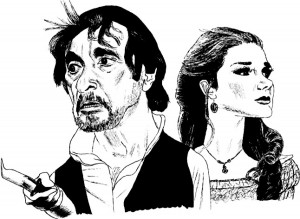
Al Pacino, as Shylock, and Lily Rabe, as Portia, in “The Merchant of Venice.” Credit Illustration by Andy Friedman, from The New Yorker.
THE MERCHANT OF VENICE
William Shakespeare was born on 23 April 1564, in Stratford –upon – Avon in England. He wrote on all subjects of human behaviour, after keen observation of his surroundings. All his literary works will live as long as earth is alive. To him we respectfully dedicate this drama.
Scene 1
(Character introduction: All characters appear one by one & introduce themselves to the spectators.)
Shakespeare: I am William Shakespeare. I am the author of today’s drama. I wrote several tragedies and comedies. This is a tragic comedy. Shylock tries to kill Antonio but there is a happy ending after all.
Antonio: I am Antonio, one of the richest merchants of Venice. I have plenty of ships on the seas. Bassanio is my close friend. I borrowed money from Shylock to help my friend.
Bassanio: I am a friend of Antonio. I met a beautiful and rich lady, Portia, and I want to marry her. I don’t have money, so I asked my friend Antonio to help me.
Shylock: I am a Jew and money lender. I hate Antonio because he insulted me on several occasions. I am looking for a chance to take revenge.
Portia: I am the daughter of a rich man from Venice. I am in love with Bassanio. I will disguise as a lawyer. I will defend Antonio in court.
Duke: I will hear Shylock’s case in my court. I will hear both sides and give my judgement.
Scene 2
Bassanio: Oh, Antonio, my close friend, I need your help.
Antonio: Oh! My friend, tell me, what can I do for you?
Bassanio: I love Portia, a rich and beautiful lady. I want to marry her, so I need money from you.
Antonio: Don’t worry. I will help you. I have no money now, so I will borrow from Shylock.
Scene 3
(Shylock’s place)
Shylock: Oh! Antonio! Oh! Bassanio! What do you want?
Antonio: I need money, three thousand ducats.
Shylock: I usually give money for interest. But for you, if you can’t return the money in three months, I want one pound of flesh from your body.
Bassanio: Antonio, don’t sign. Don’t take the risk.
Antonio: Don’t worry. My ships will return next month. We can return the money.
Scene 4
(The Duke’s court)
Clerk reads out:
Plaintiff: Shylock
Defendant: Antonio
Defendant’s lawyer: Portia
Duke: Is Shylock here?
Shylock: Yes, your Grace.
Duke: Tell me Shylock, what is your case?
Shylock: Your Grace, Antonio agreed to give me three thousand ducats within three months after we signed, or I would take a pound of his flesh. The three months are over. Now he must give me a pound of flesh, as he signed.
Duke: Antonio, what do you say?
Antonio: My lawyer will speak for me.
Portia: (She bows and starts speaking) My Lord, Shylock wants a pound of flesh. Let him have it. Did you bring the knife, Shylock?
Shylock: Yes, I did.
Portia: Then, cut a pound of flesh from Antonio’s body. Not more. Not less.
Shylock: It doesn’t say that in the bond.
Portia: Well, in the bond it also says you must cut a pound of flesh without dropping any blood. My Lord, is that even possible? Shylock planned to kill Antonio, so you must punish him.
Duke: Now it is judgement time.
Clerk: Silence…! Silence…!
Duke: I believe that you, Shylock, planned to murder Antonio. This is your punishment: I order you to give half of your fortune to the government and half to Antonio.
(Shylock walks off in shame. Antonio, Bassanio and Portia are in gay mood).
Of course, our small play would be incomprehensible without some translating in Greek. So I wrote this part for some of the students to read at intervals:
Ο Γουίλιαμ Σαίξπηρ γεννήθηκε στις 23 Απριλίου του 1564, στο Στράτφορντ απόν Έιβον στην Αγγλία. Έγραψε πάνω σε όλα τα θέματα της ανθρώπινης συμπεριφοράς, έπειτα από στενή παρατήρηση του περιβάλλοντός του. Όλα τα λογοτεχνικά του έργα θα ζουν όσο υπάρχει η γη. Με σεβασμό αφιερώνουμε τούτο το δρώμενο σε κείνον.
Σκηνή 1
Σαίξπηρ: Είμαι ο Γουίλιαμ Σαίξπηρ. Είμαι ο συγγραφέας του σημερινού έργου. Έγραψα αρκετές τραγωδίες και κωμωδίες. Ο Σάιλοκ προσπαθεί να σκοτώσει τον Αντόνιο, αλλά το τέλος είναι αίσιο.
Αντόνιο: Είμαι ο Αντόνιο, ένας από τους πιο πλούσιους έμπορους στη Βενετία. Έχω πολλά καράβια στη θάλασσα. Ο Μπασάνιο είναι στενός μου φίλος. Δανείστηκα χρήματα από το Σάιλοκ για να βοηθήσω το φίλο μου.
Μπασάνιο: Είμαι φίλος του Αντόνιο. Γνώρισα μια όμορφη και πλούσια κοπέλα, την Πόρσια, και θέλω να την παντρευτώ. Δεν έχω χρήματα, έτσι ζήτησα από το φίλο μου τον Αντόνιο να με βοηθήσει.
Σάιλοκ: Είμαι Εβραίος και δανείζω χρήματα. Μισώ τον Αντόνιο, επειδή με πρόσβαλε αρκετές φορές. Ψάχνω μια ευκαιρία να πάρω εκδίκηση.
Πόρσια: Είμαι η κόρη ενός πλούσιου από τη Βενετία. Είμαι ερωτευμένη με τον Μπασάνιο. Θα μεταμφιεστώ σαν δικηγόρος. Θα υπερασπιστώ τον Αντόνιο στο δικαστήριο.
Δούκας: Θα δικάσω την υπόθεση του Σάιλοκ στο δικαστήριο. Θα ακούσω και τις δυο πλευρές και θα βγάλω την απόφασή μου.
Σκηνή 2
Ο Μπασάνιο βρίσκει το φίλο του τον Αντόνιο και του ζητάει τη βοήθειά του, για να κατακτήσει την αγαπημένη του Πόρσια. Εκείνος του υπόσχεται ότι θα τον βοηθήσει, ζητώντας δανεικά από τον Σάιλοκ.
Σκηνή 3
Ο Σάιλοκ υποδέχεται τον Αντόνιο και τον Μπασάνιο στο σπίτι του, όπου ο Αντόνιο του ζητάει τρεις χιλιάδες δουκάτα ως δανεικά.
Σκηνή 4
Στο παλάτι του Δούκα, ο Σάιλοκ επιχειρεί να πάρει την εκδίκησή του, κόβοντας με ένα μαχαίρι μισό κιλό σάρκας από το στήθος του Αντόνιο, δίπλα στην καρδιά. Πριν όμως το κάνει, ο δικηγόρος του Αντόνιο, που είναι στην πραγματικότητα η Πόρσια που έχει μεταμφιεστεί, καταφέρνει να πείσει το δικαστήριο ότι η συμφωνία ήταν μόνο για τη σάρκα του Αντόνιο, χωρίς ούτε μια σταγόνα αίμα. Αυτό είναι αδύνατον, οπότε ο Αντόνιο αθωώνεται και αυτόματα ο Σάιλοκ τιμωρείται, καθώς η απόφαση του Δούκα είναι να δώσει το μισό της περιουσίας του στην κυβέρνηση και το άλλο μισό στον Αντόνιο, ως αποζημίωση.
And then, the ICT teacher asked me if I would mind him working on making comics out of The Merchant of Venice with 5th and 6th graders. I said I would love it, and if they could have the final product ready by the time we would present our play, so as to accompany us by showing it at the back of the stage, all the better! This is the text I will be giving them to work on:
Ο ΕΜΠΟΡΟΣ ΤΗΣ ΒΕΝΕΤΙΑΣ
Ο Γουίλιαμ Σαίξπηρ γεννήθηκε στις 23 Απριλίου του 1564, στο Στράτφορντ απόν Έιβον στην Αγγλία. Έγραψε πάνω σε όλα τα θέματα της ανθρώπινης συμπεριφοράς, έπειτα από στενή παρατήρηση του περιβάλλοντός του. Όλα τα λογοτεχνικά του έργα θα ζουν όσο υπάρχει η γη. Με σεβασμό αφιερώνουμε τούτο το δρώμενο σε κείνον.
Σκηνή 1
Σαίξπηρ: Είμαι ο Γουίλιαμ Σαίξπηρ. Είμαι ο συγγραφέας του σημερινού έργου. Έγραψα αρκετές τραγωδίες και κωμωδίες. Ο Σάιλοκ προσπαθεί να σκοτώσει τον Αντόνιο, αλλά το τέλος είναι αίσιο.
Αντόνιο: Είμαι ο Αντόνιο, ένας από τους πιο πλούσιους έμπορους στη Βενετία. Έχω πολλά καράβια στη θάλασσα. Ο Μπασάνιο είναι στενός μου φίλος. Δανείστηκα χρήματα από το Σάιλοκ για να βοηθήσω το φίλο μου.
Μπασάνιο: Είμαι φίλος του Αντόνιο. Γνώρισα μια όμορφη και πλούσια κοπέλα, την Πόρσια, και θέλω να την παντρευτώ. Δεν έχω χρήματα, έτσι ζήτησα από το φίλο μου τον Αντόνιο να με βοηθήσει.
Σάιλοκ: Είμαι Εβραίος και δανείζω χρήματα. Μισώ τον Αντόνιο, επειδή με πρόσβαλε αρκετές φορές. Ψάχνω μια ευκαιρία να πάρω εκδίκηση.
Πόρσια: Είμαι η κόρη ενός πλούσιου από τη Βενετία. Είμαι ερωτευμένη με τον Μπασάνιο. Θα μεταμφιεστώ σαν δικηγόρος. Θα υπερασπιστώ τον Αντόνιο στο δικαστήριο.
Δούκας: Θα δικάσω την υπόθεση του Σάιλοκ στο δικαστήριο. Θα ακούσω και τις δυο πλευρές και θα βγάλω την απόφασή μου.
Σκηνή 2
Μπασάνιο: Ω, Αντόνιο, καλέ μου φίλε, χρειάζομαι τη βοήθειά σου.
Αντόνιο: Ω, φίλε μου, πες μου: Τι μπορώ να κάνω για σένα;
Μπασάνιο: Αγαπώ την Πόρσια, μια πλούσια και όμορφη κοπέλα. Θέλω να την παντρευτώ, γι’ αυτό χρειάζομαι χρήματα από σένα.
Αντόνιο: Μην ανησυχείς. Θα σε βοηθήσω. Δεν έχω τώρα χρήματα, έτσι θα δανειστώ από το Σάιλοκ.
Σκηνή 3
(Στο σπίτι του Σάιλοκ)
Σάιλοκ: Ω, Αντόνιο! Ω, Μπασάνιο; Τι θέλετε;
Αντόνιο: Χρειάζομαι χρήματα, τρεις χιλιάδες δουκάτα.
Σάιλοκ: Συνήθως δανείζω χρήματα με τόκο. Αλλά για σένα, αν δεν επιστρέψεις τα χρήματα σε τρεις μήνες, θέλω ένα κομμάτι σάρκας από το σώμα σου.
Μπασάνιο: Αντόνιο, μην υπογράψεις. Μη ρισκάρεις.
Αντόνιο: Μην ανησυχείς. Τα πλοία μου θα επιστρέψουν τον επόμενο μήνα. Μπορούμε να επιστρέψουμε τα χρήματα.
Σκηνή 4
(Στο δικαστήριο του Δούκα)
Κλητήρας:
Ενάγων: Σάιλοκ
Εναγόμενος: Αντόνιο
Υπεράσπιση: Πόρσια
Δούκας: Είναι εδώ ο Σάιλοκ;
Σάιλοκ: Ναι, Εξοχότατε.
Δούκας: Πες μου, Σάιλοκ, ποια είναι η υπόθεσή σου;
Σάιλοκ: Εξοχότατε, ο Αντόνιο συμφώνησε να μου δώσει τρεις χιλιάδες δουκάτα μέσα σε τρεις μήνες αφότου υπογράψαμε, αλλιώς θα του έπαιρνα ένα κομμάτι από τη σάρκα του. Οι τρεις μήνες πέρασαν. Τώρα πρέπει να μου δώσει μισό κιλό σάρκας, όπως υπέγραψε.
Δούκας: Αντόνιο, τι λες εσύ;
Αντόνιο: Η δικηγόρος μου θα μιλήσει για μένα.
Πόρσια: (υποκλίνεται και αρχίζει να μιλάει). Κυριέ μου, ο Σάιλοκ θέλει μισό κιλό σάρκας. Ας το πάρει. Έφερες το μαχαίρι, Σάιλοκ;
Σάιλοκ: Ναι, το έφερα.
Πόρσια: Τότε, κόψε μισό κιλό σάρκας από το σώμα του Αντόνιο. Ούτε λιγότερο, ούτε περισσότερο.
Σάιλοκ: Δεν το γράφει αυτό στο συμβόλαιό μας.
Πόρσια: Ε, λοιπόν, στο συμβόλαιο λέει ότι πρέπει να κόψεις μισό κιλό κρέας αλλά καθόλου αίμα. Κύριέ μου, είναι αυτό δυνατόν; Ο Σάιλοκ σχεδίαζε να σκοτώσει τον Αντόνιο, επομένως πρέπει να τον τιμωρήσετε.
Δούκας: Τώρα είναι η ώρα για την απόφασή μου.
Κλητήρας: Ησυχία! Ησυχία!
Δούκας: Πιστεύω ότι εσύ, Σάιλοκ, σχεδίαζες να σκοτώσεις τον Αντόνιο. Αυτή είναι η τιμωρία σου: Σε διατάζω να δώσεις τη μισή περιουσία σου στην κυβέρνηση, και την άλλη μισή στον Αντόνιο.
(Ο Σάιλοκ φεύγει ντροπιασμένος. Ο Αντόνιο, ο Μπασάνιο και η Πόρσια είναι χαρούμενοι).
Διασκευή: Δήμητρα Φιλιπποπούλου