The word “touché” is a French term that literally means “touched.”
In the context of fencing, it is an acknowledgment that a valid touch or hit has been made by an opponent. When a fencer successfully lands a touch on their opponent according to the rules of the bout, they might say “touché” to recognize the hit, or an official might declare it to indicate that a point has been scored.
InEnglish, it is commonly used in conversation to acknowledge a good or effective point made by someone else, often in a debate or argument. It signifies that the speaker concedes the validity or cleverness of the other person’s remark. Here are some examples of how “touché” might be used:
In a debate: • Person A: “You always leave the dishes in the sink.” • Person B: “Well, you always leave your clothes on the floor.” • Person A: “Touché!”
In a friendly argument: • Friend 1: “You’re late again!” • Friend 2: “You said we’d meet at 7, but it’s only 6:45.” • Friend 1: “Touché! I got my times mixed up.”
In a discussion about work: • Colleague 1: “I think we should implement this new strategy.” • Colleague 2: “Didn’t you suggest the same strategy last year and it didn’t work?” • Colleague 1: “Touché! But I believe it might work this time with some adjustments.”
In a playful banter: • Person A: “You never win at chess.” • Person B: “That’s because I always let you win.” • Person A: “Touché!”
In each case, “touché” is used to acknowledge thesharpnessorwitof the other person’s comment.
Το εκπαιδευτικό πρόγραμμα «Ήφαιστος» σχεδιάστηκε στη βάση της διαπίστωσης ότι η αναπηρία δεν είναι ανικανότητα. Η ικανότητα ενός ατόμου μπορεί μεν να είναι διαφορετική, αλλά εξακολουθεί να είναι ικανότητα— ανεξάρτητα από το φύλο ή την ηλικία, τη σωματική ή ψυχική κατάσταση κάθε ανθρώπου.
Ελληνική Εταιρία Τοπικής Ανάπτυξης και Αυτοδιοίκησης Μυλλέρου 73-77, Μεταξουργείο
Δευτέρα 17 Ιουνίου 2024 • Προσβασιμότητα, ένταξη και αναπηρία • Η πραγματικότητα της αναπηρίας στην Ελλάδα • Κοινωνικό μοντέλο προσέγγισης της αναπηρίας • Τι σημαίνει «καθολικός σχεδιασμός»; • Πώς δημιουργούμε μια ζώνη άνεσης για τα παιδιά; • Συμπεριληπτικές πρακτικές • Good and Not So Good Case Studies
• Δες τη ζωή με άλλα μάτια!
• Συμπεριληπτική γλώσσα
• Συμβουλές συνεργασίας, διάδρασης, δραστηριοτήτων και επικοινωνίας στη σχολική ζωή
• Ο διάδρομος τη συνείδησης
• Ελεύθερη συζήτηση: Σύνδεση της εκπαίδευσης με τις προσωπικές εμπειρίες και τις προκλήσεις στο εργασιακό περιβάλλον
Τρίτη 18 Ιουνίου 2024 • Ο ρόλος των Δήμων για την ενσωμάτωση των ανθρώπων με αναπηρία • Η ζωή θέλει τόλμη! • Πώς ενσωματώνεις την αναπηρία στην καθημερινότητά σου: προγραμματισμός παιχνιδιών ρόλων • Προετοιμασία για ατομική μελέτη
Hans Christian Andersen(1805-1875) was a prolific Danish author and poet, who introduced the idea of fantasy into children’s stories, paving the way for Lewis Carroll in the 1860’s.
He created a separate children’s world of talking toys and animals, and he had a profound effect on later classics of childhood, such as The Wind in the Willows and Winnie the Pooh.
He visited Athens in the spring of 1841, as part of his tour of Germany, Italy, Greece and Turkey. It was a period of rapid change for the capital of the young kingdom. Andersen stayed in Athens for a few weeks and kept notes on his impres- sions from this “oriental” city, with its palm trees, coffee shops, classical antiquities, and the ruins left behind by the recent Greek War of Independence.
Andersen arrived from Piraeus covered in dust (“classical dust” according to him) and took up rooms in a hotel from where he could enjoy the view of the Acropolis. He was able to meet King Otto and Queen Amalia after many delays and a long wait.
The famous author felt that Athens resembled a provincial Danish town, albeit one put together in great haste. He enjoyed the comforts of European-style hotels and cafés but also dealt with dirty and ill-lit streets. He attended the theatre as well as the Independence celebrations on 25 March. He was impressed by the liveliness of the marketplace and the learning abilities of the Greeks.
He visited the Acropolis on a daily basis, whether to read his correspondence or celebrate his birthday.
Το κείμενο από τη σελ. 135 του Βιβλίου Μαθητή της Δ′ τάξης
σε διαφορετική διατύπωση και συνοδευόμενο από ερωτήσεις.
The Covered Market of Oxford, established in 1772, is now a bustling hub of small shops and stalls where tourists can find everything from clothes and gifts to Oxford sausages and old books. The market features a variety of cafés, sandwich stalls, and bakeries offering fresh bread. You’ll also find butchers selling the famous sausages, delicatessens, greengrocers with fresh fruit, and florists with beautiful flowers. The market is open Monday to Saturday from 8:00 a.m. to 5:00 p.m.
Vocabulary
established:set up, created bustling: full of activity and excitement delicatessens: stores that sell high-quality foods greengrocers:sellers of fruit and vegetables florists: people who sell flowers sausages: a type of food made from ground meat stalls: small shops or counters
Questions
1.When was the Covered Market of Oxford established? 2. What can tourists find at the market besides clothes and gifts? 3.Describe the types of food items available at the market. 4. What are some of the different shops you might see at the market? 5. What days of the week is the market open? 6. What time does the market open in the morning? 7.Why might the market be described as bustling?
Ένα ερωτηματολόγιο με βάση το κείμενο στη σελ. 80 του βιβλίου Activity Book της Ε’ τάξης
1.Where was Hans Christian Andersen born?
a. Paris, France
b. Odense, Denmark
c. Rome, Italy
d. London, England
2.What was his father’s profession? a. Doctor
b. Shoemaker
c. Carpenter
d. Teacher
3.At what age did Hans Christian Andersen leave home to make his fortune?
a. 12
b. 14
c. 16
d. 18
4.What was the profession of the person who helped Andersen continue his education?
a. Farmer
b. Director of the Royal Theatre
c. Sailor
d. Chef
5.Which city did Andersen go to university in?
a. Stockholm
b. Berlin
c. Copenhagen
d. Madrid
6.How many fairy tales did he write in his lifetime?
More than—
a. 50
b. 100
c. 150
d. 200
7.Which award in children’s literature is named after him? a. Nobel Prize
b. Pulitzer Prize
c. Andersen Award
d. Hans Prize
8.What physical feature did Andersen consider himself to be very ugly?
a. Big nose
b. Big ears
c. Small eyes
d. Bushy eyebrows
9.What do his stories teach us about appearances?
a. They don’t matter
b. Always trust appearances
c. Appearances can be deceiving
d. Appearance is everything
10.What is one of the themes found in his stories?
a. Power of technology
b. Family dynamics
c. The rich vs the poor
d. Space exploration
Πηγή έμπνευσης:
Τα Έξι καπέλα της σκέψης του συγγραφέα Edward de Bono
Κείμενο προς μελέτη: Dolphin Therapy for Persons with Special Needs, σελ. 51 στο βιβλίο Pupil’s Book της Ε’ τάξης
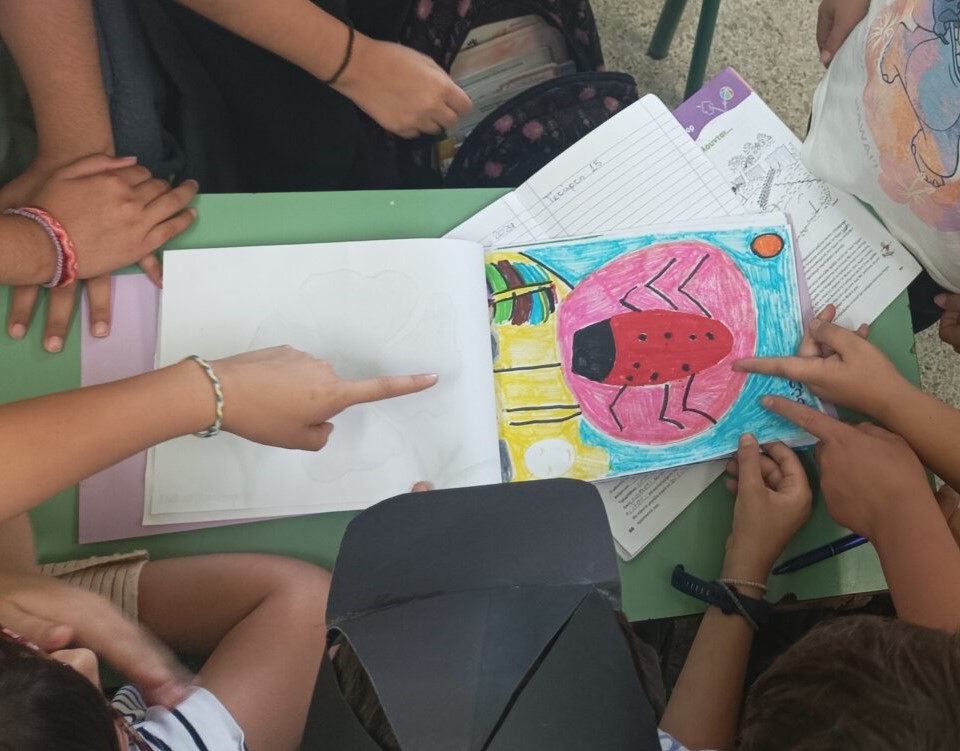
Ολοκληρώνοντας στο μάθημα των Αγγλικών το Πρόγραμμα Πολιτιστικών Θεμάτων/Αγωγής Υγείας με τίτλο «Φύγε άγχος, γίνε χρώματα!», ο εκπαιδευτικός κ. Παναγιώτης Βασιλείου μερίμνησε να έλθουμε σε επικοινωνία με το Κέντρο Δημιουργικής Απασχόλησης (ΚΔΑΠ) ΑμεΑ «Διάπλασις» του Πύργου Ηλείας και σήμερα μας παρουσίασε ένα υπέροχο λεύκωμα με ζωγραφιές των παιδιών.
Το ξεφυλλίσαμε με ενθουσιασμό! Διαβάσαμε πάλι το κείμενο Dolphin Therapy for Persons with Special Needs (Δελφινοθεραπεία για άτομα με ειδικές ανάγκες) και φορέσαμε τα χρωματιστά καπέλα μας για να εκφράσουμε τις σκέψεις μας και τα συναισθήματά μας, έχοντας εμπνευστεί από τα Έξι καπέλα της σκέψης.
Την κατασκευή των καπέλων επιμελήθηκε η εκπαιδευτικός κ. Ειρήνη Μπαζάρα και τη δημιουργία εικόνων μέσω Τεχνητής Νοημοσύνης ο εκπαιδευτικός κ. Κων/νος Βούλγαρης.
άσπρο: γεγονότα και πληροφορίες κόκκινο : συναισθήματα και αυθορμητισμός κίτρινο : αισιοδοξία και θετικότητα μαύρο : απαισιοδοξία και αρνητικότητα πράσινο: καινοτομία, νέες ιδέες και δημιουργικότητα μπλε : λογική επεξεργασία και ιεράρχηση προτεραιοτήτων
white : facts and information red : feelings and spontaneity yellow : optimism and positivity black : pessimism and negativity green : innovation, new ideas and creativity blue : logical processing and prioritization
Hi, I’m Kostas, short for “Constantine.” Born and raised in Athens, Greece,
I have studied English and Journalism (Σχολή Δημοσιογραφίας ANT1)
and I teach English at a state primary school in the Greek capital.
Wishing to provide my students with a wider view of the world, I am searching for interesting international opportunities to learn about different cultures and global issues.
Επιθυμώντας να προσφέρω στους μαθητές και τις μαθήτριές μου μία ευρύτερη θεώρηση του κόσμου, αναζητώ ευκαιρίες συνεργασίας στην Ελλάδα/Κύπρο και το εξωτερικό προκειμένου να μάθουμε μαζί για διαφορετικούς πολιτισμούς και να ενημερωθούμε για παγκόσμια θέματα.
Αυτόν τον κόσμο τον καλό
Νίκος Ξυλούρης (1936-1980)
Απ’ τ’ αεροπλάνο (Όταν κοιτάς από ψηλά)
Κώστας Χατζής (1936- )
Κάποτε ήθελα να γίνω… δημοσιογράφος!
Με κέρδισε όμως η Εκπαίδευση. 🙂
“The time is always right to do what is right.” — Martin Luther King, Jr.
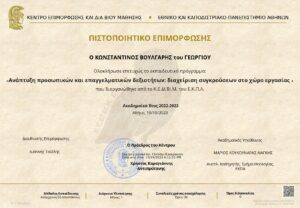
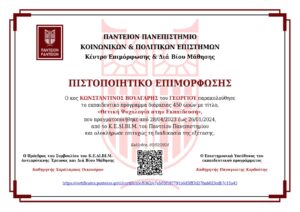
1. Teach.in.G. | Εκπαίδευση εκπαιδευτικών: Γλωσσική και ψυχοπαιδαγωγική διαχείριση πολύγλωσσων και πολυπολιτισμικών τάξεων 2. Ειδική Αγωγή: Διεπιστημονικές πρακτικές σύγκλισης 3. Ανάπτυξη προσωπικών και επαγγελματικών δεξιοτήτων: Διαχείριση συγκρούσεων στο χώρο εργασίας 4. Διαπροσωπικές σχέσεις: Το φαινόμενο της μοναξιάς στη σύγχρονη εποχή Διαχείριση και αντιμετώπιση 5. Από τη μία στην άλλη πλευρά του Αιγαίου: Η εγκατάσταση των Μικρασιατών προσφύγων στην Ελλάδα μέσα από τη λογοτεχνία 6. Θρησκεία και Ψυχανάλυση 7. Παραπληροφόρηση ή αληθινές ειδήσεις; Μάθετε να τα ξεχωρίζετε 8. Σπουδή στην Ορθόδοξη Θεολογία 9. Τα δικαιώματα του παιδιού 10. Philosophical Life Coaching
Πανεπιστήμιο Αιγαίου
1. Εκπαιδευτικός στον 21ο αιώνα: Πώς να ξεχωρίσω 2. Διαχείριση της πολυπολιτισμικότητας στην εκπαίδευση και κοινωνική ένταξη μεταναστών /προσφύγων 3. Σχολική Ψυχολογία 4. Ενδοσχολική βία και εκφοβισμός: Πρόληψη και αντιμετώπιση 5. Μέθοδοι της Μετασχηματίζουσας Μάθησης στο πλαίσιο της Διά Βίου Μάθησης
Ελληνικό Μεσογειακό Πανεπιστήμιο
Σύγχρονες αρχές και πρακτικές στην Ειδική Αγωγή και Εκπαίδευση
Διεθνές Πανεπιστήμιο της Ελλάδος
1. Σχολική Νοσηλευτική και Ψυχική Υγεία 2. Πρόληψη και αντιμετώπιση της επιθετικότητας στο σχολικό περιβάλλον: Εργαλεία και στρατηγικές διαχείρισης
Πάντειον Πανεπιστήμιο Κοινωνικών και Πολιτικών Επιστημών
1. Πρόληψη και αντιμετώπιση ρατσισμού
στα δημοτικά σχολεία 2. Θετική Ψυχολογία στην Εκπαίδευση 3. Ενισχύστε την εκπαίδευσή σας με τη δύναμη
της Τεχνητής Νοημοσύνης (AI)
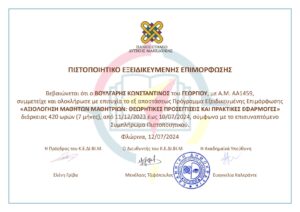
1. Αξιολόγηση μαθητών/μαθητριών: Θεωρητικές προσεγγίσεις και πρακτικές εφαρμογές 2. Έμφυλες σχέσεις και ενδυνάμωση μέσα από αφηγηματικές τεχνικές
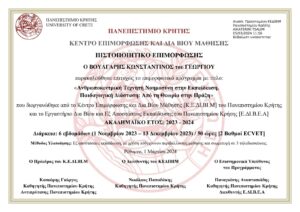
Πανεπιστήμιο Κρήτης
1. Ο/Η άνθρωπος-πολίτης/πολίτιδα απέναντι στο θάνατο και την απώλεια: Παιδαγωγικές και κοινωνικές προσεγγίσεις 2. Ανθρωποκεντρική Τεχνητή Νοημοσύνη στην Εκπαίδευση: Παιδαγωγική διάσταση
Από τη θεωρία στην πράξη 3. Γνωριμία με το Magic School στην εκπαιδευτική πράξη 4. LIFE on mARTs 5. Ανθρωποκεντρική Τεχνητή Νοημοσύνη στην Εκπαίδευση: Μετασχηματίζοντας τον τρόπο με τον οποίο διδάσκουμε και μαθαίνουμε
Δημοκρίτειο Πανεπιστήμιο Θράκης
1. Επιμορφώνοντας τους εκπαιδευτικούς στο Ολοκαύτωμα: Ανθρωπολογικές αναγνώσεις
του κινηματογράφου 2. Εισαγωγή στην αλβανική γλώσσα
Ελληνικό Ανοικτό Πανεπιστήμιο
1. Σπουδές στονΠοντιακό Ελληνισμό 2. STEAM Education for All Learners: Incorporating STEAM and Inclusive Education Practices in Everyday Teaching
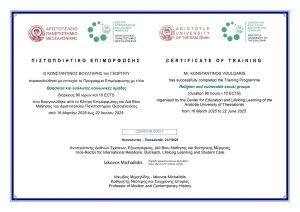
Αριστοτέλειο Πανεπιστήμιο Θεσσαλονίκης
Θρησκεία και ευάλωτες κοινωνικές ομάδες
Πανεπιστήμιο Ιωαννίνων
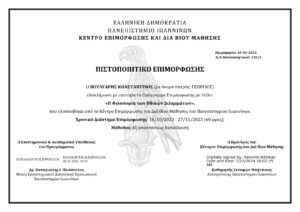
1. Ψυχολογικές προσεγγίσεις του παιδικού σχεδίου 2. Η Φιλοσοφία των Ηθικών Διλημμάτων
Πανεπιστήμιο Δυτικής Αττικής
Προαγωγή ψυχικής υγείας και ευεξίας
στα σχολεία: Well@School Project
Χαροκόπειο Πανεπιστήμιο
Αξιολόγηση του σχολείου, των εκπαιδευτικών
και ανάπτυξη βέλτιστων λεκπαιδευτικών πρακτικών
Ινστιτούτο Εκπαιδευτικής Πολιτικής
1. Επιμόρφωση των Εκπαιδευτικών
στις Δεξιότητες μέσω Εργαστηρίων 2. Εισαγωγή της Αγγλικής Γλώσσας
στο Νηπιαγωγείο (ΕΑΝ) 3. Αναπηρία και διαφορετικότητα, αυτιστικό φάσμα, προβλήματα προσοχής και συγκέντρωσης 4. Εκπαίδευση για την Ιδιότητα
του Παγκόσμιου Πολίτη Ευρωπαϊκό Έργο GENE
(Global Education Network Europe) 5. Διαφοροποιημένη Διδασκαλία: Πρακτικές υποστήριξης
των μαθητών και των μαθητριών 6. Πρόληψη και αντιμετώπιση περιστατικών ενδοσχολικής βίας και εκφοβισμού
Εθνικό Κέντρο Δημόσιας Διοίκησης και Αυτοδιοίκησης
1. Ανάπτυξη δεξιοτήτων των Παιδαγωγικών Συμβούλων-Μεντόρων 2. Ενεργητική ακρόαση και αποτελεσματική επικοινωνία
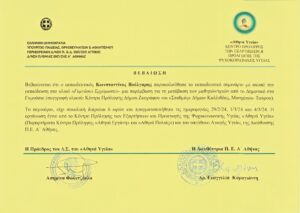
Κέντρο Πρόληψης «Αθηνά Υγεία»
1. Peer Support / Συμβουλευτική Ομηλίκων 2. Εκπαιδευτικός στην τάξη ξανά: Ενδυναμώνοντας τον εαυτό μου
και το ρόλο μου 3. — Γυμνάσιο, ερχόμαστε!
Μία παρέμβαση για τη μετάβαση των μαθητών/-τριών από το Δημοτικό στο Γυμνάσιο 4. Τεχνικές πρόληψης για παιδιά
1. Εκμάθηση βασικών τεχνικών NLP 2. Εκμάθηση προχωρημένων τεχνικών NLP 3. NLP – Ο Νευρογλωσσικός Προγραμματισμός στην Ψυχολογία
Ανοιχτή Τέχνη
Δημιουργική γραφή
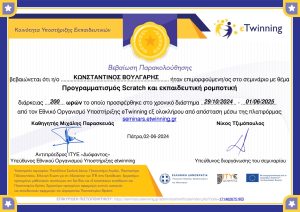
Εθνική Υπηρεσία Υποστήριξης eTwinning
Προγραμματισμός Scratch και εκπαιδευτική ρομποτική
eTwinning και Εργαστήρια Δεξιοτήτων: Συνεργατικές Δράσεις για την Καλλιέργεια Γνώσεων, Δεξιοτήτων και Ικανοτήτων
Εκπαιδευτική ρομποτική με το Edison
και για τις μικρότερες τάξεις:
Bee-Bot
Τα πολιτιστικά μου προγράμματα
1. Το δικό μας όνειρο 2. Αληθινή φιλία 3. Δύο ευγενικοί άνθρωποι 4. Ανακαλύπτω τον κόσμο της Ποίησης 5. Φύγε άγχος, γίνε χρώματα!
Έργα eTwinning
1. True Friends Forever 2. True Friends Forever | France and Greece 3. Be a European Star for a European Christmas 4. Comment fait-on la paix ? 5. Μαθαίνω να βλέπω τον Άνθρωπο | Learning to See the Person #SkillsLabs