
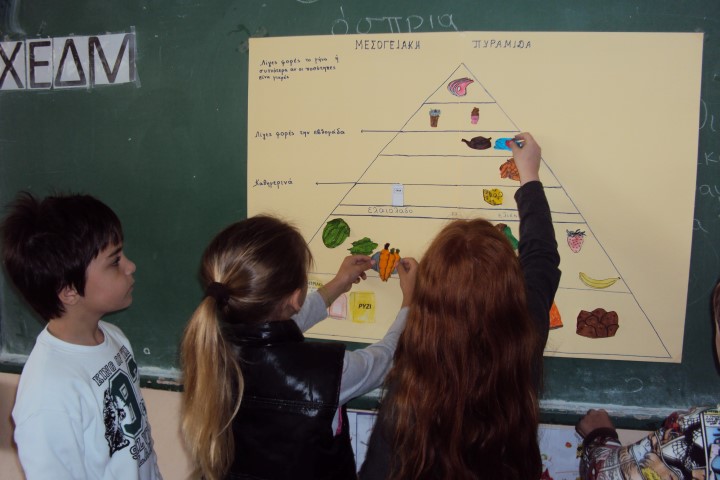
Σήμερα 23-04-13 στην Τρίτη τάξη (Γ2) της κυρίας Δέσποινας Ταμάμη οι μαθητές μαζί με τη φοιτήτρια Βένια Παπαμικρούλη που κάνει τις πρακτικές της στην τάξη μας κατασκεύασαν τη Μεσογειακή Πυραμίδα στο πλαίσιο του μαθήματος της Γλώσσας με θέμα τη διατροφή. Αφού έγινε μια προετοιμασία για το θέμα της διατροφής, οι μαθητές εργαζόμενοι ομαδικά ζωγράφισαν τρόφιμα, τα τοποθέτησαν στη σωστή θέση στην πυραμίδα και το ευχαριστήθηκαν. Η αφίσα δημιουργήθηκε με στόχο τη γνωριμία των παιδιών με τη Μεσογειακή διατροφή, το σημαντικό ρόλο που διαδραματίζει στην υγεία μας, τη Μεσογειακή πυραμίδα και των προϊόντων που περιλαμβάνει, καθώς και τη συχνότητα κατανάλωσης τους.




Απρ 25 2013
Ανανεώσιμες μορφές ενέργειας
Την Πέμπτη 4 Απριλίου 2013 επισκέφτηκε το σχολείο μας και συγκεκριμένα το Α1 Τμήμα της κυρίας Βασιλικής Ρεσβάνη μία ομάδα ειδικών, οι οποίοι παρουσίασαν στα παιδιά ανανεώσιμες μορφές ενέργειας. Οι μικροί μαθητές άκουσαν, προβληματίστηκαν και στη συνέχεια ζωγράφισαν και κατασκεύασαν όμορφους ανεμόμυλους. Ήταν μία καλή εμπειρία για τους μαθητές. Ευχαριστούμε πολύ την υπεύθυνη των περιβαλλοντικών προγραμμάτων κυρία Πηνελόπη Σακοβέλη για την πρωτοβουλία αυτή.


Απρ 24 2013
El Bandoler Serralonga
El Bandoler Serralonga
Greek version of the story
Μια φορά και έναν καιρό στην Ισπανία, σε ένα εγκαταλελειμμένο σπίτι ζούσε ο Serrallonga με την γυναίκα του και τους 12 ληστές της συμμορίας του.
Ο Serrallongia μαζί με τη γυναίκα του ζούσανε ληστεύοντας τις τράπεζες. Το όνειρό τους ήταν να γίνουν πλούσιοι. Ο Serrallonga δεν ήθελε να χαλάει χατίρι στη γυναίκα του επειδή του ζητούσε πολλά πράγματα και έτσι αναγκάστηκε να ληστεύει τράπεζες.
Ήταν ο αρχηγός της συμμορίας επειδή τους είχε αποδείξει ότι είναι ο δυνατότερος και ο πιο ατρόμητος. Αυτός πρώτος είχε οργανώσει τη «συμμορία των 12». Όλα τα μέλη της συμμορίας του τον σέβονταν και τον φοβούνταν, γιατί ήταν ο πιο δυνατός και ο πιο ατρόμητος από την συμμορία.
Μια μέρα πήγαν να κάνουν ένα πολύ τολμηρό πράγμα, να κλέψουν τη μεγαλύτερη τράπεζα της περιοχής. Στη ληστεία αυτή ο Serrallonga ζήτησε τη βοήθεια της γυναίκας του. Θα προσπαθούσε να αποσπάσει την προσοχή των φρουρών της τράπεζας. Η γυναίκα του θα έδινε ένα ψεύτικο μωρό σε έναν ληστή της συμμορίας και θα φώναζε: «μου έκλεψαν το παιδί μου! Μου έκλεψαν το παιδί μου!»Αφού οργάνωσαν καλά το σχέδιο, πήγαν να το βάλουν σε εφαρμογή.
Αργά το απόγευμα βρέθηκαν όλοι έξω από την τράπεζα και ήξεραν τι θα κάνει ο καθένας ακριβώς. Η γυναίκα φορώντας ένα μαντίλι στο κεφάλι είχε στα χέρια το ψεύτικο μωρό. Το έδωσε στο ληστή, όταν δεν την κοίταζαν οι φρουροί.
Άρχισε να κλαίει και να φωνάζει: «Βοήθεια! Βοήθεια! μου έκλεψαν το παιδί!»
Οι φρουροί αναστατώθηκαν και αμέσως έτρεξαν να βοηθήσουν. Έτσι, άφησαν ακάλυπτη την τράπεζα. Ο Serrallonga και οι υπόλοιποι ληστές μόλις είδαν το πεδίο ελεύθερο, μπήκαν και έκαναν βιαστικά τη δουλειά τους.
Οι φρουροί έπιασαν το ληστή με το ψεύτικο μωρό και αντιλήφθηκαν την απάτη. Γύρισαν τρέχοντας πίσω στην αφύλαχτη τράπεζα.
Εκεί οι φρουροί περικύκλωσαν τους ληστές και το Serrallonga. Ο Serrallonga όμως είδε την τελευταία στιγμή ένα μυστικό πέρασμα που οδηγούσε σε ένα λαγούμι.
Τρέχουν στο λαγούμι ασταμάτητα. Ξαφνικά βλέπουν φως! Χάρηκαν γιατί νόμιζαν ότι βρήκαν μία έξοδο που θα τους οδηγούσε στην ελευθερία και μακριά από τους φρουρούς.
Πλησιάζουν, πλησιάζουν και τι να δουν!!! Βρίσκονται σε ένα μπουντρούμι!
Έτσι λοιπόν έληξε άδοξα η δράση της συμμορίας του Serrallonga. Τους πήραν τα λεφτά και έμειναν εκεί για πάντα…..
The bandit Serrallonga
Once upon a time in Spain, there was Serrallonga and his wife Margarida who lived in a ruined house together with the 12 bandits of Serrallonga’s gang.
Serrallonga and his wife made their living by robbing banks. Their dream was to become rich. Serrallonga’s wife was very spoiled and always wished for a lot of things so her husband was forced to rob banks to make his wife’s wishes true.
He was the leader of the gang because he had proven to be the strongest and the most fearless of all. He was the one that had formed the “gang of 12”. All the members of the gang respected and feared him since he was the mightiest of all.
One day the gang decided to do a very risky thing: rob the largest bank in the area. Serrallonga asked for his wife’s help. She would distract the guards of the bank. The plan was that Margarida would give a baby doll to a bandit of the gang and then she would shout: “Help! He took my baby!” Everything was planned to the last detail and the gang was ready to go ahead.
Late in the evening they arrived at the bank. Each one knew exactly what to do. The woman, wearing a head scarf, was holding the baby doll. She gave it to the bandit when the guards were not looking at them, and then started crying and shouting: “Help!Help!My baby has been stolen!”
The guards came to help leaving the bank unattended. With no one to stop them, Serrallonga and his gang went inside the bank and took all the money.
Meanwhile, the guards managed to capture the bandit with the baby and realized that they had been deceived. They hurried back to the bank.
There, the guards surrounded Serrallonga and his gang. Suddenly, Serrallonga saw a secret passage that led to an underground tunnel. The bandits started to run without looking back. Then, they saw a light! They felt excited because they thought they found their way out and managed to escape.
When they came closer to the light, they realized that the tunnel led to a dungeon! And this is how the gang ended up in prison. The guards took back all the money and the bandits stayed in the dungeon forever…


Απρ 22 2013
Παραμύθι για το πρόγραμμα Comenius από το Δ1
Το Δ1 στο πλαίσιο του προγράμματος Comenius ολοκλήρωσε τη συγγραφή ενός παραμυθιού με τίτλο: « The enormous turnip ». Παρακάτω αναγράφεται το παραμύθι στην αγγλική γλώσσα.
The enormous turnip
Once upon a time there lived an old couple. They lived in a small wooden house in a green meadow. The old man, a long time ago, had planted a lot of turnips in the meadow. The couple was poor so their only food was the vegetables and fruit from their garden.
A winter Sunday afternoon, it was raining heavily and the water swept away all the turnips in the centre of the meadow. They all joined together and they formed a huge turnip, the biggest of all!
The next morning, the old man woke up and saw the turnip. He couldn’t believe his eyes! He immediately shouted out to his wife “ I need your help to uproot it! My back hurts, the aspirin did not help much!’ The old lady came out of the house looking worried.
-What do you want to uproot?’
-‘Our enormous turnip’ he answered.
-‘How on earth did that happen?’
-‘I have no idea, it happened at night’
And then they started pulling. They pulled and pulled and pulled again but the turnip wouldn’t come out. A girl, who happened to pass by, saw them and decided to help. A boy helped them, too. Even the dog together with a cat and the mouse stopped chasing each other and gave a hand. Finally, the turnip came out of the ground. When they saw it, they shouted all together ‘wow, what a huge turnip!’
Then the old lady had an idea: ‘I found it!’ she said. ‘We should take it to the feast of the village and sell it!’ They believed that in this way they would make some money.
Everyone in the feast bought a piece of the turnip and the old couple managed to gather a lot of money. Of course they kept some pieces for them to eat when they were hungry.
The money they got lasted for their whole life. As time went by, the story of the enormous turnip started to fade out. However, the old couple never forgot about it. And so, they lived happily ever after!