Get your facts right!

If you are on social media, you have certainly heard of ‘fake news’ or ‘Internet hoaxes’. How much do you really know about these terms?

Let’s take a short quiz:

  • Do you often share stories that seem strange, unbelievable or that make you feel angry or upset?
  • Would you share a news item without checking the source?
  • Does this URL seem to be a trustworthy website: crazymonkeyblogspot85.com.co ?
  • Do you think an image can provide solid evidence for a particular news item?
  • If a well-known journalist reports something is it necessarily a fact?

If you have answered ‘YES’ in most of the questions above, then you need to learn more about how to spot fake news.

Here’s a useful video lesson by the British Council website to help you spot fake news while practising some useful language.

Video lesson: Five ways to spot fake news

There has recently been a lot of misinformation and disinformation regarding the new coronavirus disease on the media. Some commentators are now referring to this avalanche of false information as a ‘disinfodemic’, which is as dangerous (if not more) as the pandemic itself. Organizations such as UNESCO and the World Health Organization (WHO) are making constant efforts to prevent the spreading of misleading rumours and promote the facts about the virus.

How much do you know about coronavirus disease? Are you confused about opposing views or not sure whether a rumour is a myth or a fact? Where can you get reliable information about the pandemic?

Here is your place to start!

CORONAVIRUS: MYTHS & FACTS

Explore this interactive poster to debunk some myths and learn all you need to know about coronavirus. Do a quiz, watch videos, get answers to your questions from trusted sources and have fun! Be informed and stay safe!
We can be heroes!

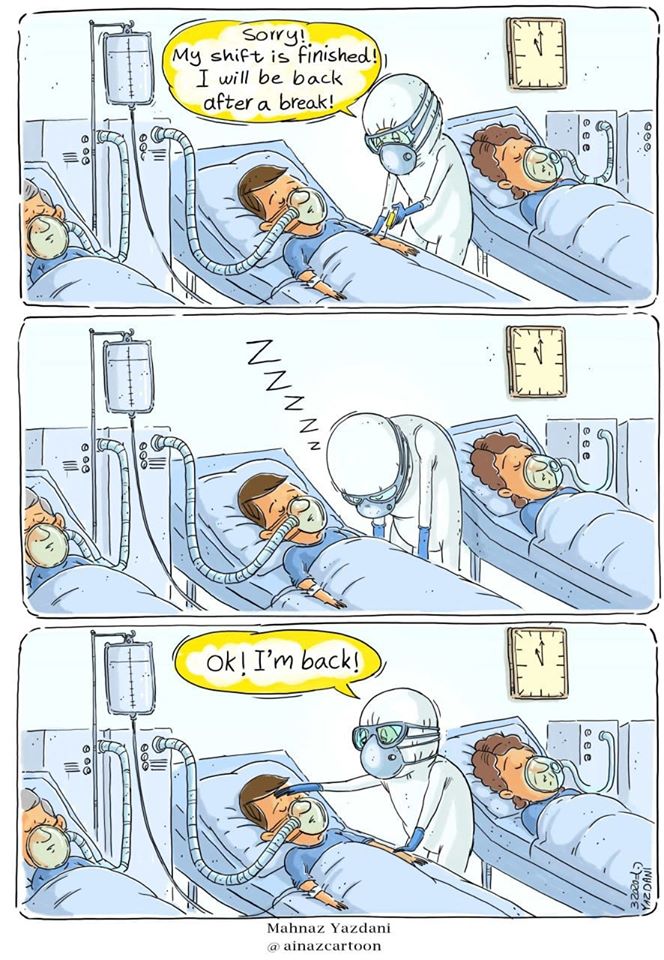
Real heroes don’t wear capes. In fact, they look nothing like the glamorous superheroes we see in the movies. They are all around us, exhausted, dirty and sometimes scared. However, these ordinary people, whose names will never become famous, are the ones who work day and night, trying their best and even risking their lives to support us during this difficult time of crisis. This lesson  is my small tribute to them.
I thought it would be suitable to start with a favourite song of mine, David Bowie’s Heroes.

Heroes BowieListen to the song and complete the lyrics here.

Then,  read the background information about the song and fill in the missing prepositions. In what ways do you think this song could be relevant to coronavirus crisis?

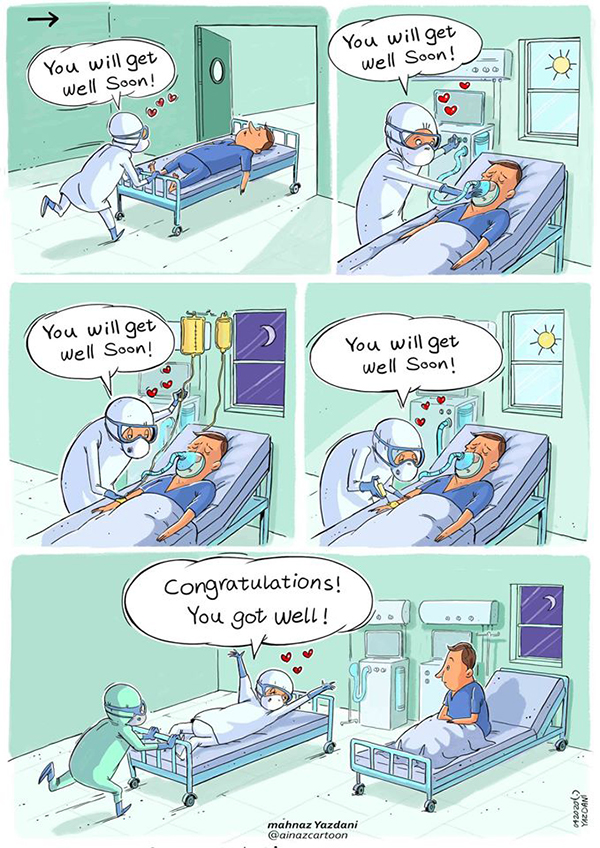
Maybe the following comic strips by Iranian cartoonist and screenplay writer Mahnaz Yazdani might help you think a bit. The reason why these comic strips that Yazdani posted on Facebook and Instagram have gone viral is obvious: they send a powerful message about the real heroes around us in the most sensitive way.

So, why don’t you too pay a small tribute to these courageous frontline workers by adding a post on this padlet? Follow the link and post a story, an article or a message about these unsung heroes!


Get it off your chest!

The past few weeks have been really… should I say ‘weird’? It’s really hard to find a single word to describe one’s feelings during this difficult time. When school closure due to coronavirus was first announced, my kids jumped for joy! I can’t say I was sorry either; I would finally be able to do the things I had been putting off for quite some time, let alone relax at home a bit. (God knows I needed that!) Soon, the little ones started complaining about not seeing their friends, about Internet disconnections and so on… Then came boredom, anxiety about the whole situation getting out of control and, at times, fear about the ‘unknown enemy’. As a teacher I had to adapt to the new ‘distance teaching’ idea and somehow make it work. Confusion and curiosity soon gave place to disappointment and anger, when the online teaching platforms didn’t work as they were supposed to. I’ve been looking for alternatives and trying my best, but my best is still not good enough…
What about you? Can you find the right words to describe your emotions during the past few weeks? Experts say that in difficult situations like this, talking to people about your worries, in other words, “getting it off your chest” is the best way to keep your mental balance.

Here are some tips for teenagers that Unicef offers in order to protect their mental health during coronavirus. Read the following article then do a matching quiz.

Vocabulary: Feelings and emotions

  1. First take a short quiz to check your vocabulary knowledge.
  2. Which of the words in the box below express how you are feeling at the moment?
    anxious  lonely   bored   calm   hopeful   angry
    disappointed  sad   isolated  optimistic  scared
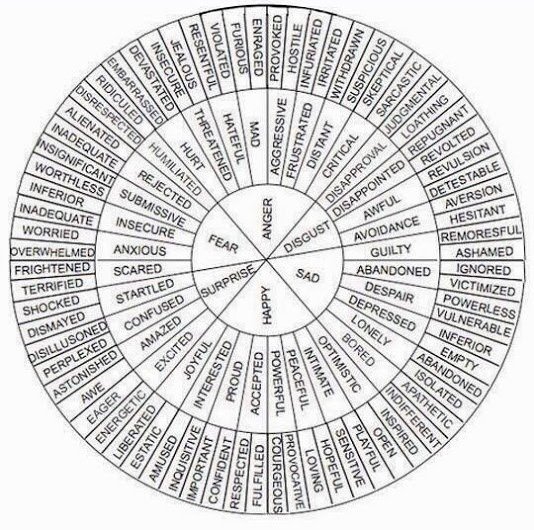
  3. Find the right words to talk about your feelings. Look at this chart.


  • In the inner circle you can find 6 basic emotional states:
    happy / sad / disgust / anger / fear / surprise
  • The middle circle includes different types of happiness, sadness, disgust, anger, fear and surprise, ranging from mild emotions (not so strong) such as ‘bored’ to intense emotions (much stronger) such as ‘despair’.
  • The outer circle gives you with synonyms for the emotional states in the middle circle.

Your turn

  1. Ask yourself: How am I feeling today? Choose one of the basic emotions in the inner circle and answer the question, e.g. I’m feeling happy.
  2. Ask yourself: Happy, in what way? Choose a word from the middle circle, e.g. I’m feeling optimistic.
  3. Ask yourself: Why am I feeling optimistic? Answer by choosing a word from the outer circle, e.g. I’m feeling inspired by the brave doctors and nurses fighting to heal the world.

Look up any unknown words in this online dictionary.

Source used for this activity: ‘Talking about emotions and feelings’
https://britishenglishcoach.com/talking-about-emotions-and-feelings/


So how are you feeling today?

Write a sentence, a paragraph or if you don’t feel like it, draw something, sing a song or talk to a friend. In any case, don’t forget: you are not alone!


Get informed about coronavirus by taking these online quizzes on globalcitizen.org:

Coronavirus shutdown: How do teenagers feel about life at home?

Hello everyone!

I hope you are all doing well. School closure due to Coronavirus outbreak is obviously not a holiday, but nevertheless, it has offered us plenty of free time to do things we didn’t have the time to do before. Some people see it as a ‘blessing in disguise’, while others as a curse. How do teens feel about life at home during this quarantine? Read the stories teenagers from different parts of the US submitted on Facebook and answer the questions that follow.

Reading

Article: 12 Teens On Being Stuck At Home Because Of The Coronavirus

Scan the text above and do this matching exercise.

Vocabulary

Do this gap-filling exercise and learn some Coronavirus buzzwords.

So, what about you? Submit your own story about what life at home has been like for you so far in the comments section below.

And remember: Stay home, stay SAFE!


What would you think if you saw this 99-year-old man begging?

dobri1You would probably feel sorry for him, having to beg at that age. However, Bulgarian Dobri Dimitrov Dobrev, also known as Grandpa Dobri or Elder Dobri, is not an ordinary beggar. He walks several kilometers every day to sit in front of the Cathedral of Alexander Nevsky in Sofia to beg for money. But what really makes the difference is that he doesn’t keep any of this money for himself! What does he do with it then? He gives it all to charities, orphanages, churches and monasteries, while he manages to live with only an 80 euros pension a month!

Elder Dobri, who will be 100 years old on 20th July 2014, has lived through both world wars. His father died in World War I, and in one of the bombings of Sofia during World War II, a shell fell near him and he lost almost all his hearing.

dobri2Around year 2000, he decided to donate all his belongings to the church and now he lives in a small extension to the church “Sts. Cyril and Methodius” in the village of Baylovo. Over the years, “the saint of Baylovo”, as many people call him, has donated every single penny he has collected, which makes over 40,000 euros! A true saint? In our material world, Grandpa Dobri is definitely a role model for everyone.


Shake, rattle and rock!

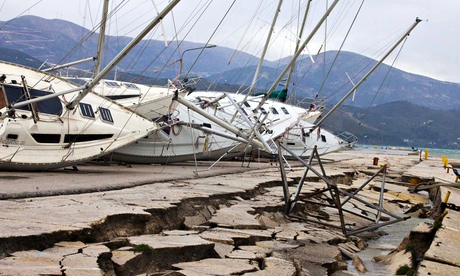
Earthquake damage at Lixouri port on Kefalonia. Photograph: AP

Wednesday, 5th March, 2.50 p.m. Here it comes again. First, the rumbling sound, then the tremor. I freeze for a few seconds. My son’s at school. We call them to see if the kids are all right. “Don’t worry, the children are all safe, outside”, says the head teacher. Then, I go online. It was a 4.8 earthquake on the Richter scale this time.

After two major earthquakes and more than 2.500 aftershocks within a month, the earth still rocks on the island of Kefalonia. Buildings have been damaged, roads have cracked, people have been left homeless. Fortunately, there were no casualties or serious injuries. It seems Saint Gerasimos has protected his people once again.

Most of us, in Kefalonia, have almost become used to the daily tremors by now. However, do we really know how to protect ourselves during an earthquake or have we just been lucky?

What did I do when the first big earthquake happened on January 26th? I stood under a doorway, holding my 6-year-old son tight in my arms. He asked me to hide under the dinner table, but I was too scared to let him go. Then, while the ground was still shaking, we ran together to the other side of the house where my younger boy was still sleeping in his bedroom. Again, we stood in the doorway and waited until the earthquake stopped. Did I do the right thing? Well, actually, everything I did was wrong! Why? Watch the following video and find out!

Which 3 things can save your life during an earthquake? Are your reactions the right ones?


Αλλαγή μεγέθους γραμματοσειράς
Αντίθεση