
 The past few weeks have been really… should I say ‘weird’? It’s really hard to find a single word to describe one’s feelings during this difficult time. When school closure due to coronavirus was first announced, my kids jumped for joy! I can’t say I was sorry either; I would finally be able to do the things I had been putting off for quite some time, let alone relax at home a bit. (God knows I needed that!) Soon, the little ones started complaining about not seeing their friends, about Internet disconnections and so on… Then came boredom, anxiety about the whole situation getting out of control and, at times, fear about the ‘unknown enemy’. As a teacher I had to adapt to the new ‘distance teaching’ idea and somehow make it work. Confusion and curiosity soon gave place to disappointment and anger, when the online teaching platforms didn’t work as they were supposed to. I’ve been looking for alternatives and trying my best, but my best is still not good enough…
What about you? Can you find the right words to describe your emotions during the past few weeks? Experts say that in difficult situations like this, talking to people about your worries, in other words, “getting it off your chest” is the best way to keep your mental balance.
Here are some tips for teenagers that Unicef offers in order to protect their mental health during coronavirus. Read the following article then do a matching quiz.
Vocabulary: Feelings and emotions
- First take a short quiz to check your vocabulary knowledge.
- Which of the words in the box below express how you are feeling at the moment?
anxious lonely bored calm hopeful angry
disappointed sad isolated optimistic scared - Find the right words to talk about your feelings. Look at this chart.
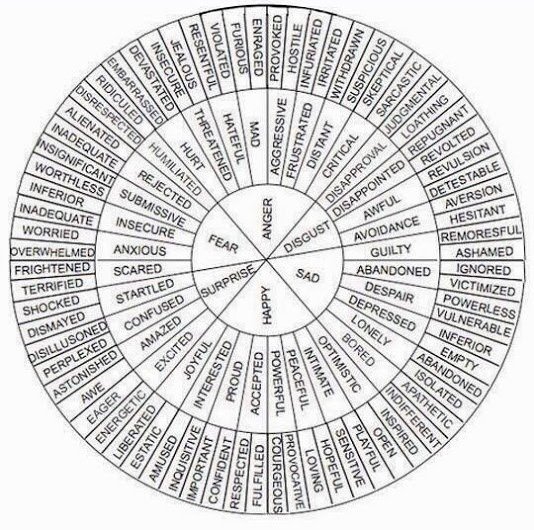
- In the inner circle you can find 6 basic emotional states:
happy / sad / disgust / anger / fear / surprise - The middle circle includes different types of happiness, sadness, disgust, anger, fear and surprise, ranging from mild emotions (not so strong) such as ‘bored’ to intense emotions (much stronger) such as ‘despair’.
- The outer circle gives you with synonyms for the emotional states in the middle circle.
Your turn
- Ask yourself: How am I feeling today? Choose one of the basic emotions in the inner circle and answer the question, e.g. I’m feeling happy.
- Ask yourself: Happy, in what way? Choose a word from the middle circle, e.g. I’m feeling optimistic.
- Ask yourself: Why am I feeling optimistic? Answer by choosing a word from the outer circle, e.g. I’m feeling inspired by the brave doctors and nurses fighting to heal the world.
Look up any unknown words in this online dictionary.
Source used for this activity: ‘Talking about emotions and feelings’
https://britishenglishcoach.com/talking-about-emotions-and-feelings/
 So how are you feeling today?
Write a sentence, a paragraph or if you don’t feel like it, draw something, sing a song or talk to a friend. In any case, don’t forget: you are not alone!
Get informed about coronavirus by taking these online quizzes on globalcitizen.org:
 Hello everyone!
 Είναι γεγονός ότι το κλείσιμο των σχολείων, όπως και η γενικότερη κατάσταση που επικρατεί παγκοσμίως λόγω της ραγδαίας εξάπλωσης του κορονοϊού, έχουν αλλάξει την καθημερινότητα όλων μας. Ως εκπαιδευτικοί, προσπαθούμε να προσαρμοστούμε στα νέα δεδομένα και να συνεχίσουμε το έργο μας με σκοπό να διατηρήσουν οι μαθητές την επαφή με την εκπαιδευτική διαδικασία αλλά και την εκπαιδευτική κοινότητα. Εκμεταλλευόμενοι τις δυνατότητες της εξ’αποστάσεως εκπαίδευσης και ακολουθώντας τις οδηγίες του Υπουργείου καταβάλλουμε κάθε δυνατή προσπάθεια να έρθουμε σε επαφή με τους μαθητές και να δημιουργήσουμε ένα περιβάλλον μάθησης και επικοινωνίας χρησιμοποιώντας τα ψηφιακά εργαλεία που έχουμε στη διάθεσή μας.