Lord Byron’s last poem: Missolonghi

640px-Lord_Byron_on_his_Death-bed_c__1826


If someone asked you to name a famous philhellene, the first name that would come to your mind would be that of Lord Byron. George Gordon Byron, one of the greatest British Romantic Poets, is also revered as a national hero by Greek people. On 4th August 1823, he arrives at Kefalonia, in the Ionian Islands, to join the Greek revolutionaries in their war of independence from the Ottoman Empire. A few months later, on 19th April 1824, he dies of fever in Missolonghi. Two months before his death, on his 36th birthday, he composes his last poem…

January 22nd,  Missolonghi

On this Day I Complete my Thirty-Sixth Year

‘Tis time this heart should be unmoved,
       Since others it hath ceased to move:
Yet though I cannot be beloved,
                                    Still let me love!


   My days are in the yellow leaf;
       The flowers and fruits of Love are gone;
The worm—the canker, and the grief
                                    Are mine alone!


   The fire that on my bosom preys
       Is lone as some Volcanic Isle;
No torch is kindled at its blaze
                                    A funeral pile.


   The hope, the fear, the jealous care,
       The exalted portion of the pain
And power of Love I cannot share,
                                    But wear the chain.


   But ’tis not thus—and ’tis not here
       Such thoughts should shake my Soul, nor now,
Where Glory decks the hero’s bier,
                                    Or binds his brow.


   The Sword, the Banner, and the Field,
       Glory and Greece around us see!
The Spartan borne upon his shield
                                    Was not more free.


   Awake (not Greece—she is awake!)
       Awake, my Spirit! Think through whom
Thy life-blood tracks its parent lake
                                    And then strike home!


   Tread those reviving passions down
       Unworthy Manhood—unto thee
Indifferent should the smile or frown
                                    Of beauty be.


   If thou regret’st thy Youth, why live?
       The land of honourable Death
Is here:—up to the Field, and give
                                    Away thy breath!


   Seek out—less often sought than found—
       A Soldier’s Grave, for thee the best;
Then look around, and choose thy Ground,
                                    And take thy rest.
Missolonghi, 1824
Source: The Longman Anthology of Poetry (2006)


For a Greek translation of the poem click here.


Listen to the poem here:

A poem against racism

21 March is International Day for the Elimination of Racial Discrimination (proclaimed by United Nations in 1966), a day when people around the world show their opposition to racism.  On that day, in 1960, police opened fire and killed 69 people at a peaceful demonstration in Sharpeville, South Africa,  against the Apartheid regime (a regime which embraced racial discrimination). The same day, however, was also declared World Poetry Day by UNESCO in 1999. The purpose of the day is to promote the reading, writing, publishing and teaching of poetry throughout the world.

(Source: Wikipedia

http://en.wikipedia.org/wiki/International_Day_for_the_Elimination_of_Racial_Discrimination

http://en.wikipedia.org/wiki/World_Poetry_Day)


In order to celebrate this special day, three of my students, Sofia, Zoe and Sotiria, helped me write a poem against racism. Here it is:

It doesn’t matter

It doesn’t matter

What colour your skin is,

As long as you stand

By my side


It doesn’t matter

What your origin is,

Because your heart

Beats like mine


It doesn’t matter

What your religion is,

As long as I know

You respect mine


We both breathe the same air,

We both have a red heart,

My friend


It doesn’t matter

What language you speak,

As long as your eyes

Are true


And it doesn’t matter

What God you believe in,

As long as you pray

For me too.


We share the same earth

We share the same sky,

My friend


And nothing else matters,

My friend


What would you think if you saw this 99-year-old man begging?

dobri1You would probably feel sorry for him, having to beg at that age. However, Bulgarian Dobri Dimitrov Dobrev, also known as Grandpa Dobri or Elder Dobri, is not an ordinary beggar. He walks several kilometers every day to sit in front of the Cathedral of Alexander Nevsky in Sofia to beg for money. But what really makes the difference is that he doesn’t keep any of this money for himself! What does he do with it then? He gives it all to charities, orphanages, churches and monasteries, while he manages to live with only an 80 euros pension a month!

Elder Dobri, who will be 100 years old on 20th July 2014, has lived through both world wars. His father died in World War I, and in one of the bombings of Sofia during World War II, a shell fell near him and he lost almost all his hearing.

dobri2Around year 2000, he decided to donate all his belongings to the church and now he lives in a small extension to the church “Sts. Cyril and Methodius” in the village of Baylovo. Over the years, “the saint of Baylovo”, as many people call him, has donated every single penny he has collected, which makes over 40,000 euros! A true saint? In our material world, Grandpa Dobri is definitely a role model for everyone.


Women have the power!

Emmeline Pankhurst,  a British political activist and leader of the British suffragette movement who helped women win the right to vote. Here, she is arrested by police outside Buckingham Palace in May 1914.
Emmeline Pankhurst, a British political activist and leader of the British suffragette movement who helped women win the right to vote. Here, she is arrested by police outside Buckingham Palace in May 1914.

On 8th March every year, women all around the world celebrate International Women’s Day. It is a day to remember the struggles of women for social and political rights and equality.


A bit of history…

The idea of an International Women’s Day dates back to the turn of the 20th century. At that time, factory workers in many countries protested over bad working conditions and low wages. On 8th March 1857 women from clothing factories organised one such protest in New York City. In 1910, the first international women’s conference in Copenhagen established an International Women’s Day to celebrate the movement for women’s rights and to help gain women’s right to vote. In Russia demonstrations on International Women’s Day were the first stage of the Russian Revolution of 1917.

So how do women celebrate International Women’s Day?

In most countries around the world on Women’s Day, men give their mothers, wives, girlfriends, etc. flowers or gifts. Women’s groups around the world organise different events, such as political rallies, theatrical performances, fashion shows and more. In some countries of the former Soviet Union, such as Russia, Bulgaria and Ukraine, it is an official holiday!

A women's rally in India on International Women’s Day.
A women’s rally in India on International Women’s Day.


What about the future?

Women have won many battles over the years. But there is still a long way to go. Equal opportunities to work and education are still a dream for millions of women. Organisations, such as the The Girl Effect (www.girleffect.org), help women around the world make this dream come true.

Do women really have the power to change the world? Watch the video and say if you agree!

Shake, rattle and rock!

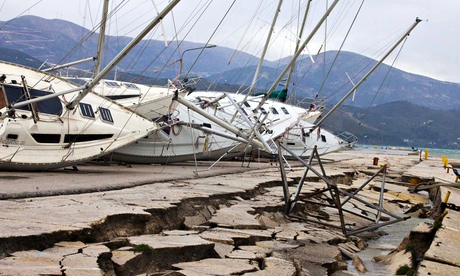
Earthquake damage at Lixouri port on Kefalonia. Photograph: AP

Wednesday, 5th March, 2.50 p.m. Here it comes again. First, the rumbling sound, then the tremor. I freeze for a few seconds. My son’s at school. We call them to see if the kids are all right. “Don’t worry, the children are all safe, outside”, says the head teacher. Then, I go online. It was a 4.8 earthquake on the Richter scale this time.

After two major earthquakes and more than 2.500 aftershocks within a month, the earth still rocks on the island of Kefalonia. Buildings have been damaged, roads have cracked, people have been left homeless. Fortunately, there were no casualties or serious injuries. It seems Saint Gerasimos has protected his people once again.

Most of us, in Kefalonia, have almost become used to the daily tremors by now. However, do we really know how to protect ourselves during an earthquake or have we just been lucky?

What did I do when the first big earthquake happened on January 26th? I stood under a doorway, holding my 6-year-old son tight in my arms. He asked me to hide under the dinner table, but I was too scared to let him go. Then, while the ground was still shaking, we ran together to the other side of the house where my younger boy was still sleeping in his bedroom. Again, we stood in the doorway and waited until the earthquake stopped. Did I do the right thing? Well, actually, everything I did was wrong! Why? Watch the following video and find out!

Which 3 things can save your life during an earthquake? Are your reactions the right ones?


Αλλαγή μεγέθους γραμματοσειράς
Αντίθεση