[slideboom id=1237306&w=425&h=370]
A Class Project-Poetry In Motion
Μάι 201520
ΥΛΗ Β’ ΛΥΚΕΙΟΥ-ΑΓΓΛΙΚΑ
Μάι 201520
Take Off!!! CEF Level:B2
Student’s Book:
Units 5, 6, 7, 8
Όλα τα γραμματικά και λεξιλογικά φαινόμενα των κεφαλαίων αυτών και οι χρόνοι που έγιναν επαναληπτικά.
Από το Workbook οι αντίστοιχες ασκήσεις των Units 5, 6, 7, 8.
I Love Poetry
Μαρ 201521


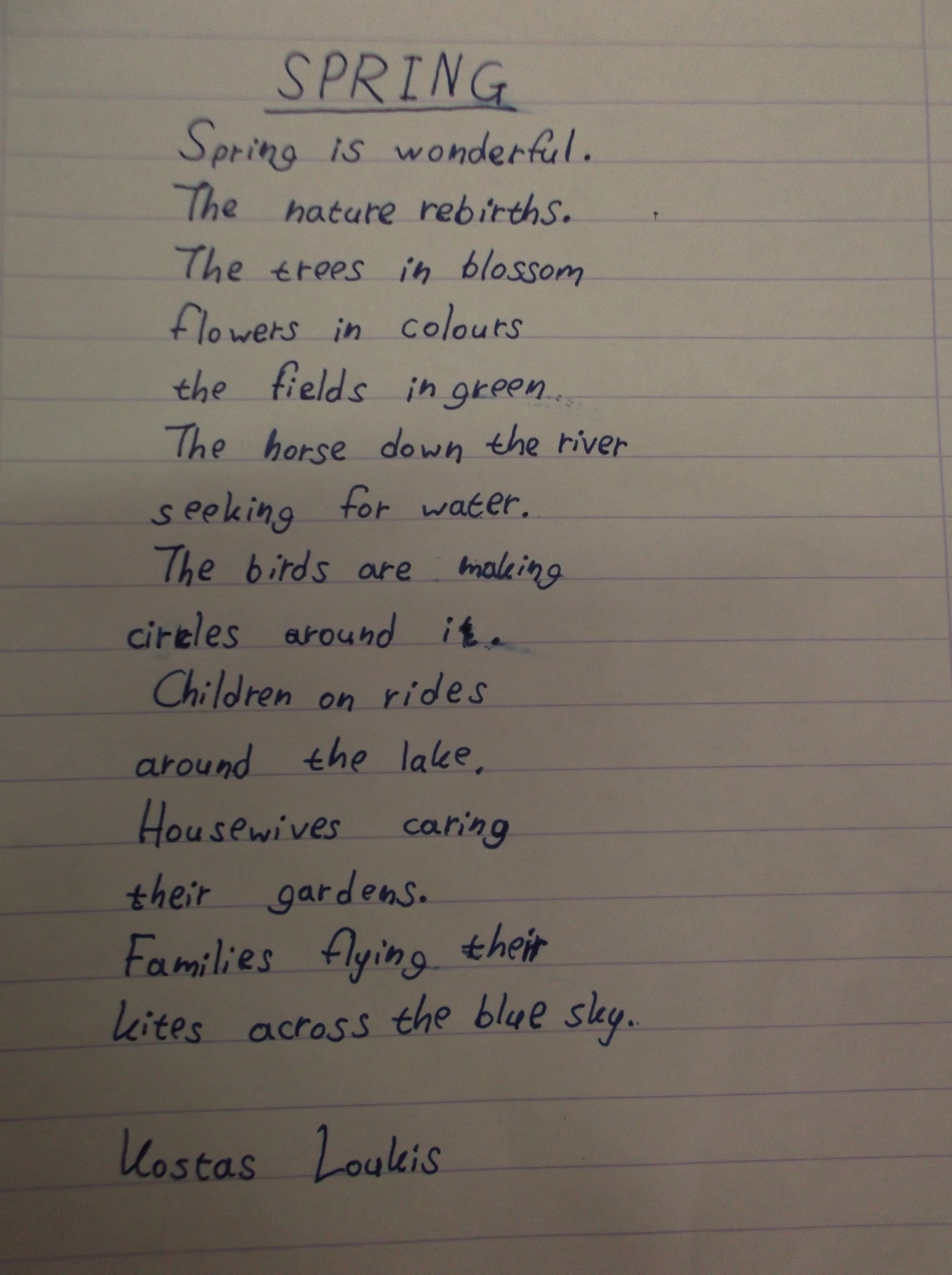
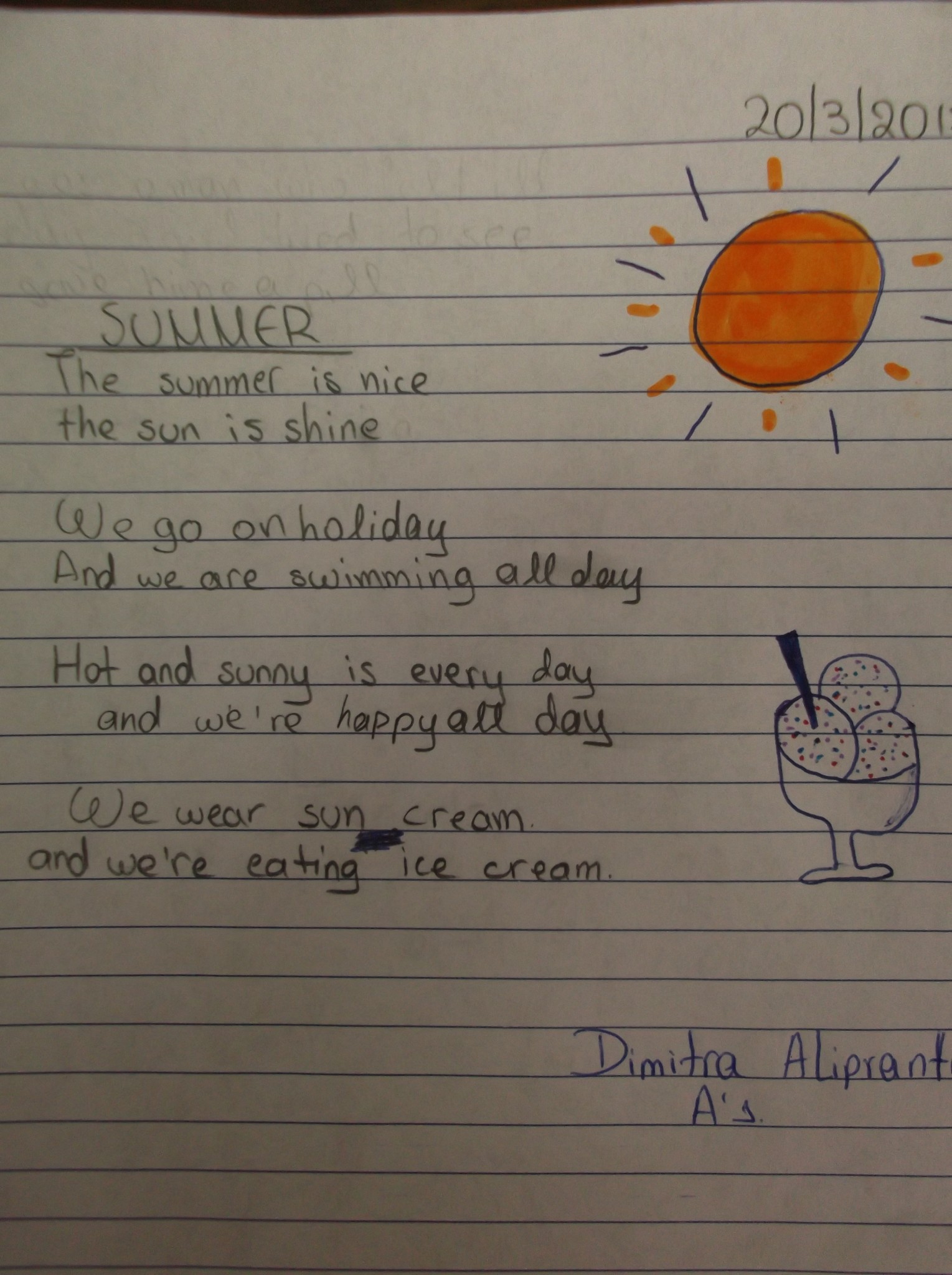
March 21st is World Poetry Day. Taking advantage of our lesson, my A ‘ Class Avanced Students looked at William Shakespeare’s sonnets: a poem of an expressive thought or idea made up of 14 lines, each being 10 syllables long. Its rhymes are arranged in three quatrains followed by a rhyming couplet- ab ab, cdcd, efef, gg
I asked my students to try and write a poem; nothing difficult just to express themselves in writing. Of course, a sonnet would have been difficult to write, so we decided that free verse would be best. There were some students who told me that poetry writing was not their thing, so I let them draw what they wanted to express. Let’s see how they expressed themselves!






Who was this person?
Μαρ 201518
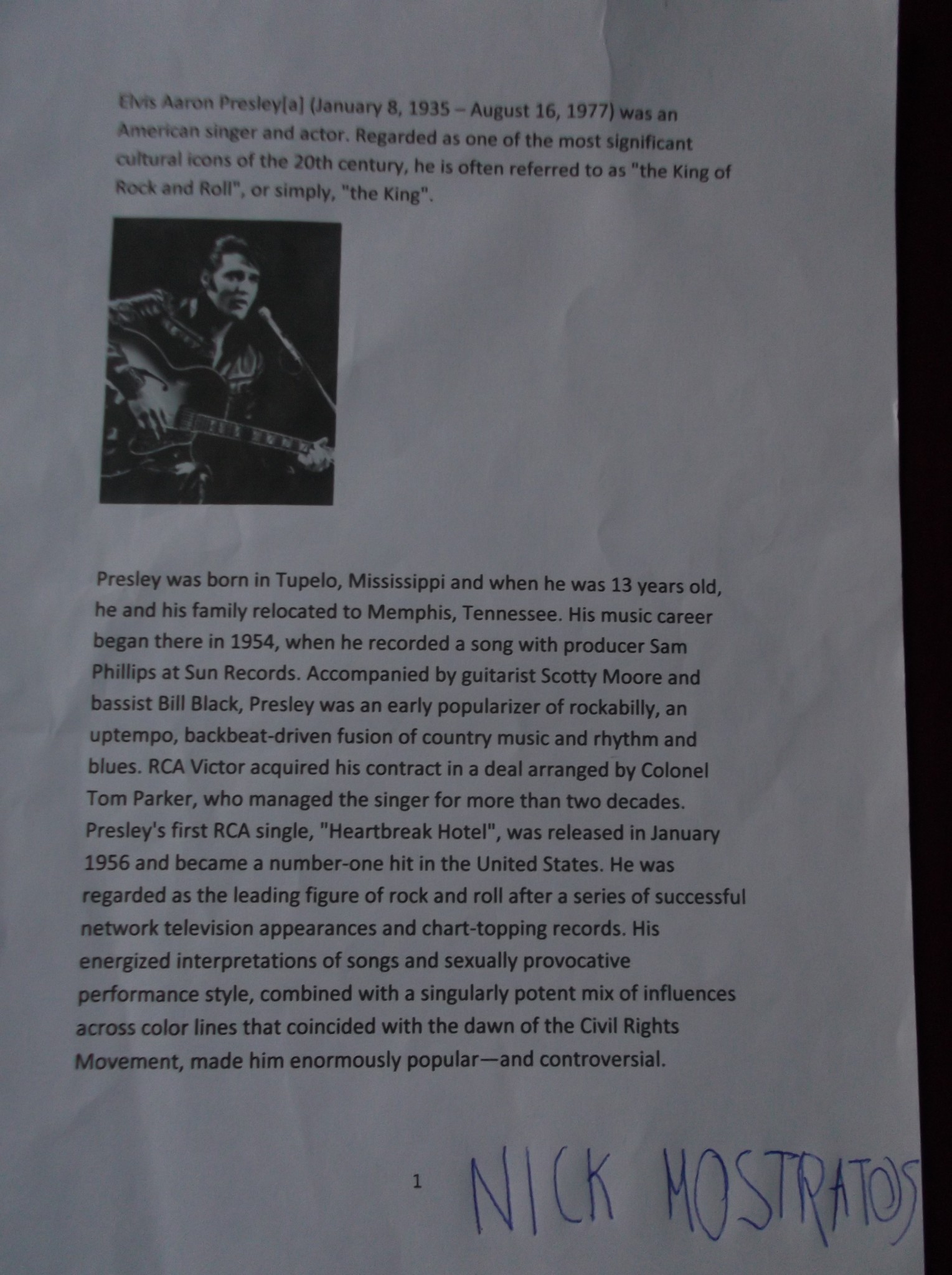
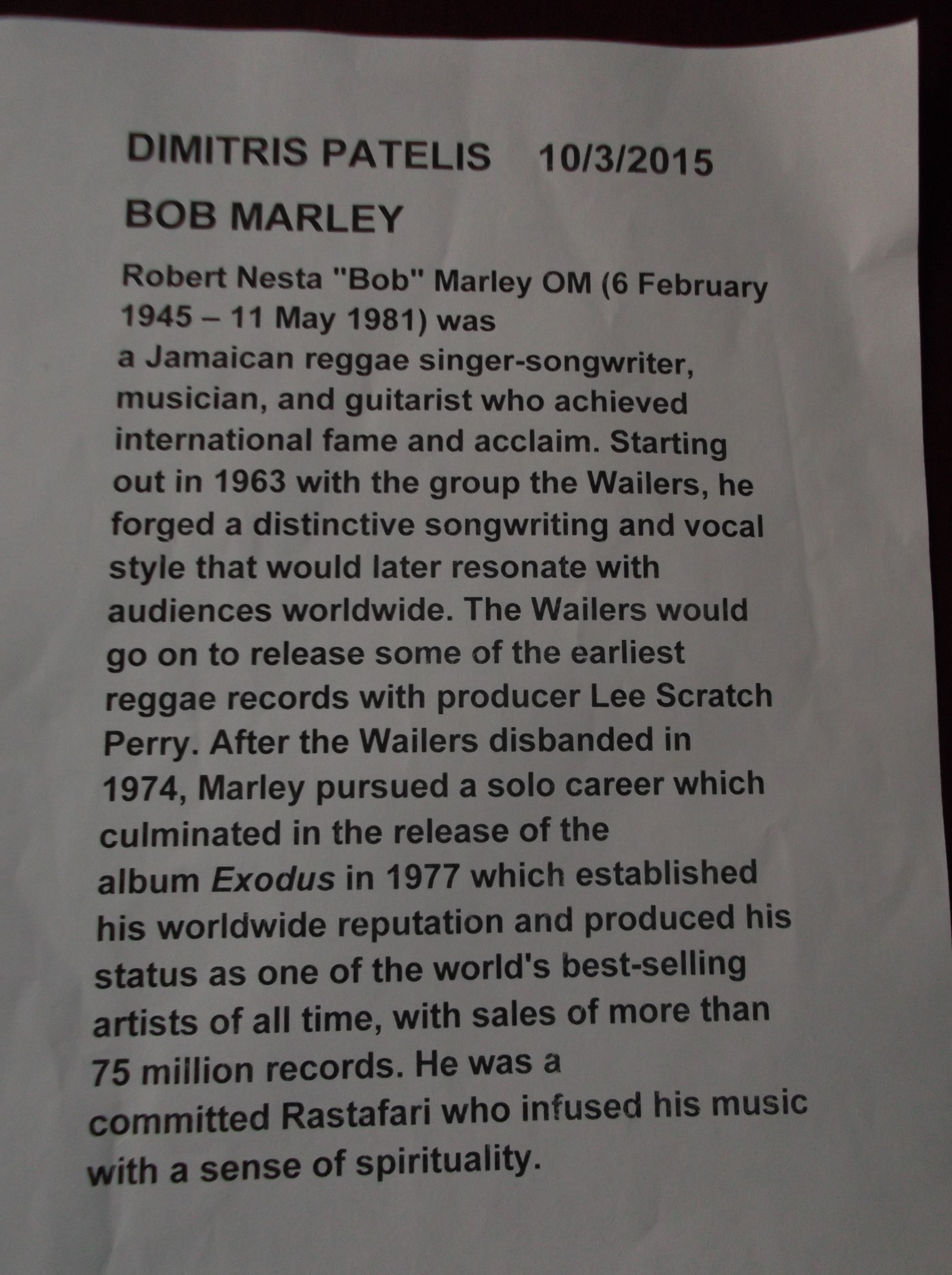
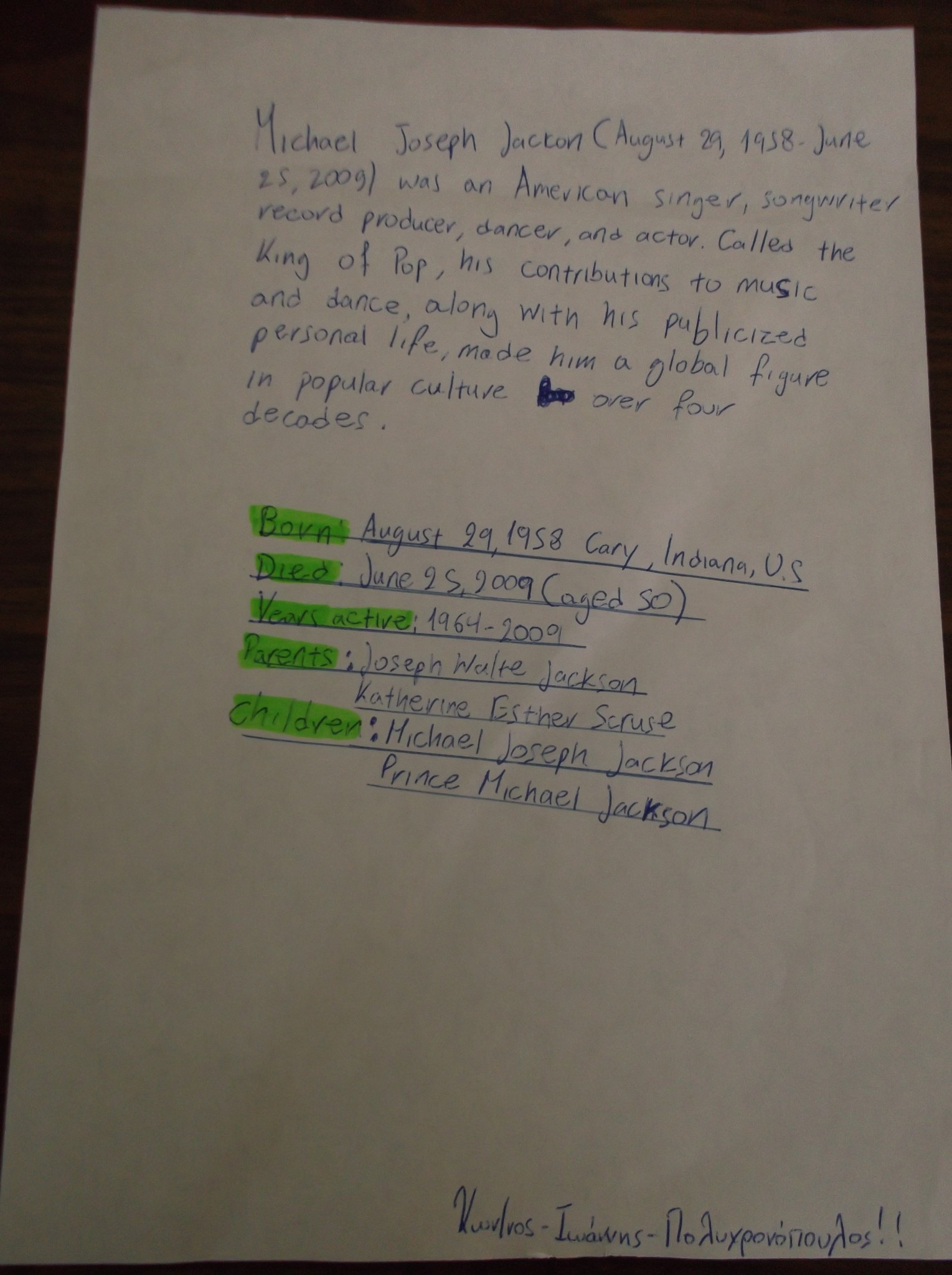
My advanced A’ Class students were asked to think of a person who they admire and write an article about this important personality. My students chose personalities from the literary, scientific, political, and artistic/entertainment world. Let’s see who they mentioned.
D. Alipranti A. Anagnostou L. Andreopoulou E. Apostolidou N. Vitzileos


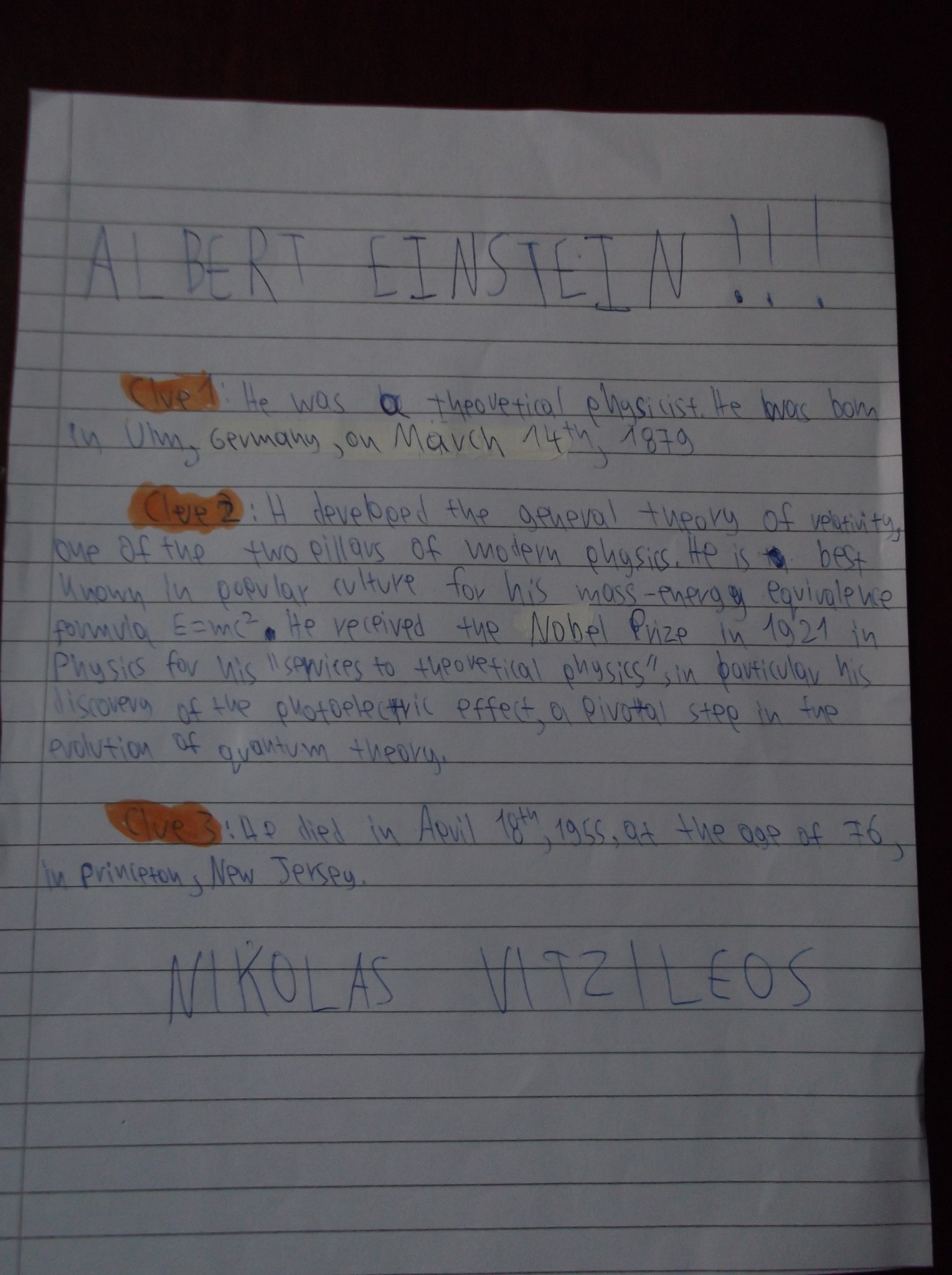
M. Gemeliari B. Georgas A. Gourogiannis V. Dabri S. Daniilidou


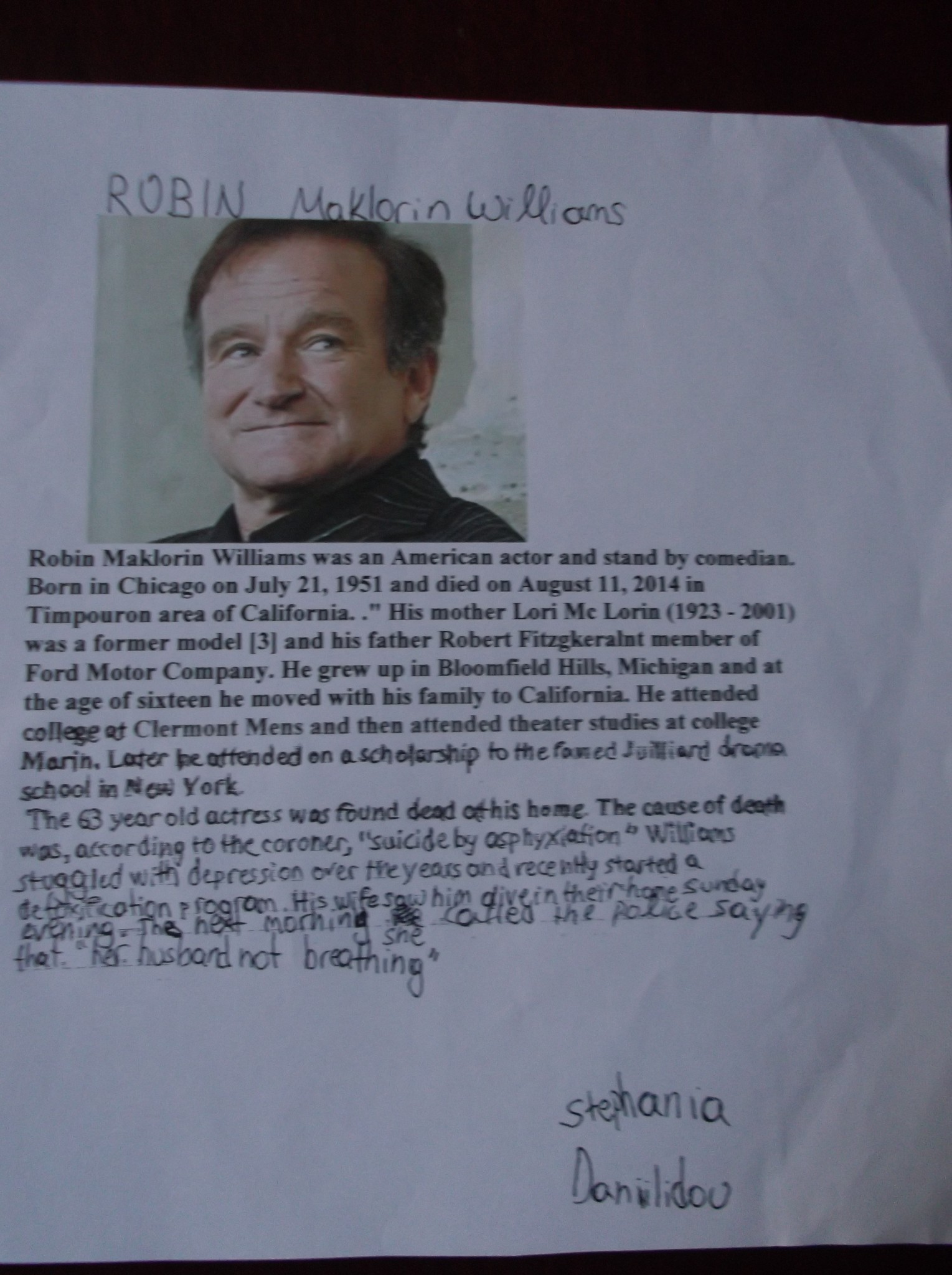
A. Drakaki K. Samaltani A. Skandalis A. Skarlatou D. Flessa


N. Fragouli M. Fokianou N. Chaniotis A. Kourmouki K. Loukis
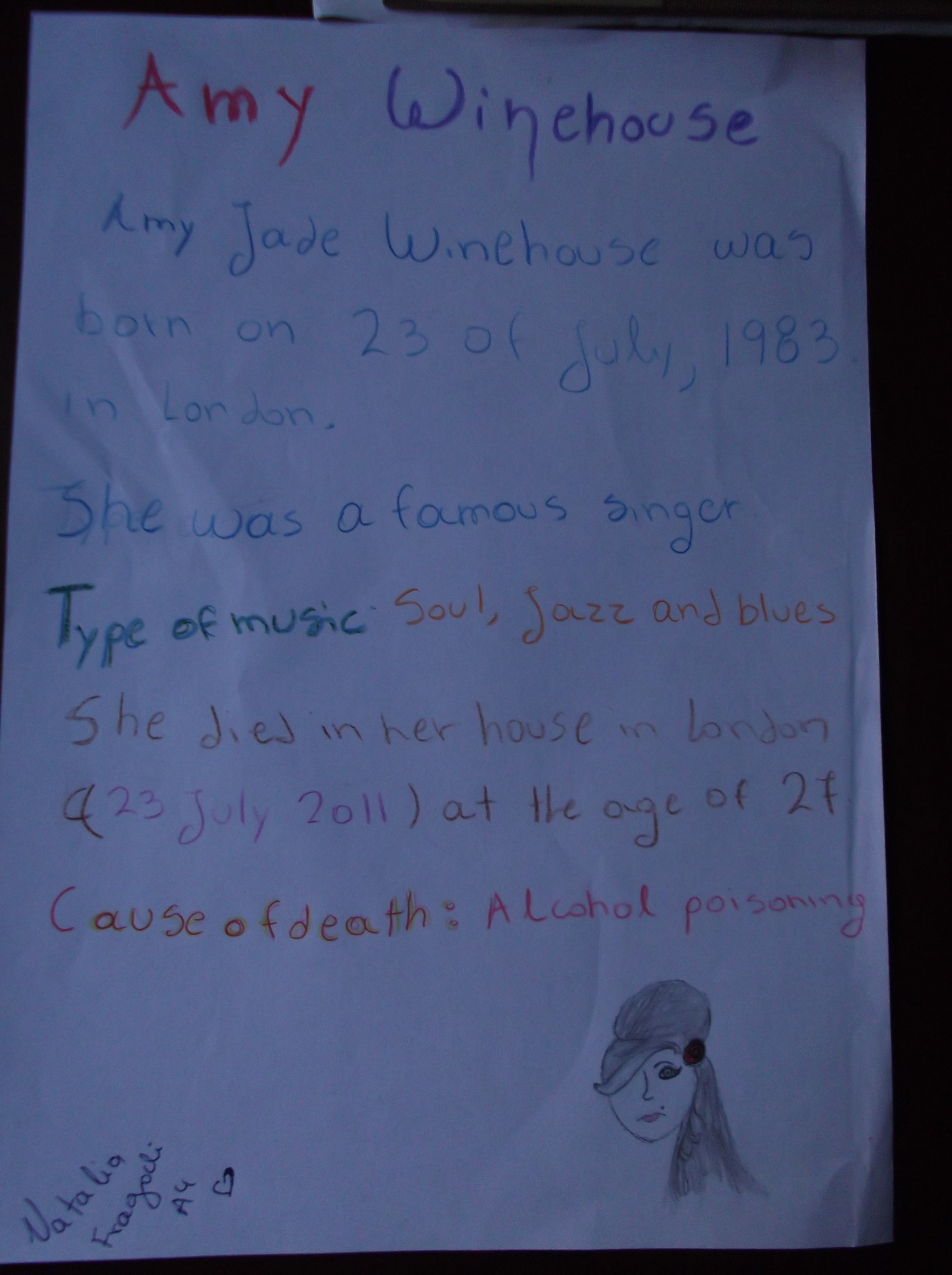


N. Mostratos F. Biza A. Biskentzis P. Boni G. Mytilineos


P. Panteleou D. Patelis I. Perrakis G. Petru



K. Polychronopoulos A. Ragousis

[slideboom id=1237021&w=425&h=370]
Pi Day
Μαρ 201514
This Saturday is not only Pi Day (3.14), but it’s the Pi Day of the Century (3.14.15).
Pi, or π, is the ratio of the circumference of a circle to its diameter. It’s usually shortened to 3.14, which is why March 14 is celebrated every year as Pi Day, but it’s an irrational number that continues infinitely without a pattern, like so: 3.14159265358979323846264338327950288419716939937510582…
World Sleep Day
Μαρ 201514
The World Sleep Day (Friday of the second full week of March) is an annual event organized by the World Sleep Day Committee of the World Association of Sleep Medicine(WASM) since 2008. It is aimed to celebrate the benefits of good and healthy sleep and to draw society attention to the burden of sleep problems and their medicine, education and social aspects; to promote sleep disorders prevention and management.
Through the World Sleep Day the WASM tries to raise awareness of sleep disorders and their better understanding and preventability, and to reduce the burden of sleep problems on society that constitute a global epidemic and threaten health and quality of life for as much as 45% of the world’s population.
The World Sleep Day is held annually on the Friday of the second full week of March. The first World Sleep Day was held on 14 March 2008. Events involving discussions, presentations of educational materials and exhibitions take place around the world and online.
| Year | Date | Slogan |
|---|---|---|
| 2008 | 14 March | ‘Sleep well, live fully awake’ |
| 2009 | 20 March | ‘Drive alert, arrive safe’ |
| 2010 | 19 March | ‘Sleep Well, Stay Healthy’ |
| 2011 | 18 March | ‘Sleep Well, Grow Healthy’ |
| 2012 | 16 March | ‘Breathe Easily, Sleep Well’ |
| 2013 | 15 March | ‘Good Sleep, Healthy Aging’ |
| 2014 | 14 March | ‘Restful Sleep, Easy Breathing, Healthy Body’ |
| 2015 | 13 March | ‘When sleep is sound, health and happiness abound’ |
International/World Days
Μαρ 201514
-
Παγκόσμια Ημέρα Βιβλίου World Book and Copyright Day

Στις 23 Απριλίου 1616 έφυγαν από τη ζωή δύο μεγάλα ονόματα των γραμμάτων: ο ισπανός συγγραφέας του Δον Κιχώτη Μιγκέλ Ντε Θερβάντες και ο άγγλος δραματουργός Γουίλιαμ Σέξπιρ. Με αφορμή το διπλό αυτό γεγονός, η UNESCO έχει καθιερώσει την 23η Απριλίου ως την Παγκόσμια Ημέρα του Βιβλίου.
World Book Day or World Book and Copyright Day (also known as International Day of the Book or World Book Days) is a yearly event on 23 April, organised by the United Nations Educational, Scientific and Cultural Organization (UNESCO), to promotereading, publishing and copyright. In the United Kingdom, the day is recognised on the first Thursday in March. World Book Day was celebrated for the first time on 23 April 1995.
The connection between 23 April and books was first made in 1923 by booksellers in Spain as a way to honour the author Miguel de Cervantes, who died on this date. In 1995 UNESCO decided that the World Book and Copyright Day would be celebrated on 23 April, as the date is also the anniversary of the death of William Shakespeare and Inca Garcilaso de la Vega, as well as that of the birth or death of several other prominent authors. -
Ευρωπαϊκή Ημέρα Μουσικής European Music Day

Η Ημέρα της Μουσικής άρχισε να γιορτάζεται στο Παρίσι το 1982, με πρωτοβουλία του τότε υπουργού Πολιτισμού Ζακ Λανγκ, ενώ το 1985 ο θεσμός εξαπλώθηκε έξω από τα γαλλικά σύνορα. Η Αθήνα, Πολιτιστική Πρωτεύουσα της Ευρώπης 1985, ήταν η πρώτη εκτός Γαλλίας χώρα στην οποία πραγματοποιήθηκε η Γιορτή της Μουσικής.
Μέσα σε λίγα χρόνια, η Ημέρα της Μουσικής έφτασε να είναι ένας πραγματικός θεσμός, ένα μεγάλο ευρωπαϊκό πολιτιστικό γεγονός που διεξάγεται κάθε 21 Ιουνίου σε περισσότερες από 22 χώρες, από την Ιρλανδία μέχρι το Καζακστάν και από τις Βαλτικές χώρες μέχρι την Κύπρο.
The Fête de la Musique, also known as World Music Day, is an annual music festival taking place on June 21, the first day of summer in cities around the world.
The concept of an all-day musical celebration on the days of the solstice, was originated by American musician Joel Cohen, who spent two seasons as a producer of musical radio programs for the French National Radio (France Musique) The idea later was adapted as a national celebration each June 21 in France and made official by the French Minister of Culture, Jack Lang. The festival later became celebrated in 110 countries around the world.
-
Παγκόσμια Ημέρα Χορού International Dance Day

Η Παγκόσμια Ημέρα Χορού καθιερώθηκε το 1982 από το Διεθνές Συμβούλιο Χορού της UNESCO. Εορτάζεται κάθε χρόνο στις 29 Απριλίου, ημερομηνία γέννησης το 1727 του Ζαν-Ζορζ Νοβέρ, δημιουργού του σύγχρονου μπαλέτου.
Κάθε χρόνο το μήνυμα της Ημέρας αναλαμβάνει να συγγράψει μία γνωστή προσωπικότητα του χώρου. Ο σκοπός της Παγκόσμιας Ημέρας Χορού είναι να ενώσει όλους τους ασχολούμενους με την τέχνη της Τερψιχόρης, πέρα από πολιτικούς, πολιτισμικούς και ηθικούς φραγμούς.
International Dance Day was introduced in 1982 by the International Dance Council (CID, Conseil International de la Danse), aUNESCO partner NGO, and is celebrated on April 29 every year. The date is not linked to a particular person or a particular form of dance, although incidentally it is also the day when the French dancer and balletmaster Jean-Georges Noverre was born.. The main purpose of Dance Day events is to attract the attention of the wider public to the art of dance. Emphasis should be given to addressing a new public, people who do not follow dance events during the course of the year.
-
Παγκόσμια Ημέρα Θεάτρου World Theatre Day

Η Παγκόσμια Ημέρα Θεάτρου είναι η ετήσια γιορτή της διεθνούς θεατρικής κοινότητας, από το 1961, όταν πρωτοεμφανίσθηκε με πρωτοβουλία του Διεθνούς Ινστιτούτου Θεάτρου. Εορτάζεται κάθε χρόνο στις 27 Μαρτίου, με θεατρικά δρώμενα και άλλες συναφείς με το θέατρο εκδηλώσεις, που διοργανώνονται από τα εθνικά τμήματα του Διεθνούς Ινστιτούτου Θεάτρου, μιας Μη Κυβερνητικής Οργάνωσης που συνενώνει τους επαγγελματίες του θεάτρου και συνεργάζεται στενά με την UNESCO.
Κάθε χρόνο ένας άνθρωπος του θεάτρου αναλαμβάνει να γράψει το μήνυμα του εορτασμού, το οποίο είθισται να διαβάζεται στα θέατρα πριν από την παράσταση της 27ης Μαρτίου. Το φετινό μήνυμα (2015) ανήκει στον Πολωνό σκηνοθέτη Krzysztof Warlikowski!
World Theatre Day was initiated in 1961 by the International Theatre Institute (ITI). It is celebrated annually on the 27th March by ITI Centres and the international theatre community. Various national and international theatre events are organized to mark this occasion. One of the most important of these is the circulation of the World Theatre Day International Message through which at the invitation of ITI, a figure of world stature shares his or her reflections on the theme of Theatre and a Culture of Peace. The first World Theatre Day International Message was written by Jean Cocteau (France) in 1962. It was first in Helsinki, and then in Vienna at the 9th World Congress of the ITI in June 1961 that President Arvi Kivimaa proposed on behalf of the Finnish Centre of the International Theatre Institute that a World Theatre Day be instituted. The proposal, backed by the Scandinavian centres, was carried with acclamation.
Each year a figure outstanding in theatre or a person outstanding in heart and spirit from another field, is invited to share his or her reflections on theatre and international harmony. What is known as the International Message is translated into more than 20 languages, read for tens of thousands of spectators before performances in theatres throughout the world and printed in hundreds of daily newspapers. Colleagues in the audio-visual field lend a fraternal hand, more than a hundred radio and television stations transmitting the Message to listeners in all corners of the five continents.
Παγκόσμια Ημέρα Ποίησης World Poetry Day
Τον Οκτώβριο του 1999, στη Γενική Διάσκεψη της UNESCO στο Παρίσι, η 21η Μαρτίου ανακηρύχθηκε Παγκόσμια Ημέρα Ποίησης. Το σκεπτικό της απόφασης ανέφερε: «Η Παγκόσμια Ημέρα Ποίησης θα ενισχύσει την εικόνα της ποίησης στα ΜΜΕ, ούτως ώστε η ποίηση να μην θεωρείται πλέον άχρηστη τέχνη, αλλά μια τέχνη που βοηθά την κοινωνία να βρει και να ισχυροποιήσει την ταυτότητά της. Οι πολύ δημοφιλείς ποιητικές αναγνώσεις μπορεί να συμβάλουν σε μια επιστροφή στην προφορικότητα και στην κοινωνικοποίηση του ζωντανού θεάματος και οι εορτασμοί μπορεί να αποτελέσουν αφορμή για την ενίσχυση των δεσμών της ποίησης με τις άλλες τέχνες και τη φιλοσοφία, ώστε να επαναπροσδιοριστεί η φράση του Ντελακρουά “Δεν υπάρχει τέχνη χωρίς ποίηση”».
World Poetry Day is on 21 March, and was declared by UNESCO (the United Nations Educational, Scientific and Cultural Organization) in 1999. The purpose of the day is to promote the reading, writing, publishing and teaching of poetry throughout the world and, as the UNESCO session declaring the day says, to “give fresh recognition and impetus to national, regional and international poetry movements”.
St. Patrick’s Day – Saint Patrick, the Apostle of Ireland
Μαρ 201514
Beannacht Lá Fhéile Pádraig 2015
March 17th 2015 celebrating the life and work of the patron Saint of Ireland, Saint Patrick
May the Irish hills caress you; 
may her lakes and rivers bless you;
may the luck of the Irish enfold you;
may the blessings of St Patrick behold you
Saint Patrick is the patron saint and national apostle of Ireland. St Patrick is credited with bringing christianity to Ireland. According to different versions of his life story it is said that he was born in Britain, around 385AD. His parents Calpurnius and Conchessa were Roman citizens living in either Scotland or Wales. As a boy of 14 he was captured and taken to Ireland where he spent six years in slavery herding sheep. He returned to Ireland in his 30s as a missionary among the Celtic pagans.
Saint Patrick described himself as a “most humble-minded man, pouring forth a continuous paean of thanks to his Maker for having chosen him as the instrument whereby multitudes who had worshipped idols and unclean things had become the people of God.”

Many folk ask the question ‘Why is the Shamrock the National Flower of Ireland ?’ The reason is that St. Patrick used it to explain the Holy Trinity to the pagans. Saint Patrick is believed to have been born in the late fourth century, and is often confused with Palladius, a bishop who was sent by Pope Celestine in 431 to be the first bishop to the Irish believers in Christ.
In the custom known as “drowning the shamrock”, the shamrock that has been worn on a lapel or hat is put in the last drink of the evening.
Saint Patrick is most known for driving the snakes from Ireland. It is true there are no snakes in Ireland, but there probably never have been – the island was separated from the rest of the continent at the end of the Ice Age. As in many old pagan religions, serpent symbols were common and often worshipped. Driving the snakes from Ireland was probably symbolic of putting an end to that pagan practice. While not the first to bring christianity to Ireland, it is Patrick who is said to have encountered the Druids at Tara and abolished their pagan rites. The story holds that he converted the warrior chiefs and princes, baptizing them and thousands of their subjects in the “Holy Wells” that still bear this name.
There are several accounts of Saint Patrick’s death. One says that Patrick died at Saul, Downpatrick, Ireland, on March 17, 460 A.D. His jawbone was preserved in a silver shrine and was often requested in times of childbirth, epileptic fits, and as a preservative against the “evil eye.” Another account says that St. Patrick ended his days at Glastonbury, England and was buried there. The Chapel of St. Patrick still exists as part of Glastonbury Abbey. Today, many Catholic places of worship all around the world are named after St. Patrick, including cathedrals in New York and Dublin city
A toast for St Patrick’s Day, “May the roof above us never fall in, and may we friends beneath it never fall out.”
Saint Patrick’s Day?
Saint Patrick’s Day has come to be associated with everything Irish: anything green and gold, shamrocks and luck. Most importantly, to those who celebrate its intended meaning, St. Patrick’s Day is a traditional day for spiritual renewal and offering prayers for missionaries worldwide.
Why is it celebrated on March 17th? One theory is that that is the day that St. Patrick died. Since the holiday began in Ireland, it is believed that as the Irish spread out around the world, they took with them their history and celebrations. The biggest observance of all is, of course, in Ireland. With the exception of restaurants and pubs, almost all businesses close on March 17th. Being a religious holiday as well, many Irish attend mass, where March 17th is the traditional day for offering prayers for missionaries worldwide before the serious celebrating begins.
In American cities with a large Irish population, St. Patrick’s Day is a very big deal. Big cities and small towns alike celebrate with parades, “wearing of the green,” music and songs, Irish food and drink, and activities for kids such as crafts, coloring and games. Some communities even go so far as to dye rivers or streams green!
Safety on the Internet
Μαρ 20155
Το διαδίκτυο είναι ένας καταπληκτικός κόσμος μάθησης επικοινωνίας και διασκέδασης, είναι όμως και ένας κόσμος ανοιχτός σε όλους, καλούς και κακούς! Συμβουλευτείτε τα παρακάτω για να απολαμβάνετε τα οφέλη του Διαδικτύου και να αποφεύγετε τους πιθανούς κινδύνους!
- Δεν αποκαλύπτω ποτέ προσωπικές λεπτομέρειες στο Διαδίκτυο, όπως το πραγματικό μου όνομα, τη διεύθυνση της κατοικίας μου ή το τηλέφωνό μου γιατί δεν ξέρω που μπορεί να καταλήξουν.
- Δεν αποκαλύπτω σε κανέναν, ούτε και στους καλύτερούς μου φίλους, τους κωδικούς πρόσβασης των λογαριασμών μου στο Διαδίκτυο.
- Γνωρίζω ότι οποιαδήποτε προσωπική πληροφορία δημοσιεύσω στο Διαδίκτυο, εκείνη τη στιγμή παύει να είναι προσωπική και γίνεται δημοσίως προσβάσιμη, παντού στον κόσμο.
- Ενημερώνω τους γονείς ή τους καθηγητές μου στην περίπτωση που διαβάσω στο Διαδίκτυο κάτι που με ενοχλεί ή που με κάνει να νιώθω άβολα, δίχως να διστάσω. Δεν ξεχνάω ότι εκείνοι μπορούν να με προστατεύουν από κακοτοπιές μέσα από τη γνώση και την εμπειρία τους.
- Ποτέ δεν συναντώ φίλους που γνώρισα στο διαδίκτυο και που δεν τους γνωρίζω προσωπικά.Τα άτομα αυτά δεν είναι πάντοτε αυτά που ισχυρίζονται ότι είναι, ακόμα και αν αλληλογραφώ ή επικοινωνώ πολύ καιρό μαζί τους.
- Εάν κάποιος διαδικτυακός φίλος μου ζητήσει να κρατήσω τη φιλία μας μυστική, τότε κάτι δεν πάει καλά.Ποιος αληθινός φίλος θα το ζητούσε αυτό; Πρέπει αμέσως να ενημερώσω τους γονείς μου ή τους καθηγητές μου.
- Εάν κάποιος μου προσφέρει στο διαδίκτυο κάτι που μου φαίνεται υπερβολικό όπως δώρα ή χρήματα, τότε είναι σίγουρο ότι πρέπει να σταματήσω κάθε είδους επαφή με αυτό το άτομο.
- Διασταυρώνω πάντα το υλικό που βρίσκω στο διαδίκτυο με άλλες πηγές, όπως βιβλία, εφημερίδες, περιοδικά, ρωτώ επίσης τους καθηγητές ή τους γονείς μου. Ολοι εμείς μπορούμε να είμαστε συγγραφείς του διαδικτύου και δεν είναι όλοι οι άνθρωποι επιστήμονες ή ειδικοί.
- Αντιμετωπίζω τους άλλους χρήστες του διαδικτύου με τον ίδιο τρόπο που θα ήθελα να μου φέρονται αυτοί.Δεν κατηγορώ ούτε προσβάλλω κάποιον στο διαδίκτυο θεωρώντας ότι αστειεύομαι, γιατί το αστείο μου μπορεί να μη γίνει αποδεκτό και να πληγώσει το άτομο αυτό.
- Δεν κάνω αγορές από το Διαδίκτυο αν δεν είναι δίπλα μου ένας γονέας.Αποφεύγω ιστοχώρους που δεν γνωρίζω εάν είναι έγκυροι.
- Κάνω τακτικά διαλείμματα όταν είμαι στον υπολογιστή, για να ξεκουράζονται τα μάτια μου.Οχρόνος που μένω στον υπολογιστή και το Διαδίκτυο δεν πρέπει να μου στερεί ούτε ένα λεπτό από το παιχνίδι, τα χόμπυ μου το διαβασμά μου και τον ύπνο μου.
Μπορώ να διασκεδάζω στον εικονικό κόσμο του Διαδικτύου, όμως πάντα αναγνωρίζω ότι διαφέρει από τον πραγματικό κόσμο.
Για οτιδήποτε συναντώ στο Διαδίκτυο και με ενοχλεί το καταγγέλλω στις παρακάτω διευθύνσεις ή ζητώ βοήθεια στη δωρεάν γραμμή βοήθειας: 800 11 800 15 (χωρίς χρέωση), www.safeline.gr ή στο email: help@saferinternet.gr
Το Διαδίκτυο – The Internet
Φεβ 201528
Η πολύωρη ενασχόληση ατόμων σε διαδικτυακές δραστηριότητες όπως τα δωμάτια συζητήσεων, παιχνίδια και άλλα στο Διαδίκτυο μπορεί να προκαλέσει εθισμό. Μπορούμε φυσικά να το αντιμετωπίσουμε.
- Μπορούμε να ευαισθητοποιηθούμε και να το παραδεχτούμε ότι περνάμε πολλές ώρες στο Διαδίκτυο.
- Να χρησιμοποιούμε το Διαδίκτυο με μέτρο
- Να καλλιεργούμε ορθές στάσεις αξιοποίησης του Διαδίκτυο από μικρές ηλικίες
- Να ελέγχουμε το χρόνο που ξοδεύουν τα παιδιά μπροστά στην οθόνη.
Μια νέα τρέλα είναι τα κοινωνικά παιχνίδια(social games) και απευθύνονται στους χρήστες ιστοσελίδων κοινωνικής δικτύωσης. Ο απώτερος σκοπός είναι να δημιουργήσουν μια εικονική φάρμα ή εικονικό καφέ κτλ. Αποκτούν όλο και περισσότερους φίλους.
Η πολύωρη ενασχόληση και με αυτά τα παιχνίδια οδηγεί πολλές φορές στην αποξένωση από τον πραγματικό κόσμο. Όλα αυτά γίνονται σε βάρος του χρόνου που διαφορετικά μπορούν να έχουν διαθέσιμο για την συμμετοχή τους σε άλλες δραστηριότητες με φίλους ή ομάδες ανθρώπων με κοινά ενδιαφέροντα.
Όπως έλεγαν οι αρχαίοι σοφοί “Παν μέτρον άριστο”.
Πρόσφατα σχόλια