Remote Collaborative Creative Writing Program (in English)
Two schools, one story!
From March to May 2026, the students of Class E1 at our school and Class E1 at the 1st Primary School of Nea Smyrni wrote a story together — without sharing the same classroom, but with plenty of exciting ideas and contributions! Every Wednesday, through the interactive whiteboard and shared documents, two classes from different corners of Attica met, created, and inspired one another — guided by the English Language teachers from both schools, who designed and coordinated every step of this unique collaboration.
How we worked
1. Getting to know each other & character design
Students from both classes introduced themselves through videos and jointly created the characters of the story — Julia, Loukas, their world, and their era.
2. Parallel writing every Wednesday
Each week, we “met” digitally and wrote the story together. The plot developed step by step, with each class adding its own twist.
3. Creating a shared e-book
At the end of the program, all the ideas were brought together into a digital book — a joint creation of both schools. AI tools were also used to generate the story’s illustrations.
Click HERE to read the e-book.
A big ‘well done’ to the students who made this program a reality. Their collaboration reminds us that creativity grows when we share it!
(Teachers in charge: Eleni Malliakos, Garyfalia Sapountzaki / 1st Primary School of Nea Smyrni)
Our English Theatre Club at the 2nd Student Theatre Festival of the Municipality of Ilion!
 With pride and emotion, we share with you a milestone in our school life: the English Theatre Club of our school took to the stage of the Multifunctional Cultural Centre “Mikis Theodorakis” — Anna Synodinou Theatre, as part of the 2nd Student Theatre Festival of the Municipality of Ilion, on Saturday, 6 June 2026 at 7:00 PM.
A performance born in the classroom, nurtured with love, and lifted into the spotlight.
The theatrical production “When Yannis Met Willie” is the fruit of months of collective work, creative imagination, and genuine collaboration. The Club’s students gave their very best — under the lights, on the stage, and throughout each of the 2 rehearsals that preceded it. The result was a performance that truly impressed the audience!
Credits
- Written by: Maria Dimou (theatre studies specialist) & Niki Savvani (English teacher)
- Script adaptation: Eleni Malliakos (English teacher)
- Direction: Katerina Bokari (primary school teacher), Eleni Malliakos & the Club’s students
- Set design: Stefania Zouroudis (visual artist) & the Club’s students
Heartfelt thanks
A performance never stands alone — it is supported by people who believe in it. We warmly thank:
- The parents of the Club’s students, who stood by us as wholehearted supporters at every step of this endeavour.
- Our students, who participated in the Club with enthusiasm, imagination, and a true spirit of collaboration — they are the soul of all this work.
- The headteacher of our school, Mr. Theodoros Archontidis, for his guidance and his constant, invaluable support.
- Ms. Maria Kaptanelli, for her help during both the rehearsals and the performance itself.
- Ms. Stefania Zouroudis, for the remarkable set designs that dressed the stage with life and colour.
- Ms. Maria Giavasi, Ioanna Charakida, Panagiota Kostopoulou, and Matoula Kolofotia for their significant help with the costumes and set pieces.
- The Municipality of Ilion, for granting us the wonderful Anna Synodinou Theatre and for organising this festival that gives voice to student creativity.
Every performance is a breath of love for the theatre.
Congratulations to all our young actors — you filled us with joy and moved us deeply!


Eleni Malliakou & Katerina Bokari
Πρόσκληση σε θεατρική παράσταση
Το σχολείο μας συμμετέχει με τον Όμιλο English Theatre Club στο 2ο Μαθητικό Φεστιβάλ Θεάτρου του Δήμου Ιλίου με τη θεατρική παράσταση “‘Οταν ο Γιάννης συνάντησε τον Willie”, το Σάββατο 6 Ιουνίου 2026 στις 19:00, στο Πολυδύναμο Πολιτιστικό Κέντρο “Μίκης Θεοδωράκης” – Θέατρο Άννα Συνοδινού (Ηροδότου & Πωγωνίου, Ίλιον).
Σας περιμένουμε!

Λίγα λόγια για το έργο
Το έργο «Όταν ο Γιάννης συνάντησε τον Willie» είναι μια διασκεδαστική θεατρική παράσταση που συνδυάζει στοιχεία φαντασίας, χιούμορ και λογοτεχνίας. Κεντρικός ήρωας είναι ο Γιάννης, ένας μαθητής δημοτικού που δυσκολεύεται να κατανοήσει τα έργα του Σαίξπηρ. Μέσα από ένα ονειρικό ταξίδι, με τη βοήθεια των Μουσών Μελπομένης και Θάλειας, μεταφέρεται στην ελισαβετιανή εποχή, γνωρίζει τον ίδιο τον Σαίξπηρ και αποσπάσματα από τα πιο γνωστά έργα του, όπως ο «Ρωμαίος και Ιουλιέτα», ο «Μάκβεθ», ο «Άμλετ» και «Το ημέρωμα της στρίγκλας».

From our classroom to Digital Europe: CyberKnights_XIV in action!

On Wednesday, April 29th, 2026, action, collaboration, and digital adventure “met” our classroom! 🚀
A team of five students from class E1, proudly named CyberKnights_XIV, enthusiastically participated in the Europe Direct Region of Crete activity titled “Online Treasure Hunt: Digital Europe!”, as part of the 15th Digital Creation Festival.

💻 A mission full of challenges
Through the Zoom platform, our students collaborated in front of a computer, taking on roles and functioning as a cohesive team. The team leader handled the digital tools, while decisions were made collectively—just like in a real mission!

🗺️ The treasure map
The game began with an interactive map via Google Maps, featuring 7 levels. At each stage, students had to solve riddles and quizzes by searching for information, thinking critically, and making effective use of the internet.
⏳ Race against time
The team had one hour to complete the mission and could request help from the game master only once. The intensity, suspense, and excitement kept their interest high until the very end!
🤝 More than just a game
The online treasure hunt was not just an enjoyable activity. It was a unique opportunity for:
- developing collaboration skills
- practicing problem-solving
- enhancing digital literacy
- exploring the concept of “Digital Europe”
- reflecting on the use of Artificial Intelligence
🌟 An experience to remember!
CyberKnights_XIV proved that when learning meets play, the results are truly impressive! With team spirit, creativity, and energy, they traveled through a digital world full of knowledge and adventure.
The CyberKnights_XIV team scored a total of 235 points, achieving 6th place among 20 primary and secondary schools.
👏 Congratulations to our students for their participation and outstanding spirit!
We’re already looking forward to the next mission… 🔐✨
English Language Day-23 April

Αξιοποιώ υπεύθυνα την Τεχνητή Νοημοσύνη: Διαμορφώνω το μέλλον μου!

Η τεχνητή νοημοσύνη αποτελεί πλέον μέρος της καθημερινότητάς μας, επηρεάζοντας πολλούς τομείς της ζωής, από την επικοινωνία και την εργασία μέχρι την ψυχαγωγία και την εκπαίδευση. Στο σχολικό περιβάλλον, τα εργαλεία τεχνητής νοημοσύνης μπορούν να λειτουργήσουν ως πολύτιμοι σύμμαχοι της μάθησης, βοηθώντας τους μαθητές να οργανώνουν τη μελέτη τους, να αναζητούν πληροφορίες και να καλλιεργούν δεξιότητες κριτικής σκέψης.
Στο πλαίσιο αυτό, το Ε.ΔΙΒ.Ε.Α. του Πανεπιστημίου Κρήτης δημιούργησε έναν εύληπτο, κατανοητό και απολύτως εφαρμόσιμο Οδηγό εξατομικευμένης μελέτης στο σπίτι. Ο οδηγός παρουσιάζει 5+1 βήματα αξιοποίησης εφαρμογών τεχνητής νοημοσύνης για μαθητές και μαθήτριες, με στόχο να τους βοηθήσει να χρησιμοποιούν την τεχνολογία με δημιουργικό και υπεύθυνο τρόπο.
Πρόκειται για έναν πρακτικό οδηγό, χωρίς περίπλοκες θεωρίες, που περιλαμβάνει σαφείς οδηγίες και έτοιμες προτροπές (prompts) τις οποίες μπορούν να χρησιμοποιήσουν παιδιά όλων των ηλικιών, ώστε να αξιοποιούν τις εφαρμογές τεχνητής νοημοσύνης ως υποστηρικτικό εργαλείο στη μελέτη τους.
Η υπεύθυνη χρήση της τεχνητής νοημοσύνης μπορεί να ενισχύσει την αυτονομία των μαθητών και να μετατρέψει τη μελέτη στο σπίτι σε μια πιο δημιουργική και αποτελεσματική διαδικασία.
Πατήστε ΕΔΩ για τον οδηγό
Learning in… escape mode! 🔐 An Educational Escape Room at our school!
🎮 What would you think if learning were transformed into a thrilling mission and practising English became a journey through different cultures? If students weren’t simply answering questions, but solving puzzles, decoding messages, and working together to crack a mystery? And all of this in our school’s computer lab?
That is exactly what students from Years 5 and 6 experienced through a digital educational escape room — an innovative experience that combines knowledge with play! The students dedicated eight afternoons, after the end of the school day, to learning through play!
🧩 What is a digital educational escape room?
It is an experiential activity in which students are challenged, within a set time limit, to solve a series of puzzles and challenges. Each correct answer brings them closer to the final goal: “escape”! But this isn’t simply about play. Every puzzle is designed to draw on knowledge, skills, and creative thinking.
🕵️♂️ The Case of the Missing Journals
 The digital educational escape room was in the English language and was titled “The Case of Fogg’s Missing Journals”, inspired by Jules Verne’s literary work Around the World in Eighty Days. After Phileas Fogg’s return from his journey to London, his six journals were stolen by his rival, Sir Alistair Blackwood. The students are called upon by Scotland Yard’s Inspector Penrose to follow the digital clues left behind by Sir Blackwood in order to locate the 6 journals. The journals must be found, as they contain proof that Phileas Fogg did indeed complete his journey. If successful, the students’/detectives’ names will be added alongside Fogg’s at the Reform Club in London. If they fail, Fogg will be unable to prove he made the journey, he will lose his reputation, Sir Blackwood will have defeated them, the students/detectives will lose their good standing in the world of the game, and will never be assigned a mission again.
🚀 What did our students do?
The students took on the role of detectives, split into teams, and entered a world full of mystery! They tackled 7 missions, set in different countries and cultures. During the missions, students had to:
- Read texts and watch videos in English
- Solve puzzles in English
- Collaborate effectively
- Communicate and exchange ideas
- Solve problems using critical thinking
- Draw on knowledge from different subjects
- Manage their time


Every element of the activity was a piece of something far more important… the value that TIME holds in our lives! “All we have to decide is what to do with the time that is given us” (J.R.R. Tolkien).
The students’ mission was crowned with complete success!!!
The case of Fogg’s missing journals

INTRO presentation: The case of Fogg’s missing journals
Evidence File 
Mission 1: Unlocking London’s fog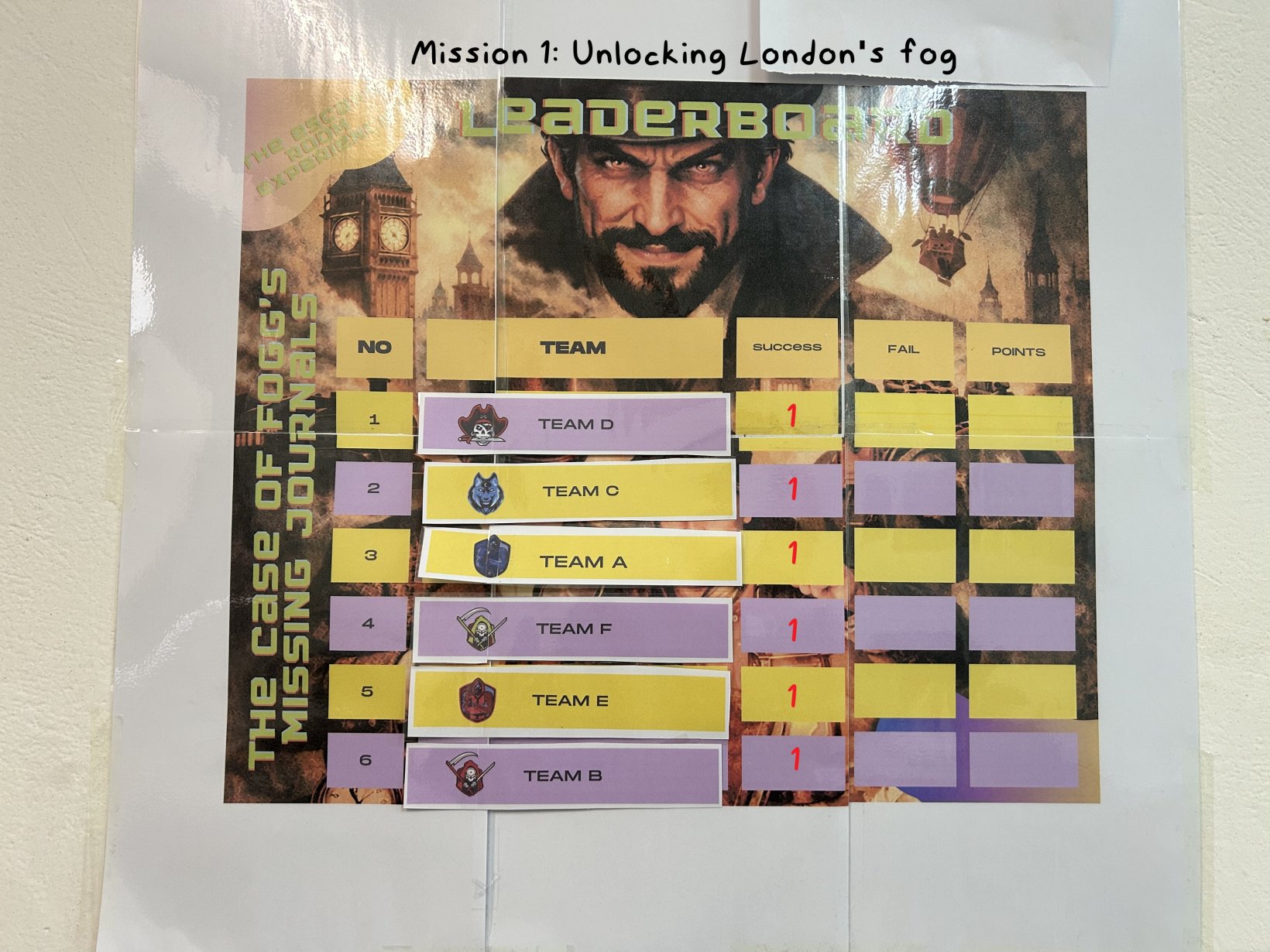
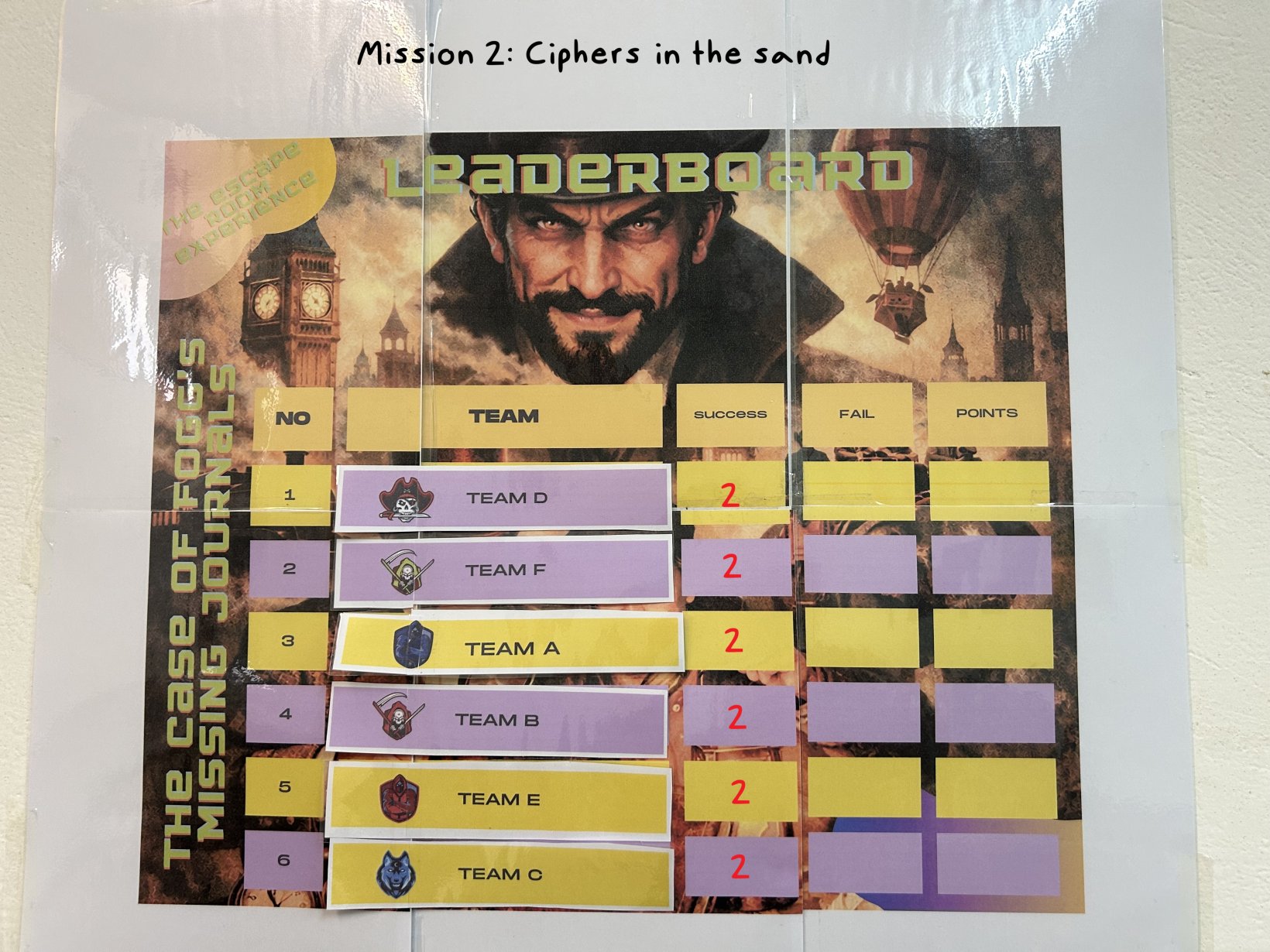
Mission 2: Ciphers in the sand
Mission 3: Tracks to eternal love

Mission 4: The silk dragon

Mission 5: Blossoms on the blade

Mission 6: The trail of tears

Mission 7: The secrets of time

The winner of the game is the team with the most successful missions and the most points collected in missions 3 and 7. For missions 3 and 7, there is an extra bonus of 1600 points for the team that completes the mission 1st, 1000 points for the second, 800 points for the 3rd, 400 points for the 4th, 200 points for the 5th and 100 for the 6th…
Good Luck!
Outro Presentation: The case of Fogg’s missing journals_CASE SOLVED
Time is not merely counted—it is felt, shaped, and remembered. Within the solemn halls of the British Museum, time becomes almost visible, resting gently upon artifacts that refuse to fade.
Consider the eternal stillness of the Giza Pyramids. They do not race against time; they endure it. In contrast, the Suez Canal and the coming of trains during the Industrial Revolution reveal humanity’s restless desire to master time—to shorten distances and to move faster. Yet, in this pursuit, a question quietly arises: does saving time always mean valuing it?
The Taj Mahal offers a different answer. It teaches that time finds its highest meaning not in speed, but in devotion. Built to preserve love beyond death, it reminds us that what is truly precious is not how long something lasts, but how deeply it is felt. Likewise, the Silk Road did more than connect lands—it accelerated the exchange of ideas, cultures, and wisdom, proving that time gains value when it is shared.
The rhythm of time is also written in nature and tradition. The Chinese calendar and the phases of the moon teach harmony with cycles, urging patience and balance.
In the fleeting blossoms of Hanami, we are gently reminded that beauty exists precisely because it does not last. From the disciplined lives of the Samurai, we learn that every moment demands intention—that time, when honored, becomes a path to mastery.
Yet history also bears witness to sorrow: the Trail of Tears stands as a painful reminder that time can carry injustice, but also memory, resilience, and the enduring spirit of a people.
And there, at Greenwich, where the Prime Meridian divides the world, humanity has tried to measure time, to order it, to make it universal. But even as clocks align, our experience of time remains deeply personal.
Thus, TIME teaches us its final, quiet lesson: it is not ours to control, only to choose within. As Gandalf reminds us, “All we have to decide is what to do with the time that is given to us.” Let us then choose wisely—not to fill our hours endlessly, but to deepen them; not merely to pass time, but to transform it into moments of meaning, presence, and true quality.

Πρoστατευμένο: The case of Fogg’s missing journals
ClassroomScreen