


The Past Simple is the most common way of talking about past events or states which have finished. It is often used with past time references (e.g. yesterday, two years ago).
- A past event could be one thing that happened in the past, or a repeated thing.
I stopped at a zebra crossing.
We carried on with the test.
We played tennis every day in August.
- A state is a situation without an action happening.
We stayed at my grandparents’ house last summer.
Regular past simple forms are formed by adding –ed to the infinitive of the verb.
start → started
kill → killed
jump → jumped
Yes, but there are some spelling rules. If a verb ends in –e, you add –d.
agree → agreed
like → liked
escape → escaped
If a verb ends in a vowel and a consonant, the consonant is usually doubled before –ed.
stop → stopped
plan → planned
If a verb ends in consonant and –y, you take off the y and add –ied.
try → tried
carry → carried
But if the word ends in a vowel and –y, you add –ed.
play → played
enjoy → enjoyed
We form questions and negatives with the verb did (do in the past) + the infinitive.
Did you pass?
You didn’t fail, did you?
Yes, I did. / No, I didn’t.
Some verbs are irregular. Their past forms do not end in –ed.
The past forms don’t change.
I took a taxi to the airport. (take → took)
That was when we spoke. (speak → spoke)
One person gave me his last bar of chocolate. (give → gave)
And the negatives are all formed with did + not + the infinitive without to. The question forms are very similar: did + subject pronoun + the infinitive without to.
What did you do all day in the airport?
Did you have enough food?
We didn’t think you would get home in time for your birthday.
The verb to be. The past form is was for I, he, she and it, but were for you, we and they.
It was horrible not being able to phone you two!
There wasn’t any food. I was so hungry!
We were stuck in the airport.
A list of Irregular verbs
| Present | Past Simple | Present | Past Simple |
| be | was / were | begin | began |
| break | broke | bring | brought |
| build | built | buy | bought |
| catch | caught | choose | chose |
| come | came | cost | cost |
| cut | cut | do | did |
| draw | drew | drink | drank |
| drive | drove | eat | ate |
| fall | fell | feel | felt |
| fight | fought | find | found |
| fly | flew | forget | forgot |
| freeze | froze | get | got |
| give | gave | go | went |
| have | had | hear | heard |
| hold | held | hit | hit |
| keep | kept | know | knew |
| learn | learnt | leave | left |
| lead | led | let | let |
| lie | lay | lose | lost |
| make | made | mean | meant |
| meet | met | pay | paid |
| put | put | read | read |
| ride | rode | run | ran |
| say | said | see | saw |
| sell | sold | send | sent |
| set | set | shut | shut |
| sing | sang | sit | sat |
| sleep | slept | speak | spoke |
| spend | spent | stand | stood |
| steal | stole | swim | swam |
| take | took | teach | taught |
| tell | told | think | thought |
| understand | understood | wake | woke |
| wear | wore | win | won |
| write | wrote |
- watch a video for the regular forms and a video for the irregular verbs of the Simple Past, by learnenglishteens.britishcouncil.org
- play some games by learnenglishkids.britishcouncil.org


Past Continuous
For the formation of this tense see the following chart

∗We use the past continuous to talk about actions that were in progress (not finished) at a specific moment in the past.
- ‘What were you doing at 9?’ ‘I was studying.’
- When I saw them yesterday, they were arguing.
The specific moment in the past can be described by a time expression (at 9 a.m., at midday, at lunchtime, all morning, all day, etc.):
- They were swimming at 7 in the morning.
- At midday, they were still working.
Or by a simple past sentence:
- They were swimming when I saw them.
- When she arrived, they were still working.
∗We often use the past continuous at the beginning of a story to describe the situation.
- It was getting dark, and I was walking fast. Suddenly …
Past Simple vs Past Continuous
∗We use the past simple for completed actions in the past, and we use the past continuous for actions in progress (not finished) in the past.
- We ate out yesterday. (the action is finished)
- We were eating at 9. (the action was not finished)
∗The past continuous describes a longer action or situation, and the past simple describes a shorter action or event.
- When I met Susan, she was having a drink at a terrace with a friend.
- We didn’t go out because it was raining
∗The short action in past simple often interrupts the longer action in past continuous.
- He was playing football when he broke his arm.
- When I went to bed, it was raining.
∗We use the past simple for completed actions that happened one after the other. Compare:
- When he arrived, she was having a shower. (The action of having a shower started before he arrived)
- When he arrived, she had a shower. (The action of having a shower started after he arrived)
∗We use past continuous with actions that happen at the same time.
- I was studying in my room, while my mother was cooking in the kitchen.
Don’t forget!
When + Simple Past
While+ Past Continuous
some liveworksheets to practise the use of Simple Past and Past Continuous


a Genially Quiz bomb

some more games by wordwall.net


and a baamboozle game(to study the sentences click Study, to play a game click Play)

Used to


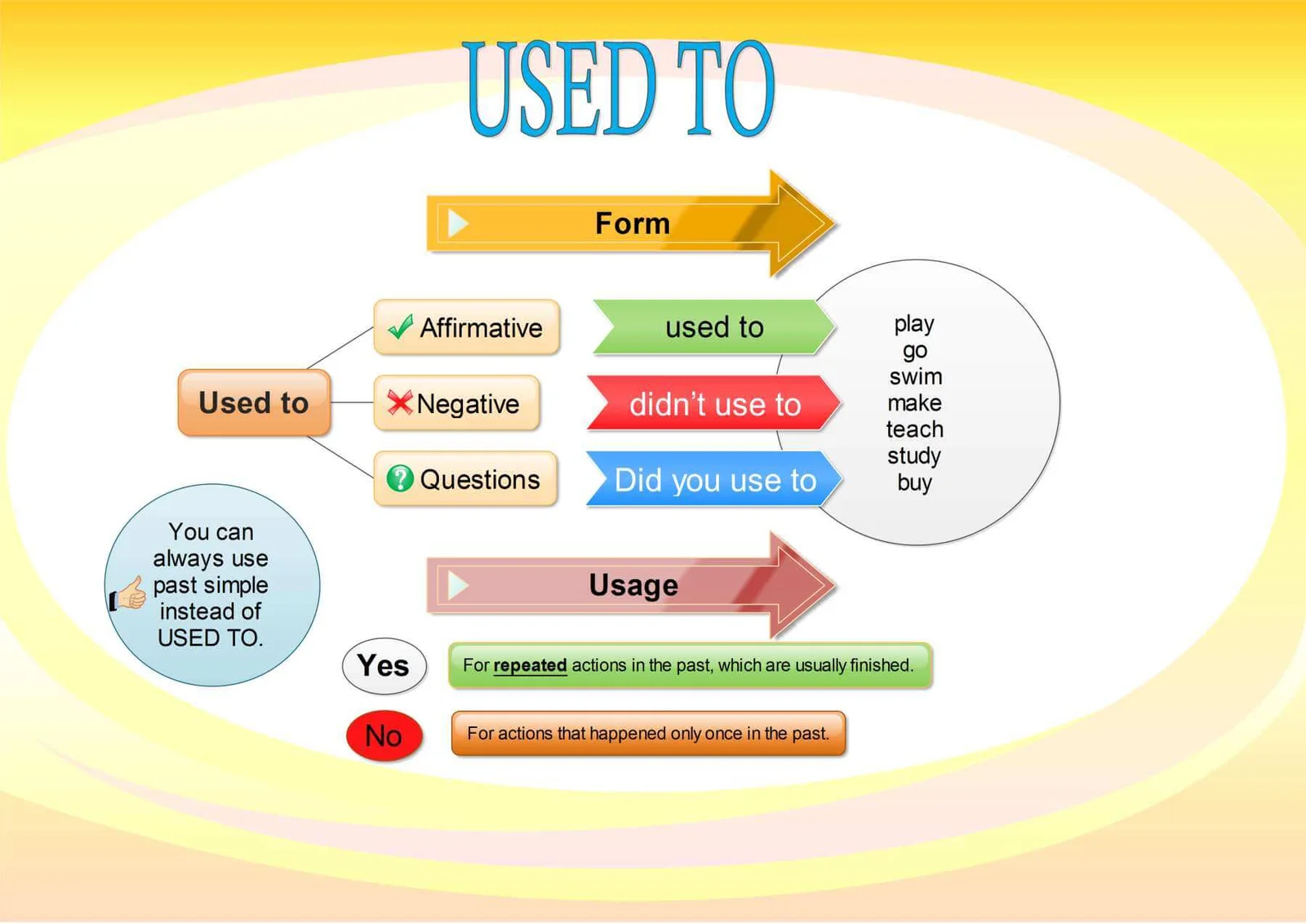
We use used to + verb for talking about states or actions that were true or happened in the past, but are not true or do not happen now.
- London’s nothing like it used to be!
- She used to go away on really long trips.
- The record shop I always used to visit is now a really cool café. (I don’t visit the place now.)
We can always use the Past Simple, but we use used to to emphasise that the state or action is not true now or does not happen now.
For the negatives we use didn’t use to + verb and for the questions we use Did+subject+use to+verb.
- He didn’t use to wear nice clothes and recently he’s been looking quite cool.
- So what else did you use to go to London for?
Watch a video and do the exercises that follow (by learnenglishteens)

(by Ckontou)

(by Lagadmaria)

(by Basilikirakopou)


Listen to the song “We Used to Be” and do the exercise that follows

Now do this exercise for more practice.
