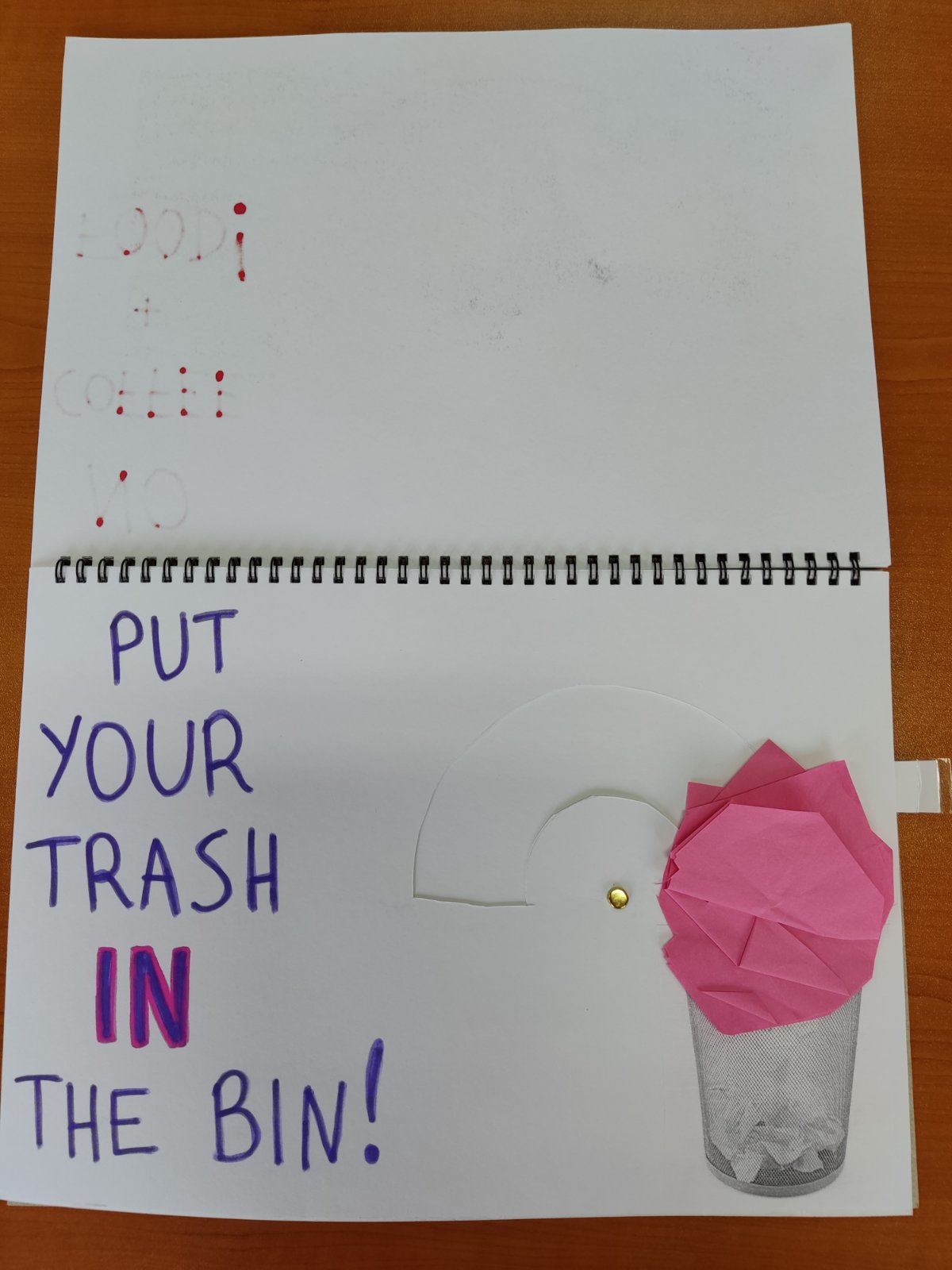
Inspired by Bec Hill, I have made my first flipchart to use in my classroom!
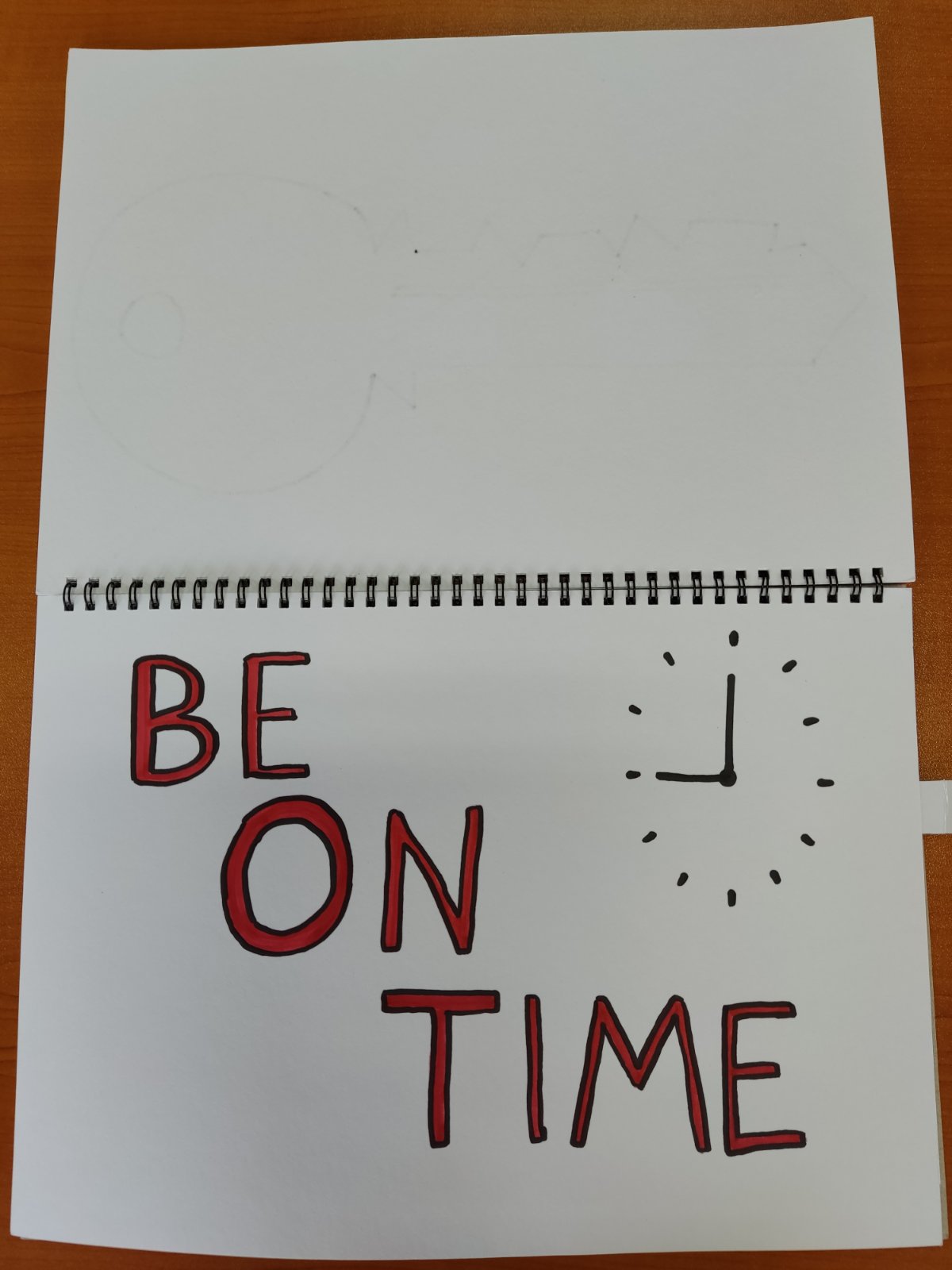
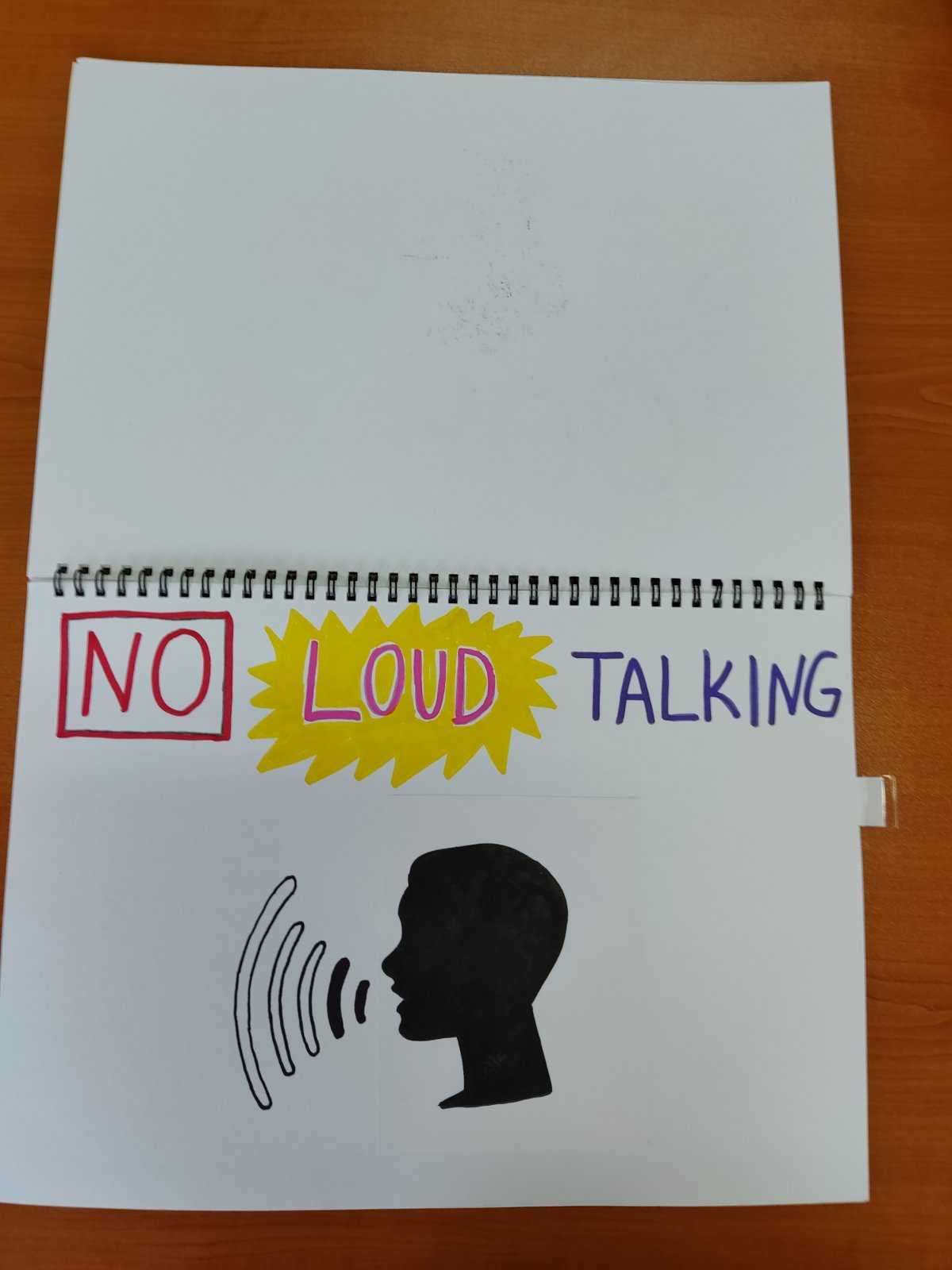
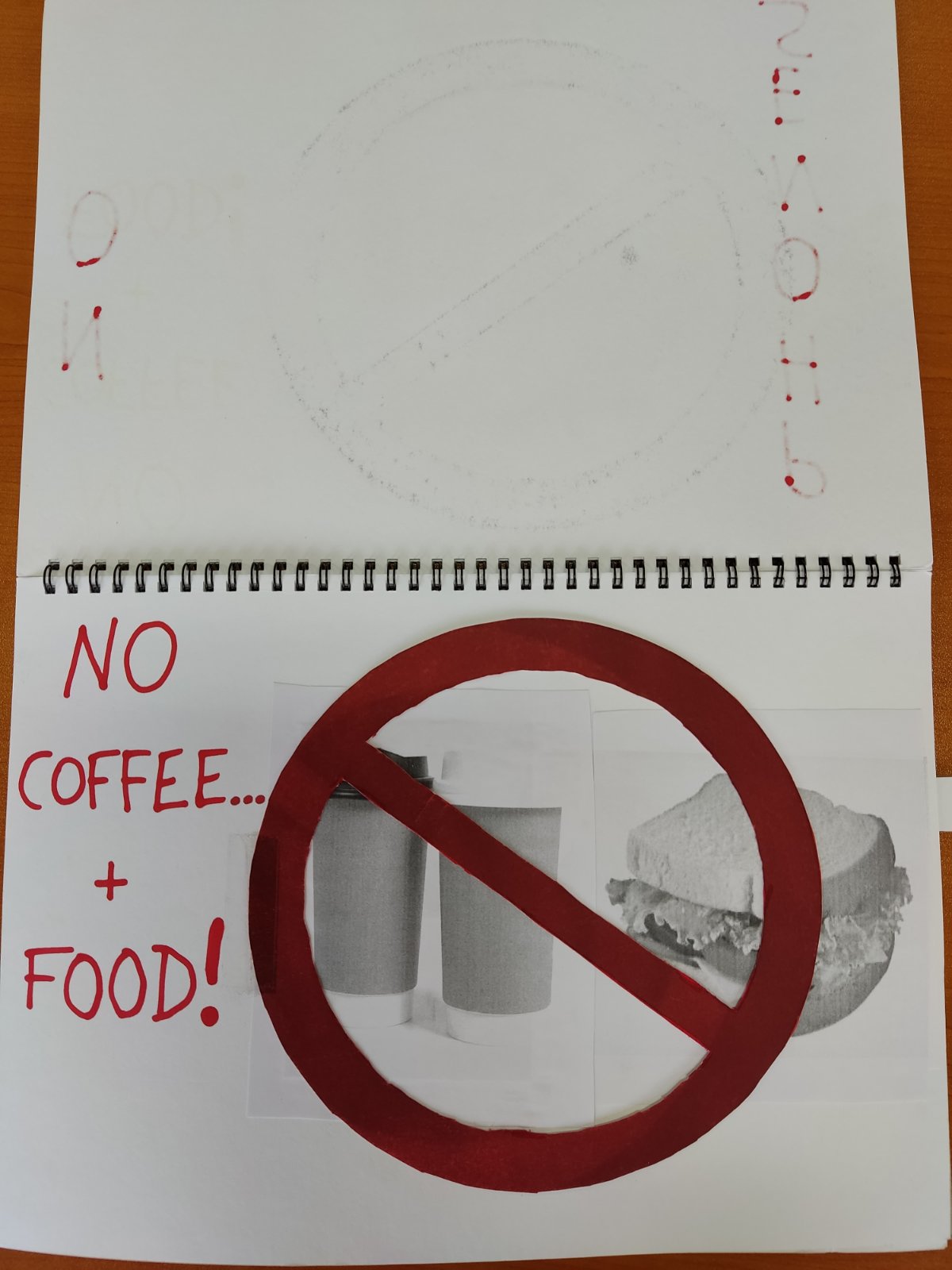
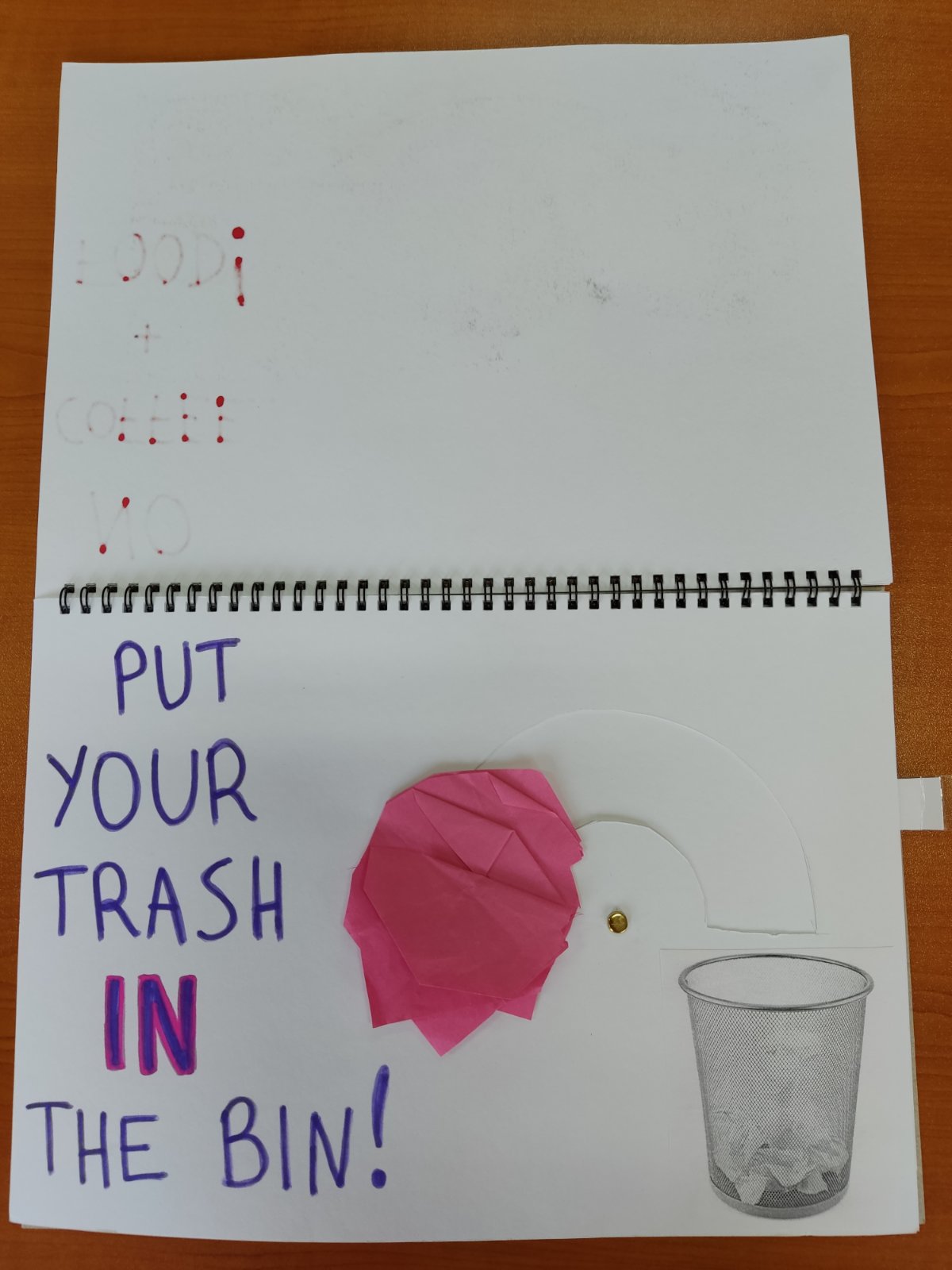
Apart from this short story, I have also created a “Rules” flipchart that I use at the beginning of each school year:






As I was watching one of my favourite series, Outlander, I remembered the first episode, in which Claire, a 20th century nurse, puts Jamie’s dislocated shoulder back into place. Jamie is an 18th century Scot, and the two have met because Claire has travelled back in Jamie’s time.
That was a great chance to create an ESP lesson plan, concerning English for Nurses. The idea was simple: teach the students basic shoulder vocabulary, read the original book excerpt and compare it with the actual series scene. The students’ reaction was not as enthusiastic as I expected, as they found the book excerpt quite challenging to understand, but it was a good chance to expose them to authentic material concerning their specialty!
The idea is simple: show your students a video in which the characters don’t speak (e.g. Shaun the Sheep or The Pink Panther). Then, show it again, but this time pause and ask them: “In this scene, if Shaun could speak, what would he say?”
That’s the easy way. A more time-consuming way is to printscreen scenes from the video, attach them on a piece of paper, divide the students in teams and let them decide what the character would say. Either way, they love it!
Here is what my “agriculturist”-students came up with after I showed them the episode “Troublesome tractor” from Shaun the Sheep.


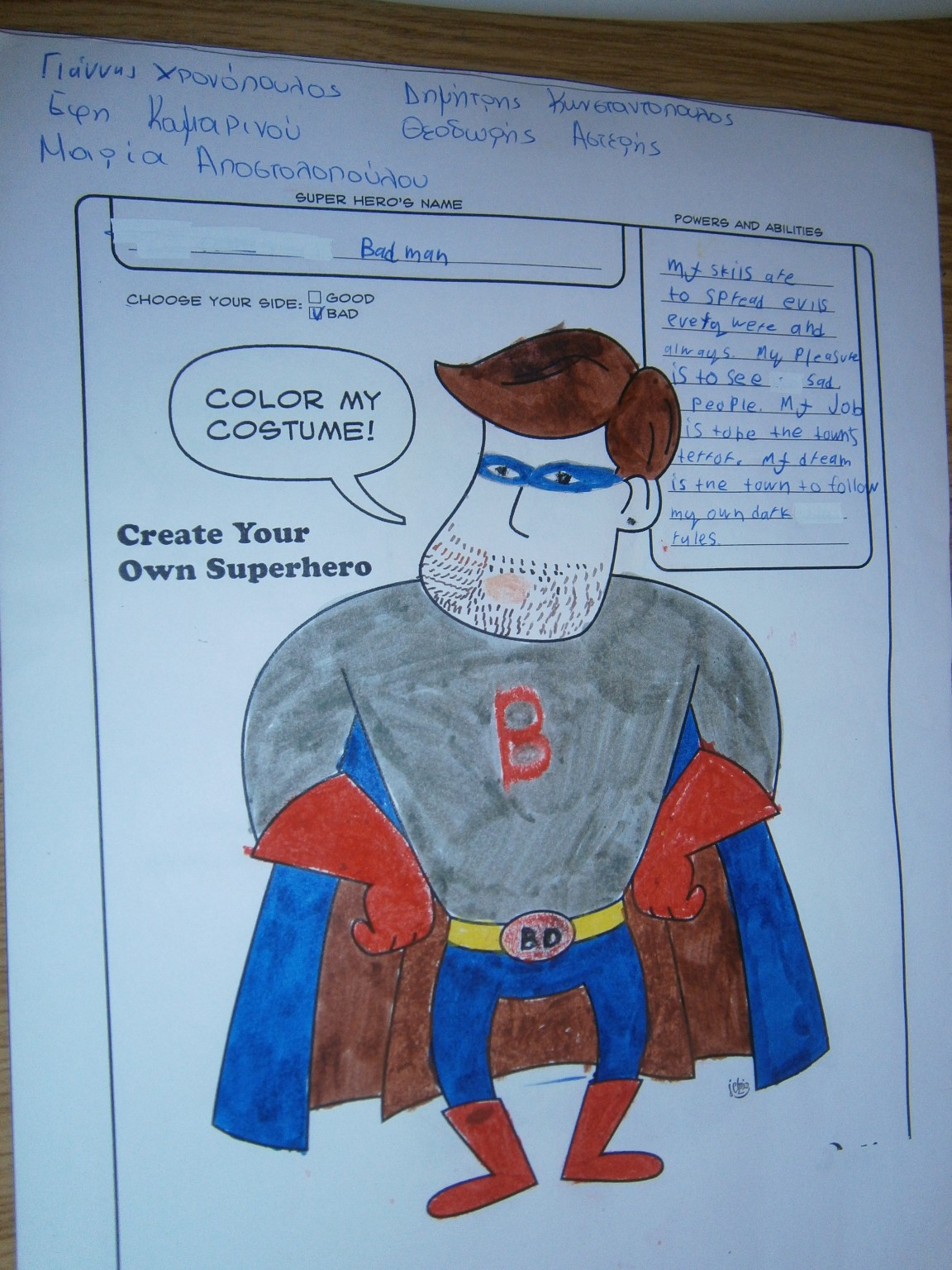
As far as the Pink Panther video is concerned (“Super Pink”), after guessing what the characters would say, I gave them their own printed superheroes ( boy and girl )and they had to write about their superpowers. Yes, I’m talking about Senior High School, not Primary School! They equally enjoy this activity!




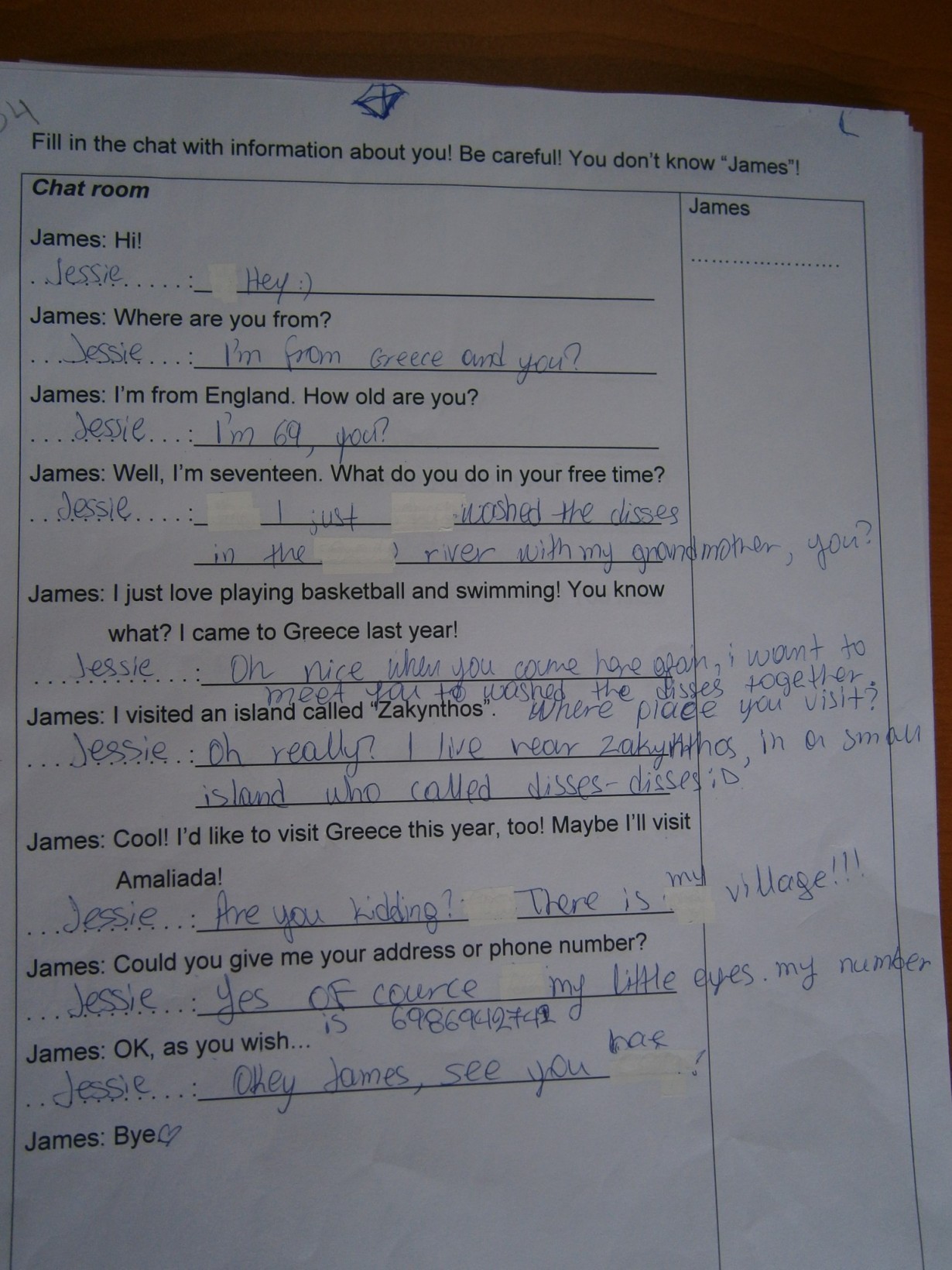
I wanted my students to practise in everyday conversation and I turned the dialogue I prepared into a Facebook chat, so as to attract their attention! My goal was to add the element of internet safety as well! Here’s how they responded!



It all started when a student of mine, Anna Maria Danika, complained that I keep making sweets for my colleagues, but nothing for my students! When I told her that I would make chocolate truffles for the whole school, she said: “Why don’t you bring the ingredients at school, so that we can help you?” Thinking as a teacher, I proposed: “How about turning this into a video, with instructions in English?”
Here is the result! We offered the truffles to the whole school on the last day of lessons, in May 2015. They vanished into thin air within minutes!
Our school advisor, Ms Marianthi Kotadaki, organised a seminar called “Digital Storytelling for the Development of Productive and Collaborative skills” and I thought it would be a good idea to attend it.
In order to understand the way digital stories are built, we had to write our own short story and turn it into a digital one! My story is about school bullying. The tool I used was “Picasa 3“, as I have used it before and allows the use of image, sound and slides with text. Special thanks go to my colleague, Christina Chorianopoulou, for lending her warm voice to narrate “Regret”, my short story. Here is the dropbox link to it.
The ultimate aim, of course, is to encourage your students to create their own digital stories!
That’s exactly what I did with my students! I chose an easy programme, Photostory 3, which you download on your PC and then add photos, text and sound. It will turn all these into a beautiful video! All they had to do was to think of a story! They came up with a very touching one, “2 Bodies, 1 Soul” and another one for Halloween!
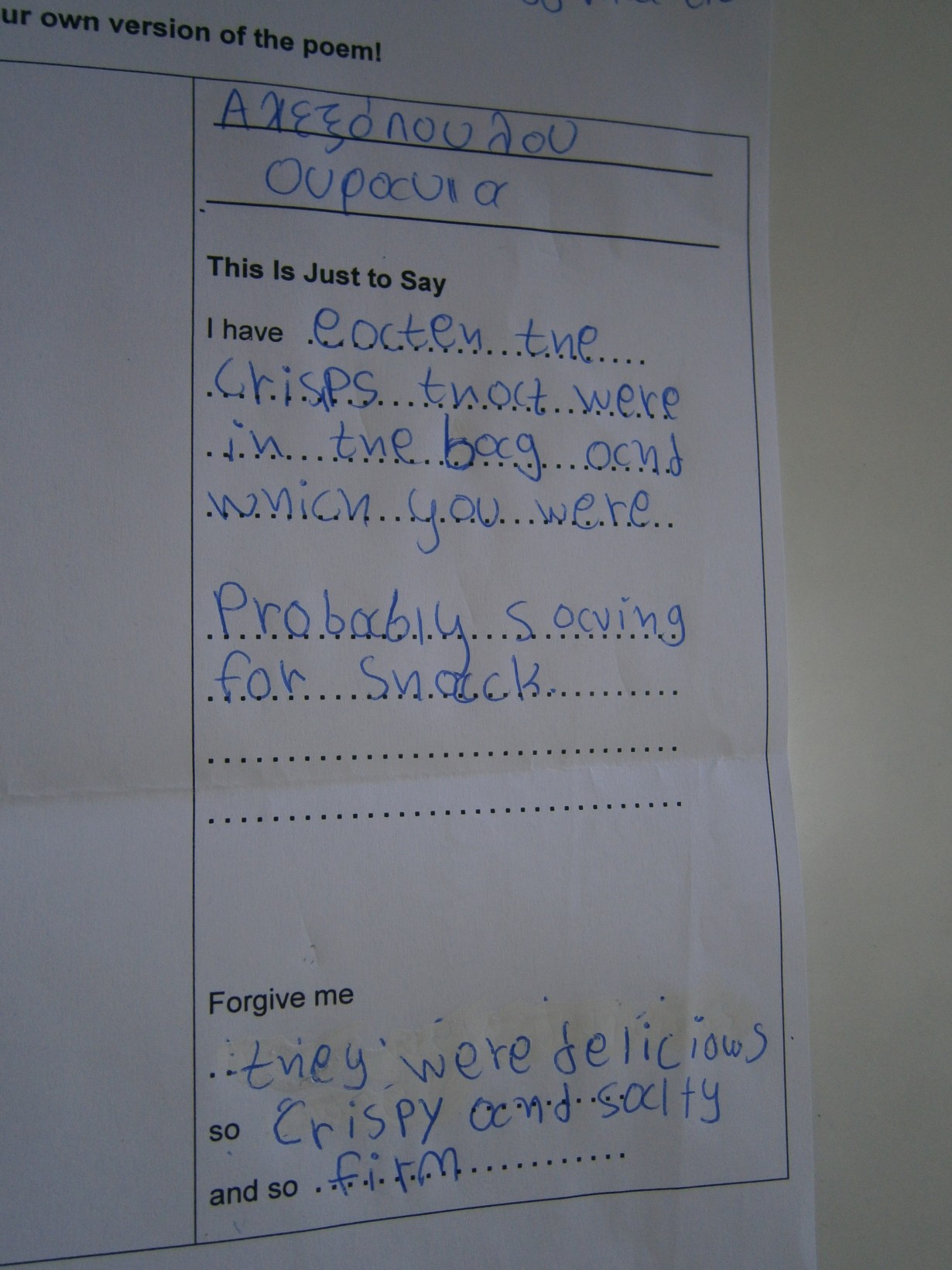
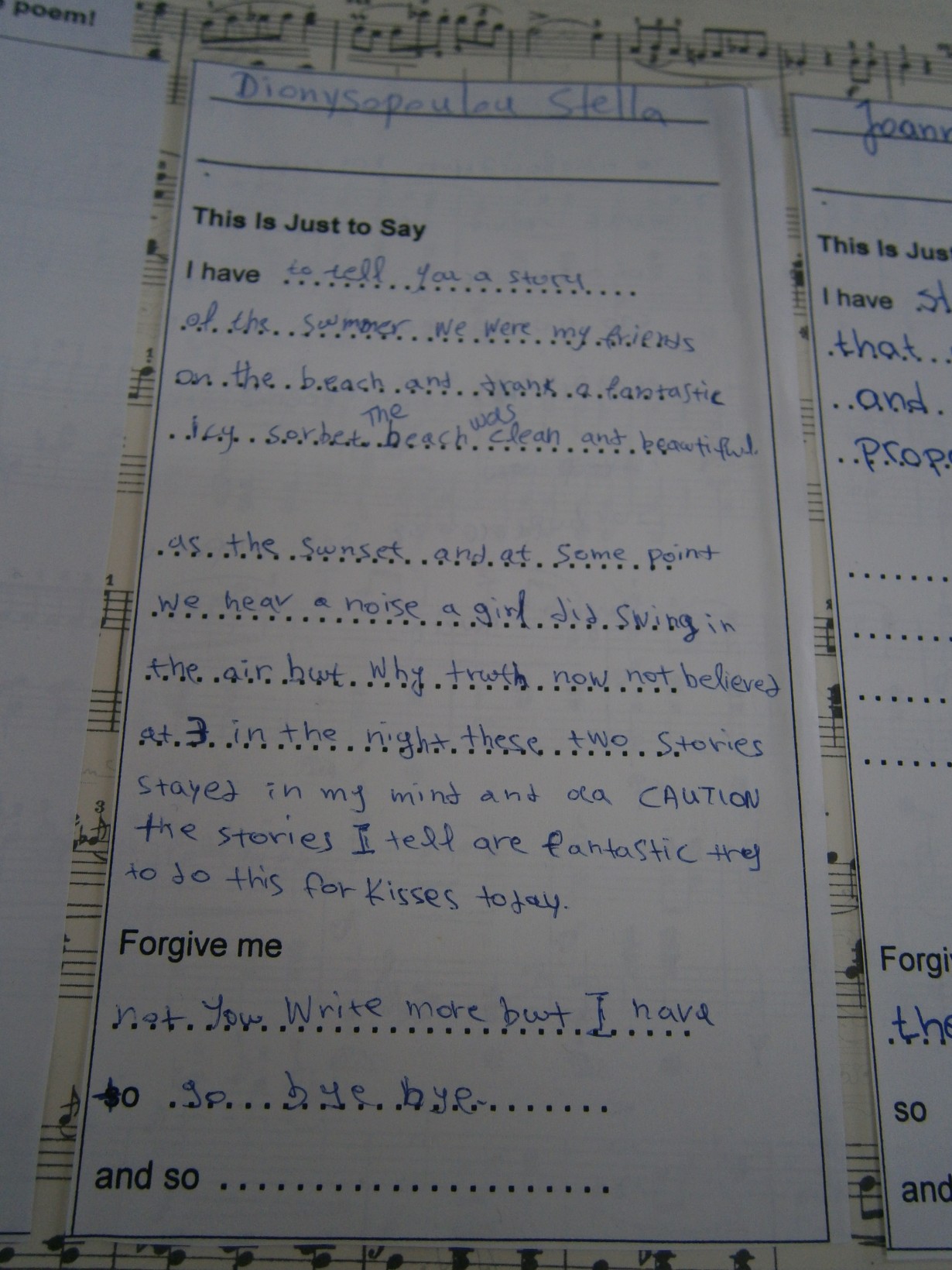
Inspired by Chuck Sandy‘s blog post and webinar about using poetry in the classroom, I introduced the poem “This is Just to Say” (William Carlos Williams) to my students and asked them to write their own version of the poem! This was not a compulsory task and only a few students were interested in giving it a try, but it was a good start!

Versions of “This is Just to Say”






Another engaging activity is to divide students in groups and let them put the verses of a poem in order! One of my favourite poems is “Stopping by Woods on a Snowy Evening” by Robert Frost.

Another option is to simply read and analyse a beautiful poem, such as “The Road Not Taken”, also by Robert Frost.

One day, as I was looking at the school’s (2nd Vocational High School of Amaliada) puppet theatre, I thought: “How could we use this as part of our English lesson?”
I tend to look for activities that motivate my pupils, but also convey a good message to them. What better than Aesop’s fables? A Greek author, translated in English! I gave them the text of “The 3 axes” and asked 4 of them to take part in it. The dolls and puppets were ready; I just covered with a yellow-golden cloth God Hermes and made the tree, the river and the 3 axes.

Aesop’s fable, “The 3 axes”
They were reluctant at first, but they really enjoyed doing something that reminded them of their early childhood! Then, I added music and sound effects from www.freesfx.co.uk , edited the video and it was ready to watch!
As actors usually say, films do not compare to theatre. That is the reason why I encouraged my pupils to take part in two short theatrical performances. Due to the generally low level of competency in English, I chose two very well known works, “A Christmas Carol”, by Charles Dickens and “Little Red Riding Hood”, so that they would find the plot familiar. The scripts were extensively modified, which resulted in quite short versions. Our “Christmas Carol” was actually the scene with the three spirits that visit Scrooge and “Red Hoodie” was based on “Girl in da Hoodie” by Sid River, an English teacher. As I am always concerned with teenagers’ interests, I added a reference to Facebook and Twitter, so that “Red Hoodie” conveys a message about internet safety.
The leading roles were given to more competent users of the language and weaker pupils also took part by saying only a couple of lines. As there was the concern that the audience will not comprehend what is being said, I taught to every single class the script a few weeks before the performance. In such cases of live performances, music and sound quality (microphones) are really important. Even though there were sound problems in “A Christmas Carol”, the outcome was that both my pupils and the audience enjoyed the performances. Both videos can also be found on the youtube channel of the 2nd EPA.L. of Amaliada.


Those performances took place during the school year 2013-2014. After staging the short version of “A Christmas Carol”, I was in charge of the Christmas celebration in 2014 as well. I didn’t want to stage the same play, though. As I was unable to find a similar, popular Christmas play, I thought of writing one myself! The outcome was “It’s Christmas Time”, a play that combines English with Greek, as it’s about two English tourists that ask for information from two Greeks and they find out about each other’s Christmas customs. A Prezi presentation and Christmas carols accompanied the performance. In order to make it easier for the audience to understand what is being said, one of the Greeks was supposed to hardly speak any English and the other Greek explained to him what the tourists said. It turned out to be a wonderful Christmas celebration!

“It’s Christmas Time!” (2014)
After a year’s break, I was responsible for organising the Christmas school celebration in 2016. Inspiration came again from “A Christmas Carol”. One of my colleagues, Ms Elena Panopoulou had this amazing idea and shared it on Facebook. How about presenting a Scrooge who is addicted to gadgets and the internet, but changes his mind after the Christmas Spirit’s visit and donates his devices to an organisation? I thought that was a brilliant idea and wrote the script for a 10 minute play. The outcome was “Mr Scroogle” (Scrooge+Google). You will find it as the second part of our celebration here .

2nd EPAL of Amaliada, “Mr Scroogle”.
I tend to use popular songs in the classroom, as gap-filling listening exercises.
Even though I have an archive of about 100 songs, I always ask my pupils what their favourite songs are and each year I update my song list. I let them know, of course, that if the lyrics cannot be heard clearly and there is inappropriate language, I will reject the song.
Two sites that I use are www.azlyrics.com (with song lyrics) and http://batlyrics.net (with lyrics and video).