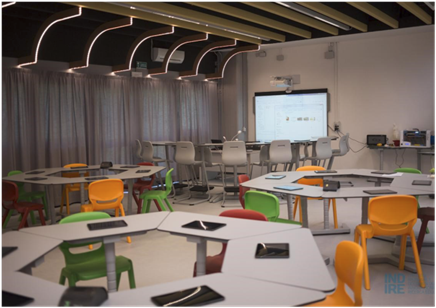
In the report published by ISTE, Basye et al (2015) highlight the need for learning spaces to be ‘active’ in order to allow students to communicate and collaborate, as they will be expected to do so in the workplace. They explore the notion of ‘Active Learning’ to demonstrate how the teacher can change what is happening at the centre by synthesising space, technology and pedagogy.
The report presents examples of ‘active learning’ in contrast to ‘passive learning’ emphasising the need for the students to be involved in different activities during the course of the lesson. (2015, p.26)
The concept of active learning is defined by Bonwell and Eison (1991, p.2) as ‘anything that involves students in doing things and thinking about the things they are doing.’ Sean Corcorran, General Manager, Steelcase Education (2015, p.x) states: “Pedagogy as the driver, supported by space and technology, all working together, empower teachers to be their most effective and students their most engaged and successful.” This is not a new idea, but the reality is that the concept is not always fully demonstrated as either the constraints of the space, the technology in use or the pedagogical approach prevents the synthesis. The challenge of integrating technology in schools within existing spaces and developing pedagogical approaches is a recognised area for continued research. Drawing on research that Steelcase has supported, there are several resources on the company’s web site related to blended learning, active learning and the design of learning spaces that teachers and school leaders may find useful.
The ISTE Report (2015) draws on a research project undertaken by Steelcase Education (2014) where the findings show that ‘classrooms intentionally designed to support active learning increased student engagement on multiple measures as compared to traditional classrooms.’