4 Skills Great Innovators Share (by Greg Satell)
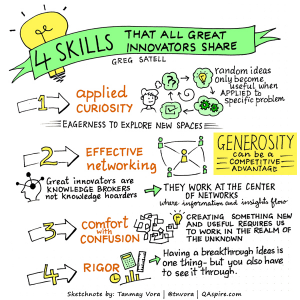
If creativity is about having unique ideas and new ways to do things, innovation is all about making those ideas happen.

In that sense, the bridge between creativity and innovation is made from the bricks of execution. That is when the rubber meets the road.

One of the key characteristics of someone who innovates is that they run small pilots to test their hypothesis. When they encounter ideas (or interesting intersections of already existing ideas), they tinker with the idea, execute in small chunks and learn along the way to adapt. They understand that to make a few things work, they have to try, fail and learn from many other things. They have to collaborate and network with others. They have to be comfortable with ambiguity and chaos when they experiment.

In this context, I read a brilliant post (with some great examples) from Greg Satell about 4 skills that all great innovators share. I highly recommend you read the full post in which Greg supports these skills with excellent examples to make sense of it all.

Classroom Observation

Classroom observation

The observation is structured around the seven principles that new observations should be based upon proposed by Williams (1989, pp.86-87), in contrast to traditional observations during which the observed teacher had no responsibility about the aim and content of the observation. These principles are:

  1. Development
  2. Limited and focused content
  3. Course-link
  4. Teacher-centredness
  5. Future development
  6. Positiveness
  7. Flexibility

Peer Observation

Peer-observation

Freeman (1982) suggests that the observation approach to be adopted largely depends on which part of the training-development continuum the observed teacher belongs to. Taking into consideration the observed teacher’s teaching profile as presented above, the type of observation to be used is for professional development (Malderez, 2003). To that end peer observation will be applied in this particular context.

The observed teacher has asked a fellow EFL teacher to undertake the role of the observer. The latter is a woman with 20 years of teaching experience. Both teachers have known each other for a long time and have collaborated on a professional level. In addition, the observed teacher has observed the class of her colleague, as well.

Peer-observation is beneficial for the reason that it is teacher-centred (Williams, 1989). That means that the observed teacher is the one who decides on the process of observation and on how to use the observer (Freeman, 1982· Malderez, 2003). Also, in this approach to observation the observed teacher is equal to the observer, in contrast to the authoritative style of traditional observations (Kennedy, 1993) and the focus is on teacher development rather than on evaluation (Sheal, 1989).