 Chinese New Year , Spring Festival or the Lunar New Year, is the festival that celebrates the beginning of a new year on the traditional lunisolar Chinese calendar. In Chinese culture and Asian countries within the Sinosphere, the festival is also commonly referred to as Spring Festival ; as the spring season in the lunisolar calendar traditionally starts with lichun, the first of the twenty-four solar terms which the festival celebrates around the time of the Lunar New Year. Marking the end of winter and the beginning of the spring season, observances traditionally take place from New Year’s Eve, the evening preceding the first day of the year to the Lantern Festival, held on the 15th day of the year. The first day of Chinese New Year begins on the new moon that appears between 21 January and 20 February. In 2021, the first day of the Chinese New Year was on Friday, 12 February, which is the Year of the Ox.
Chinese New Year is one of the most important holidays in China, and has strongly influenced Lunar New Year celebrations such as the Losar of Tibet and of China’s neighbouring cultures, including the Korean New Year , and the Tết of Vietnam. It is also celebrated worldwide in regions and countries that house significant Overseas Chinese or Sinophone populations, including Taiwan, Singapore, Indonesia, Malaysia, Myanmar,[6] Thailand, Cambodia, the Philippines, and Mauritius, as well as in North America and Europe.
The Chinese New Year is associated with several myths and customs. The festival was traditionally a time to honour deities as well as ancestors. Within China, regional customs and traditions concerning the celebration of the New Year vary widely, and the evening preceding the New Year’s Day is frequently regarded as an occasion for Chinese families to gather for the annual reunion dinner. It is also traditional for every family to thoroughly clean their house, in order to sweep away any ill-fortune and to make way for incoming good luck. Another custom is the decoration of windows and doors with red paper-cuts and couplets. Popular themes among these paper-cuts and couplets include that of good fortune or happiness, wealth, and longevity. Other activities include lighting firecrackers and giving money in red paper envelopes. For the northern regions of China, dumplings are featured prominently in meals celebrating the festival. It often serves as the first meal of the year either at midnight or as breakfast of the first day.
Source: Wikipedia
Watch these videos to learn about the Chinese New Year! Chinese New Year around the world!
Κινέζικη Πρωτοχρονιά
Τα χαρακτηριστικά της Κινεζικής Πρωτοχρονιάς
- Οικογενειακή γιορτή. Αναμένονται πάνω από 1 δισεκατομμύριο μετακινήσεις, προκειμένου οι Κινέζοι να βρεθούν κοντά στα αγαπημένα τους πρόσωπα. Θυμίζει κάτι από την αμερικανική εορτή των Ευχαριστιών (Thanksgiving Day).
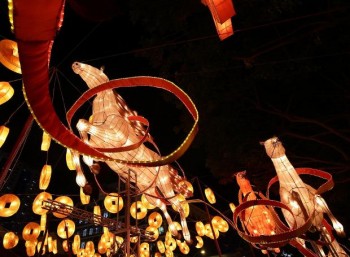
- Διαρκεί 15 ημέρες και λήγει με τη Γιορτή των Φαναριών (26 Φεβρουαρίου το 2021) Μόνο οι τρεις πρώτες ημέρες είναι αργία για τους Κινέζους.
- Ρίψη πυροτεχνημάτων, καθώς ο θόρυβος που προκαλούν πιστεύεται ότι διώχνει τους δαίμονες και τα κακά πνεύματα.
- Το κόκκινο είναι το κυρίαρχο χρώμα, στην ενδυμασία, στη διακόσμηση και τα δώρα. Συμβολίζει τη φωτιά, που πιστεύεται ότι διώχνει την κακή τύχη.
- Το κέικ είναι προσφιλές δώρο, που συμβολίζει την πρόοδο.
- Το εορταστικό τραπέζι περιλαμβάνει πιάτα με βάση το κοτόπουλο και το ψάρι, ενώ το πιο δημοφιλές φρούτο είναι το μανταρίνι.
Πηγή: https://www.sansimera.gr