Search this blog
Categories
- 2012 Doomsday (1)
- 9/11 Anniversary (1)
- Adverbs of Degree (1)
- Afghan Landslide (1)
- Africa (2)
- Animals (7)
- Apple (2)
- April Fool's Day (1)
- Articles (1)
- Athens Polytechnic Uprising (1)
- Berlin Wall (3)
- Britain (2)
- Bullying (2)
- Cartoon (4)
- Children (3)
- Chile (1)
- China (3)
- Christmas (2)
- Clauses of Result (1)
- Cloze tests (7)
- Comparison (1)
- Countable / Uncountable Nouns (1)
- Crime and Punishment (6)
- Crosswords (4)
- Debt crisis (6)
- Earthquakes (3)
- Easter (1)
- Floods (1)
- Football (2)
- Games (5)
- George Orwell (1)
- Grammar (12)
- Greece (1)
- Halloween (5)
- Holidays (9)
- hunger crisis (1)
- Idioms (2)
- Irregular Verbs (2)
- Jack-o'-lantern (1)
- Japan (3)
- Jeopardy games (3)
- Jobs and Occupations (2)
- Languages (1)
- Law and Justice (5)
- Lewis Carroll (1)
- Lunar Eclipse (1)
- Malala Yousafzai (2)
- miners (1)
- Moon (1)
- Movies (4)
- Natural Disasters (10)
- Nelson Mandela (1)
- News stories (Reading) (10)
- News stories (video listening) (19)
- Oscar Wilde (4)
- Past Simple (2)
- Personality Adjectives (3)
- Phrasal Verbs (1)
- Poetry (1)
- Powerpoints (4)
- Present Tenses (1)
- Question tags (1)
- Racism (2)
- Refugee Crisis (2)
- Reported Speech (1)
- riots (1)
- Santa (1)
- School and Education (3)
- Skydiving (1)
- Songs (6)
- Speaking (2)
- Sports (2)
- Stative Verbs (1)
- Steve Jobs (3)
- Success (1)
- summer (1)
- Syria (2)
- Technology (1)
- TED Talks (1)
- Tenses (3)
- Terracotta Army (2)
- Thanksgiving (2)
- The Conditional (2)
- The Death Penalty (2)
- The Passive (4)
- Today in History (2)
- Trailers (2)
- Travel (1)
- Unemployment (1)
- used to (3)
- Videos (57)
- Vocabulary (14)
- Volcanoes (1)
- Weather (3)
- Word Formation (1)
- Worksheets (36)
- world population (1)
- would (2)
- WWW (1)
- Year in review (1)
- Χωρίς κατηγορία (1)
Blog Archive
- November 2015 (4)
- September 2015 (4)
- July 2015 (1)
- June 2015 (1)
- May 2015 (2)
- March 2015 (5)
- December 2014 (1)
- November 2014 (1)
- October 2014 (2)
- September 2014 (2)
- May 2014 (4)
- April 2014 (1)
- March 2014 (1)
- December 2013 (1)
- November 2013 (1)
- April 2013 (1)
- March 2013 (5)
- February 2013 (3)
- January 2013 (2)
- December 2012 (1)
- November 2012 (1)
- October 2012 (6)
- September 2012 (3)
- August 2012 (1)
- July 2012 (1)
- June 2012 (1)
- April 2012 (2)
- March 2012 (1)
- February 2012 (4)
- January 2012 (2)
- December 2011 (2)
- November 2011 (3)
- October 2011 (4)
- September 2011 (6)
- August 2011 (12)
- July 2011 (17)
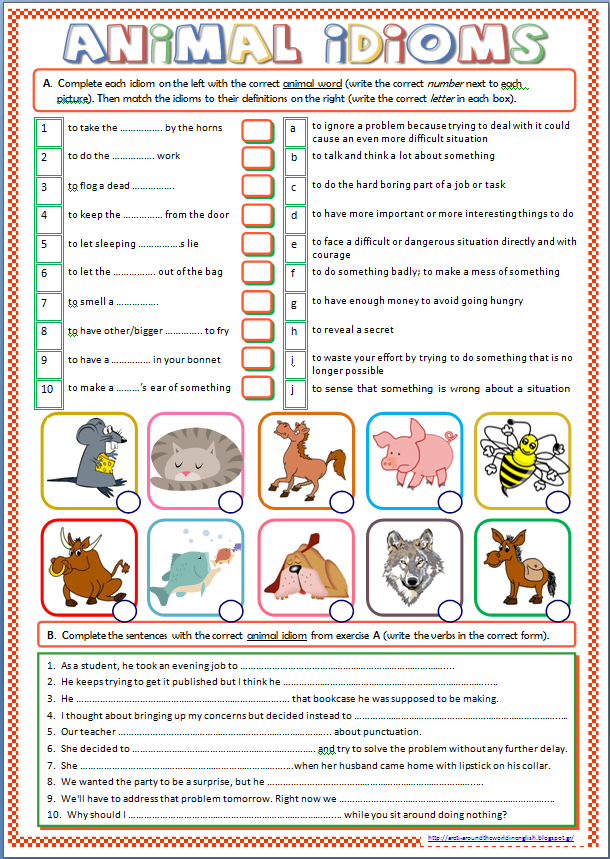
Animal Idioms (worksheet)
The aim of this worksheet is to practise some animal idioms. The students first complete the idioms with the correct animal words and then they match the idioms to their definitions. Finally they use the same idioms to complete some sample sentences.
Download here: http://www.scribd.com/doc/100865794/Animal-Idioms
You can also find an online version here: http://www.englishexercises.org/makeagame/viewgame.asp?id=8321
Posted in Animals, Idioms, Vocabulary, Worksheets
Leave a comment
Cartoon: The Devil and the Deep Blue Sea
This cartoon by Schrank from The Independent on Sunday relates to today’s Greek elections.
A Greek man is shown standing on the edge of a cliff. German Chancellor Angela Merkel is wagging her finger at him (a sign of warning or disapproval) and indicating with her thumb that he should take the path into the black mountains, where lightning is flashing. A thought bubble indicates that the Greek man sees Merkel as a devil with horns giving a Nazi salute.
COMMENTARY
If you say that someone is between the devil and the deep blue sea, you mean that they are in a difficult situation where they have to choose between two equally unpleasant courses of action (see here for a discussion of the origin of this idiom). In this case, Greece has the choice between the path of austerity (as dictated by Merkel and symbolized by the forbidding mountains), or a suicidal leap into the sea (exit from the euro zone). The ruined temple can be seen as a metaphor for Greece’s economic ruin.
ALSO SEE
• Greek election: what could happen (The Guardian)
• Greece prepares for election: ‘we are going to the wall … things must change’ (The Guardian)
• Adams comment cartoon (The Telegraph)
• Greek election: what could happen (The Guardian)
• Greece prepares for election: ‘we are going to the wall … things must change’ (The Guardian)
• Adams comment cartoon (The Telegraph)
Reposted from The English Blog
Posted in Debt crisis, Greece
Leave a comment
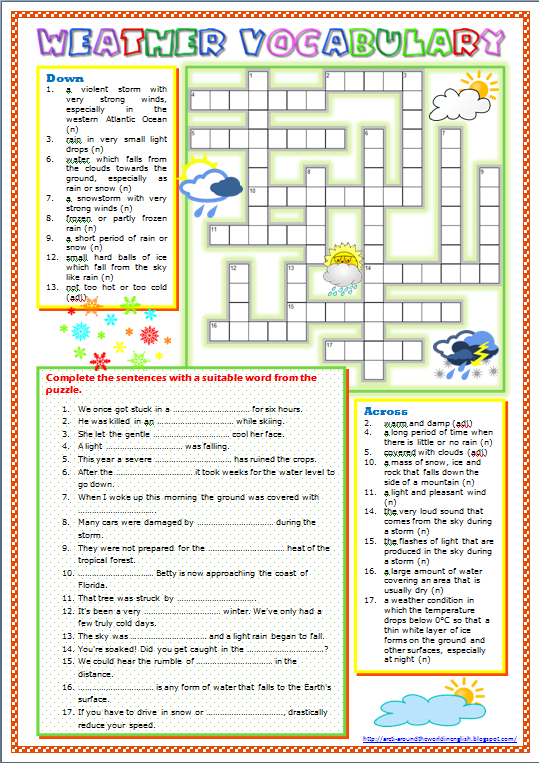
Weather Vocabulary (worksheet)
The aim of this worksheet is to revise some weather vocabulary, such as ´blizzard´, ´hurricane´, ´drought´ etc. It contains a crossword puzzle and a gap-fill exercise. B/W copy and Answer Key provided.
You can also find an online version here: http://www.englishexercises.org/makeagame/viewgame.asp?id=7969
Weather Quiz
Test your knowledge of weather vocabulary with this fun quiz.
Posted in Vocabulary, Weather, Worksheets
2 Comments
If Britain were Greece…
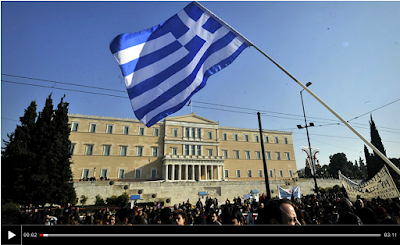
Job losses in the tens of thousands, drastic wage cuts, and working even further into old age – just some of the challenges that would loom in the UK if the government had to introduce austerity cuts on the scale currently facing the Greeks.
For BBC Radio 4’s Broadcasting House – the Sunday Times Economics Editor, David Smith, was asked to imagine what would happen if Britain had Greece’s problems.
Click on the image below to watch the audio slideshow.
Posted in Britain, Debt crisis
Leave a comment
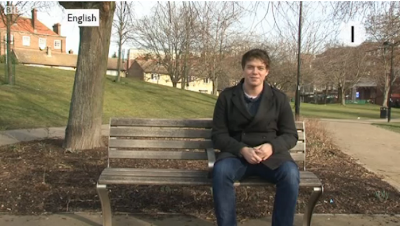
BBC News video: How did this man learn 11 languages?
How do you become fluent in 11 languages?
BBC News UK, 21 February 2012 (Click on the image to watch the video)
Twenty-year-old Alex Rawlings has won a national competition to find the UK’s most multi-lingual student.
The Oxford University undergraduate can currently speak 11 languages – English, Greek, German, Spanish, Russian, Dutch, Afrikaans, French, Hebrew, Catalan and Italian. (Read more…)
Read a relevant article on BBC News Magazine: The Cult of the Hyperpolyglot
Posted in Languages
Leave a comment