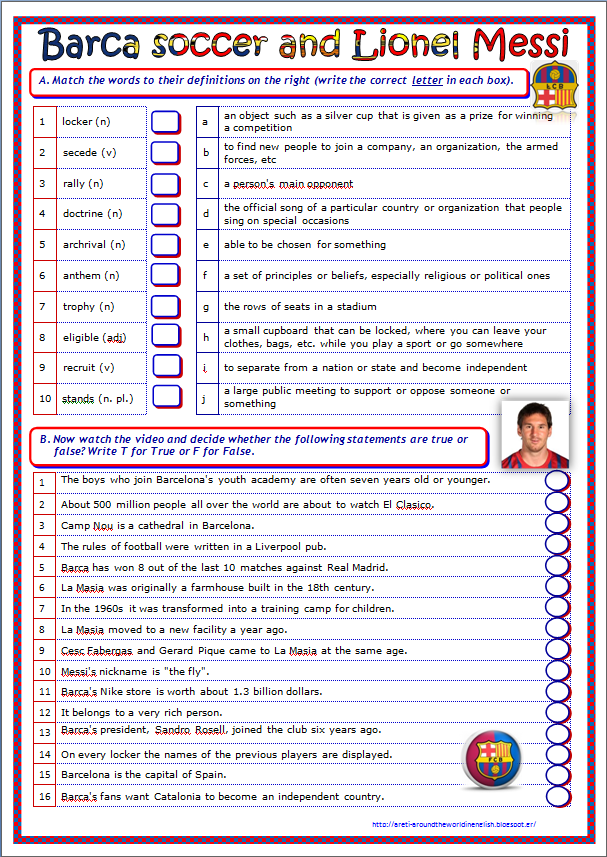
Lionel Messi and the ascent of Barca soccer (worksheet)

Here’s a worksheet that can be used with the CBS 60 Minutes video about Football Club Barcelona and Lionel Messi. (See related post here)

Download here: http://www.scribd.com/doc/122944701/Barca-Soccer-and-Lionel-Messi-video-listening-activity

Posted in Football, Sports, Videos, Worksheets | 1 Comment

Lionel Messi and the ascent of Barca soccer (CBS video)

SOURCE: CBS NEWS
With stars like Lionel Messi and a youth academy bringing up the next generation of athletes, is Barcelona becoming the world’s best soccer team? Bob Simon reports.
Click here to watch the video on CBS News.
Click here to watch the video on YouTube.
Click here to read the transcript.

Watch the video and answer the following questions. (Click the CC button if you wish to view the video with English subtitles.)

  1. What is football called in the USA? 
  2. What is the secret of Barcelona’s success? 
  3. What team is Barca’s main opponent? 
  4. What is a match between the two clubs called? 
  5. What is La Masia? 
  6. What is the Masia’s new facility like? 
  7. What happens if a boy does not study enough and just likes to have a good time? 
  8. What is the Barca doctrine? 
  9. Why has the Masia been called a football factory? 
  10. How many members does FCB have? 
  11. How many competitions has Barca won in the last four years? 
  12. What record did Messi break last month? 

Now try the following quiz.

ionel Messi and the ascent of Barca soccer » Quiz School

Click here to download a worksheet about Lionel Messi.

Posted in Football, Sports, Videos | Leave a comment

Janine Shepherd: A broken body isn’t a broken person (a TEDx Talk video)

Cross-country skier Janine Shepherd hoped for an Olympic medal — until she was hit by a truck during a training bike ride. She shares a powerful story about the human potential for recovery. Her message: you are not your body, and giving up old dreams can allow new ones to soar.

Watch the video and answer the following questions.
If you wish to watch the video with English subtitles, click here.

  1. Where was Janine and what was she doing when the accident happened?
  2. How was she carried to hospital?
  3. When did the internal bleeding stop?
  4. Was the operation successful?
  5. Could Janine still go to the Olympics?
  6. Where was she transferred after she was out of intensive care?
  7. How many other people were there?
  8. What was amazing about their situation?
  9. Why did the nurse give them the plastic straws?
  10. How long did Janine stay in hospital?
  11. How did she feel after she got home?
  12. Why being next to Maria in the spinal ward had been a blessing for Janine?
  13. What was the creative project Janine was now about to start?
  14. Where did she get the idea of learning how to fly?
  15. What feeling did she experience on her first flight when the airplane took off and they were flying in the air?
  16. What did Janine achieve just under 18 months after she had left the hospital?
  17. What did she have to do before she was able to create a new life?

Alternatively, you can try the following quiz.

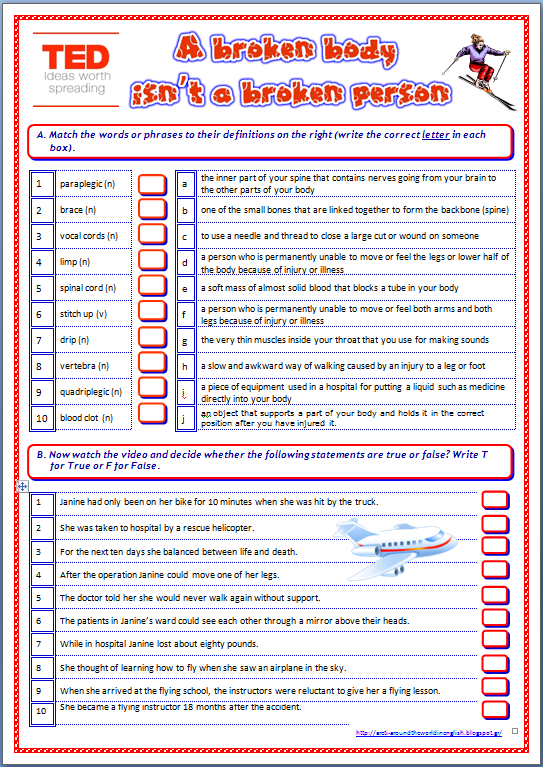
     Here is a worksheet based on this video.
     

    Click here to download the worksheet.

      Posted in TED Talks, Videos, Worksheets | Leave a comment

      Bet You Didn’t Know: Thanksgiving (video)

      Find out which traditional recipes weren’t served at the first Thanksgiving celebration.

      SOURCE: http://www.history.com/videos/bet-you-didnt-know-thanksgiving

      Click on the image below to watch the video.

      TRANSCRIPT
      We are all familiar with the story of the first Thanksgiving, when the Pilgrims invited local native Americans to share a meal with them. But we bet you didn’t know Thanksgiving didn’t become an annual tradition until more than 200 years later.
      That first Thanksgiving in 1621 wasn’t just one big meal. It was a three-day festival of eating, hunting and other entertainments in honor of the Pilgrims’ first successful harvest. The Indians killed five deer as gifts for the colonists. So venison was definitely on the first Thanksgiving menu but we bet you didn’t know that turkey was not. They also didn’t have pumpkin pie or potatoes, which hadn’t been introduced to New England yet. And while they may have eaten cranberries, they would have been served plain not in a sauce or relish.
      The Pilgrims didn’t plan on starting a Thanksgiving tradition. In fact they didn’t repeat the November celebration in subsequent years. In 1789 President George Washington announced the first ever national Thanksgiving holiday, which took place on Thursday November 26th but it didn’t become an annual tradition nationwide until the 19th century. That’s when an American writer named Sara Josepha Hale, most famous for writing the nursery rhyme ‘Mary Had a Little Lamb’, was inspired by a diary of Pilgrim life to recreate that first Thanksgiving feast. Beginning in 1827 Hale waged a 30-year campaign to make Thanksgiving a national holiday. She also published recipes for pumpkin pie, turkey and stuffing, that probably didn’t appear on the Pilgrims’ plates but would become staples of modern Thanksgiving meals.
      In 1863 in the midst of the Civil War President Abraham Lincoln announced that the nation would celebrate Thanksgiving every year on the final Thursday in November. But did you know in 1939 President Franklin D. Roosevelt decided to move the holiday up a week to give Depression Era retailers more time to make money during the pre-Christmas shopping season. The move was widely criticized and in 1941 F.D.R. signed a bill fixing Thanksgiving on the fourth Thursday in November, where it stays today.
      One of the quirkiest Thanksgiving traditions began in 1989 when President George H. W. Bush granted the first official pardon to a turkey. Every November since then the current oval office occupant has given a reprieve to one or two turkeys sending them into retirement on a farm rather than to a dinner table. Though it only began in the late 20th century, the story has become one of the more unusual chapters in the long history of Thanksgiving traditions.

      VOCABULARY

      • Venison is the meat of a deer.
      • Relish is a cold thick spicy sauce made from fruit and vegetables that have been boiled, that is served with meat, cheese, etc.
      • When you wage a war, a battle, a campaign, you start and continue it in order to get or achieve something.
      • A staple is an important food that is eaten very often. e.g. Rice is the staple of their diet.  
      • Depression Era is the period of time (the 1930s) when the U.S. and many other countries were in a very bad depression (= a period of time in which there is little economic activity and many people do not have jobs).
      • A pardon is an official decision not to punish somebody for a crime.
      • A reprieve is an official order stopping a punishment, especially for a prisoner who is condemned to death.  

        
      Now test your knowledge of Thanksgiving with the following quiz.

        Posted in Holidays, Thanksgiving, Videos | Leave a comment

        Bet You Didn’t Know: Halloween (video)

        It’s one of America’s favorite holidays, but what’s the real story behind the tricks and treats of Halloween?

        Watch the video and answer the following questions.

        1. What do most people think of when they think of Halloween?
        2. How far back can the origins of Halloween be traced?
        3. What day was Samhain ( /ˈsɑːwɪn/, /ˈs.ɪn/) celebrated on?
        4. What did the Celts believe happened on the night before Samhain?
        5. What would people do to prevent spirits from harming them?
        6. Why did they wear masks before they left the house?
        7. When did the Christian Church turn Samhain into All Saints’ Day?
        8. What was the night before called?
        9. In the medieval tradition of souling what would the needy do in return for the soul cakes?
        10. In the tradition of guising what would young people do ?
        11. Who brought these old traditions to America? When?
        12. When did Halloween take on its current form?
        13. What is the estimated cost of celebrating Halloween each year?

        TRANSCRIPT
        When most people think of Halloween, they think of trick-or-treating, parades, bobbing for apples and other family-friendly activities. But bet you didn’t know the true story behind the ancient origins of Halloween. It all gets back some 2,000 years to the ancient Celtic festival known as Samhain celebrated on November 1st. On the night before Samhain people believed that the dead returned as ghosts. They would leave food and wine on their doorsteps to keep roaming spirits at bay and were masked when they left the house so they would be mistaken for fellow ghosts.
        The Christian Church turned Samhain into All Saints’ Day or All Hallows in the 8th century. The night before became All Hallows’ Eve, later shortened to Halloween.
        You’ve heard of trick-or-treating on Halloween but what about souling or guising? All three of these traditions originated in medieval Britain. On All Souls’ Day, November 2nd, the needy would beg for pastries known as soul cakes. In return they would pray for people’s dead relatives. This was called souling. In the medieval Halloween tradition of guising young people would dress up in costume and accept food, wine, money and other offerings in exchange for singing, reciting poetry or telling jokes.
        In 19th century America Irish and Scottish immigrants revived these old traditions. The result was trick-or-treating. At first it was much more about the tricks in the form of pranks and hijinks than treats. It wasn’t until the 1950s that the custom took on its current family-friendly, kid-centered form. Today Halloween is big business with US consumers spending more than $2.5 billion on costumes annually. Add in the candy and it’s estimated that Americans spend $6 billion on Halloween each year making it the second most commercial holiday after Christmas. So whether you are a fun of tricks, treats or trivia, there’s a bit of Halloween history. I bet you didn’t know…

        VOCABULARY

        • When you keep somebody or something at bay, you prevent someone or something unpleasant from harming you. e.g. The soldiers kept the attackers at bay. [=they did not allow the attackers to come closer]
        • Roaming means moving or travelling with no particular purpose. e.g. After the pubs close, gangs of youths roam the city streets.
        • A spirit is a ghost. 
        • A prank is a trick that is done to someone usually as a joke.  
        • High jinks (US hijinks) (plural noun, informal) = energetic and excited behaviour in which people do funny things or play tricks on someone  

        RELATED POSTS
        Halloween – History of the Jack O’ Lantern (worksheet) 
        Halloween Crossword (worksheet)

         MORE HALLOWEEN RESOURCES:
        http://www.history.com/topics/halloween
        http://www.esolcourses.com/topics/halloween.html
        http://www.englishcentral.com/video/15174/halloween-a-holiday-rich-in-history
        http://www.englishcentral.com/video/18473/its-halloween-again
        http://www.insideout.net/blog/elessons/halloween-3
        http://www.newsflashenglish.com/english-lessons/halloween
        http://learnenglishteens.britishcouncil.org/english-skills-practice/life-uk/halloween 
        http://learnenglish.britishcouncil.org/en/magazine/halloween 

        Posted in Halloween, Holidays, Videos | Leave a comment

        Skydiver’s edge-of-space dive breaks sound barrier (NBC News video)

        Oct. 15 – Austrian skydiver Felix Baumgartner makes a record-breaking jump from 24 miles above Earth, leaping from the edge of space to the New Mexico desert at speeds averaging 833 mph. NBC’s Tom Costello reports.

        Watch the video and answer the following questions:

        1. How many miles did Felix Baumgartner jump from?
        2. What did he say he was most afraid of?
        3. What records did he achieve?
        4. Had he made a high altitude jump before?
        5. Who held the previous highest free fall jump record?
        6. How long did it take for the balloon to reach the altitude of 24 miles?
        7. How long did Felix’s free fall last?
        8. Where did he land?
        9. What will he do after this achievement?

        TRANSCRIPT
        TV PRESENTER: …and now for a jump that is right out of the ages. Felix Baumgartner stepped out of a balloon more than 24 miles up on Sunday, and he stepped right into the record books. NBC’s Tom Costello has more on fearless Felix’s death-defying plunge. Say that three times fast. Tom, good morning.
        REPORTER: Good for you. Good morning! Felix Baumgartner said he was most afraid of dying in front of his family and his girlfriend, considering that he jumped from an altitude three times higher than where jets fly. It was the highest jump ever. He broke the sound barrier as he fell 833 miles per hour, and he broke a youtube record for the most watched number of live views.
        MISSION CONTROL: Felix, disconnect the oxygen hose. that a boy.
        REPORTER:  There he was at 128,000 feet standing quite literally on the edge of space, preparing to do what no one had done before, with his mom watching from mission control, 43-year-old Felix Baumgartner offered a few words most hard to understand.
        FELIX: The whole world is watching us.
        REPORTER: …and then he was gone beginning a terrifying supersonic dive from 24 miles up. A white dot as he quickly passed 700 miles per hour.
        MISSION CONTROL: speed 729.
        REPORTER:  The day began well before sunrise in Roswell, New Mexico as the Red Bull Stratos team laid out the paper-thin balloon and fearless Felix zipped into his high-tech spacesuit and capsule. Baumgartner is no novice. He’s made harrowing jumps before in Brazil and Croatia from 15 and 18 miles high, but Sunday’s mission was about breaking a free fall record that had stood since 1960 when Joe Kittinger jumped from 19.5 miles high and also breaking the sound barrier. If the suit tore, the former Australian military paratrooper faced instant death. He was a guest on the “Today” show earlier this year.
        FELIX: I like the challenge…
        REPORTER:  Sunday, after a brief burst of wind Baumgartner’s balloon got the green light.
        There’s the release, and there’s the applause.
        REPORTER:  Two and a half hours later he was standing where no man had stood before with Joe Kittinger on the radio.
        JOE KITTINGER: And our guardian angel will take care of you.
        REPORTER:  Out of the capsule Felix was a bullet, 833 miles per hour, mach 1.24, exceeding the speed of sound, and then with his space mask fogging up what looked like a terrifying out-of-control flat spin before he stabilized. Finally four and a half minutes later Baumgartner pulled his chute and went to a gentle landing in the New Mexico desert.
        FELIX: When I was standing there on top of the world, you become so humble you want to come back alive, you know, because you do not want to die in front of your parents, your girlfriend…
        REPORTER:  You want to come back alive… Nasa believes there could be real scientific value in this job, in the cutting edge spacesuit that he wore that allowed him to survive the jump and techniques that could be used in future commercial or Nasa space missions. What will he do after this? He’s ready to settle down and fly rescue helicopters for a living. Matt?

        WATCH a related video and do some great interactive exercises:
        http://learnenglishteens.britishcouncil.org/freetime/video-zone/record-breaking-skydive

        Now try the following QUIZ: Skydiving the speed of sound

        More resources
        http://www.onestopenglish.com/skills/news-lessons/weekly-topical-news-lessons/2012-weekly-news-lessons-archive/weekly-news-lesson-312-1st-november-2012-skydiver-lands-safely-on-earth-after-supersonic-record/552365.article

        http://www.newsflashenglish.com/english-lessons/one-giant-leap

        Posted in News stories (video listening), Skydiving, Videos | Leave a comment

        Malala Yousafzai: Pakistan activist, 14, shot in Swat (BBC News video)

        Oct. 9 – Gunmen have wounded a 14-year-old rights activist who has campaigned for girls’ education in the Swat Valley in north-west Pakistan.

        Watch the video and answer the questions. Click on the heading below to view the questions alongside the video. If you click on “flip”, you can see the answer to each question.

        Alternatively, you can click on the image below to watch the video. Then answer the following questions.

         
        1. What happened to the teenage girl? Why?
        2. Is her life still in danger?
        3. What did the Taliban announce in 2009?
        4. How old was Malala then?
        5. What did she do in reaction to this announcement?
        6. Did she use her real name?
        7. How did she feel while getting ready for school?
        8. What did the head teacher advise the girls to do?
        9. How many girls attended school that day?
        10. According to the family friend, what will Malala do if she gets well?
        11. Where is her family tonight?
        12. How common are Taliban attacks in the area?
        13. What will happen to the people who speak out against the militants?

        TRANSCRIPT
        REPORTER: Rushed away for treatment, the teenage girl who dared to defy the Taliban. Malala Yousafzai was shot in the head. Doctors say the next few days will be critical. This was Malala in her beloved classroom. When the Taliban tried to take it from her, she spread the news around the world. It was 2009 and the militants controlling the Swat Valley decreed that girls’ schools must close. Malala, then just 11, started a blog for the BBC Urdu Service written under a pen name. This was one of her entries.
        MALALA: I was very scared getting ready for school today because the Taliban announced that the girls should stop going. Our head teacher told us at assembly we shouldn’t wear a school uniform and just come in normal clothes. Out of 27 girls only 11 attended class today.
        REPORTER: After the militants were driven out, Malala was an outspoken campaigner for education for girls winning recognition at home and abroad. A family friend told us she will fight on if she makes a good recovery.
        FAMILY FRIEND: She will continue to educate herself, she will continue to inspire others also… I don’t think they are going to chicken out, I don’t think they are going to surrender.
        REPORTER: But the Taliban have threatened to target her again. They said she is western-minded and will not be spared. Tonight Malala remains in intensive care with her family at her bedside. Brutal Taliban attacks are nothing new here but the shooting of a child has caused shock and revulsion. The militants have said anyone else who speaks out against them, as Malala did, will be silenced. Orla Guerin, BBC News, Islamabad

        VOCABULARY

        • A militant is a person who is ready and willing to fight for a cause.
        • If a leader or government decrees something, they officially decide or order it. e.g. The City Council has decreed that all dogs must be kept on a leash.
        • A pen name is a name used by a writer instead of their real name.
        • If you chicken out, you decide not to do something because you are afraid. (informal) e.g. He was going to ask her on a date, but he chickened out at the last minute.   
        • When you surrender, you stop fighting because you know that you will not win. 
        • A brutal attack is a violent and cruel attack. 
        • Revulsion is a very strong feeling of dislike or disgust.  

        SOURCE: http://www.bbc.co.uk/news/world-asia-19891396

        RELATED ARTICLES

        Posted in Children, Malala Yousafzai, News stories (video listening), School and Education, Videos | 2 Comments

        Germany’s Merkel reassures Greece (Al Jazeera video)

        SOURCE: http://www.aljazeera.com/news/europe/2012/10/201210914115283592.html 

        Oct. 9 – Police disperse protesters trying to storm barricade as the chancellor holds talks with Greek PM in Athens.

        TRANSCRIPT
        REPORTER: She arrived in a plane bearing the flags of two countries that are uncomfortably bound together by the crisis in the Eurozone. Angela Merkel’s visit shows solidarity from the economic powerhouse of Europe to its weakest link and her host Antonis Samaras and his Greek government are desperately grateful for it.
        From the streets a different mood. These hospital workers tried to block her convoy but were forced back by police. And in central Athens outside parliament many thousands came to protest despite police restrictions. Amongst them the leader of the Greek Left, Alexis Tsipras, who says austerity policies have been dictated to Greece by Mrs Merkel and have ruined this country. They came from all parts of society including reserves from the army who chanted that Nazis should leave the country.
        PROTESTER: Mrs Merkel, hear the people of Greece. We are here. We are fighting for our rights and not for our country but for the whole Europe, for the people of Europe.
        REPORTER: Many of the people who have come here to protest have seen their living standards fall dramatically in recent years but it’s important to remember that Greek society is now very divided and there are others who are not protesting, who will welcome a visit, they will see it as a gesture of support from the most poerful politician in Europe.
        MRS MERKEL: Much success has been achieved by the Greek government between 2009 and 2011. The deficit went down. Many other factors say a lot of work was done. It was not easy for the people but I am convinced these difficult ways are worth trying and Germany wants to be a good partner and friend for Greece at these difficult times.
        REPORTER: On the streets things turned ugly. Eventually the police made a determined effort to disperse the crowds. Germans watching these scenes will wonder whether Greece is worth saving just as Greeks will wonder if they can take more pain. Mrs Merkel belatedly has acknowledged Greek sacrifices but the economy here will continue to shrink. Barnaby Phillips, Al Jazeera, Athens  

        VOCABULARY 
        -If a crowd of people disperses, or if someone disperses it, the people separate and go in different directions.
        -When a group of people storms something, they attack it suddenly with a lot of force.
        -A barricade is a temporary wall, fence, or similar structure that is built to prevent people from entering a place or area.
        -If you show solidarity with someone, you support them because you have the same opinions, aims, etc.
        -A powerhouse is a group of people or an organization that has a lot of power.
        -Austerity is an economic policy by which a government reduces the amount of money it spends by a large amount.
        -A deficit is the total amount by which money spent is more than money received.
        -When something happens belatedly, it happens very late or too late.
        -When you acknowledge something, you accept that it is true.
         

        Posted in Debt crisis, News stories (video listening), Videos | Leave a comment

        China’s ‘left behind’ children growing up without parents (BBC video)

        SOURCE: http://www.bbc.co.uk/news/magazine-19787240
        Oct. 1 – For many people in China, the mid-autumn festival and National Day holiday, falling within days of each other this year, means a week off work and a chance to spend time with friends and family.
        But for millions of China’s migrant workers, this is a working week like any other.
        Many of them have young children back in their villages and do not see them for months or even years on end.
        One Beijing organisation, the All China Women’s Federation, estimates there are some 58m of these “left behind children”.
        This is the story of just one girl, Tang Xiaoqian from Anhui province in central China.

        http://www.bbc.com/news/magazine-19787240

        Click on the picture above to watch the video and answer the following questions.

        1. How old is Tang Xiaoqian?
        2. How long has it been since she last saw her mum and dad? 
        3. What do she and her classmates have in common?
        4. How old was she when her parents left home?
        5. Where did they go? Why?
        6. What does she do when she misses them?
        7. Why does she cry when she talks about the speaking competition?
        8. What are her plans for the future regarding her parents and her village? 

        Alternatively, you can take the following quiz.

          TRANSCRIPT
          My name is Tang Xiaoqian. I’m eleven years old. I study at … (name of village) primary school. And it’s been eight years since I last saw my mum and dad. Almost all of my classmates are growing up without our parents. They are not at home for us. We are called ‘left behind’ children. When I was eight months old, my parents left home for Shanghai to find jobs. I live with my grandparents in the mountains. Every time it’s New Year my parents say they are too busy to come home. When I miss them, I write a letter, fold it into a boat shape, put it in the river hoping it will reach my mum and dad. Once I represented my school in a public speaking competition in a nearby city. Other children had parents cheering for them. I was just by myself. I want to study hard and go to university one day. I will make a lot of money and buy a big house for my parents. Then we can be together every day. Although the mountains and rivers are beautiful, we can only be farmers here. That’s why our parents have to leave to find jobs in big cities, like Shanghai and Beijing. They work very hard in the factories so we can go to school at home. When I grow up, I want to help turn my village into a city with big roads everywhere. I will open a big company and all the parents can come and work here. Then the children won’t be separated from their mums and dads any more.

          READ an article about China’s ‘Left-Behind Children’.

          WATCH a relevant documentary (in three parts):
          Rural China “Children Left Behind” Documentary (part 1 of 3)
          Rural China “Children Left Behind” Documentary (part 2 of 3)
          Rural China “Children Left Behind” Documentary (part 3 of 3) 

          Posted in Children, China, News stories (video listening), Videos | 1 Comment

          Dozens dead in Hong Kong ferry crash (Reuters video)

          Oct. 2 – At least 36 people died and dozens more injured when a ferry sank near Hong Kong’s Lamma island after a collision with another vessel. Sarah Charlton reports.

          Watch the video and answer the questions.

          1. How many people was the ferry carrying?
          2. What company did it belong to?
          3. Who were the passengers?
          4. Where was the ferry taking them?
          5. Where was the second ship heading?
          6. What followed the collision?
          7. How many people were sent to hospital?
          8. Did the second boat continue its journey?
          9. Were any children among the people who died?

          VOCABULARY
          A vessel is a ship or large boat (formal). e.g. a fishing/sailing vessel
          A maritime disaster is a disaster that happens at sea.
          When you launch something, you begin something that requires much effort. e.g. The police have launched an investigation into his activities.
          A mortuary is a place where the bodies of dead people are kept until they are buried or cremated

          There is a video transcript here. 

          Read more on this story:
          http://www.bbc.co.uk/news/world-asia-19797588 
          http://www.guardian.co.uk/world/2012/oct/02/hong-kong-ferry-disaster-36 


          http://www.theguardian.com/world/gallery/2012/oct/02/hong-kong-ferry-collision-pictures 
           
          Posted in News stories (video listening), Videos | Leave a comment