Inner Giant

index

“Inner Giant is much more than a book, it is a journey through the lives and experiences of its creators. It contains over twenty short stories written by a variety of authors, introduced by two fictional school boys adding a touch of humour and irony to the stories.
The second part contains poetry of all shapes and sizes, conceived by different, but talented poets.
There are several other parts to the book, each crammed with illustrations, photographs, paintings, essays, lesson materials and pieces of sound advice.
All the material in the book has one message, do not stand for bullying, do not stand by bullying and do not bully others.
The profits from the book are being donated to anti-bullying organizations. Making this unique work a must read for all. It’s time you found your own Inner Giant.” Frank Letras
Click here to order a copy. 


Posted in Bullying | Leave a comment

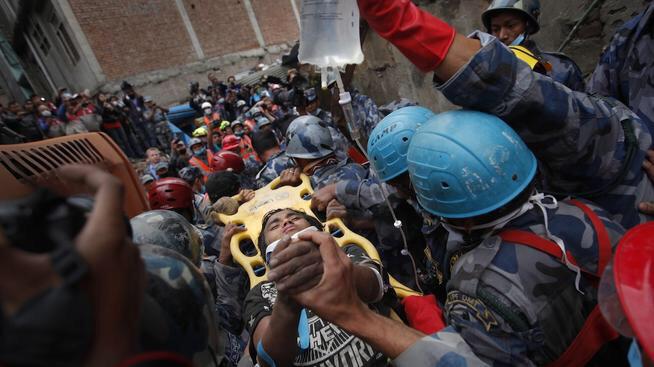
Nepal: Miracle rescues of teenager and baby bring joy amid earthquake tragedy (video)

Before watching the video, read the comprehension questions and study the words in the vocabulary section below.

Comprehension Questions

  1. Where was the teenager found?
  2. How long had he been trapped in the ruins?
  3. How many hours after the earthquake was the baby found?
  4. What alerted the rescue teams to search for him?
  5. How many people have been affected by the earthquake?
  6. What dangers are the earthquake victims facing now?

Vocabulary 

  • Rubble are broken pieces of stone, brick, etc., from walls or buildings that have fallen. e.g. Rescue workers managed to pull two injured people out of the rubble.
  • When you assess something, you make a judgment about it. e.g. After the hurricane, officials assessed  the town’s need for aid.
  • When you alert someone, you give them important information about a possible problem, danger, etc., you warn them. e.g. Several neighbors alerted  the authorities/police when they noticed strangers acting suspiciously.
  • A rural area is an area in the countryside. e.g. She lives in a rural  area.
  • When you scramble for something, you try very hard to get it before someone else does. e.g. Both players scrambled  for the ball.
    https://pbs.twimg.com/media/CD1EwfhWoAA4PRh.jpg:large 
    Posted in Cloze tests, Earthquakes, Natural Disasters, News stories (video listening), Videos | Leave a comment

    The Book Thief trailer (cloze test)

    Here is a cloze test based on the trailer for The Book Thief movie.

    You can watch the video with English subtitles/captions here.

    Posted in Cloze tests, Movies, Trailers, Videos | Leave a comment

    The Happy Prince by Oscar Wilde (worksheet)

    CE-9A-CE-B1-CF-84-CE-B1-CE-B3-CF-81-CE-B1-CF-86-CE-AE
    Here is a worksheet based on an animated film of The Happy Prince. It contains a True/False exercise, a set of comprehension questions, a vocabulary exercise (crossword puzzle) and a grammar exercise (reported speech). Click here to watch the video on YouTube.

    To download the worksheet click here.
    RELATED POST

    Posted in Grammar, Oscar Wilde, Reported Speech, Videos, Worksheets | 1 Comment

    The Happy Prince by Oscar Wilde (video)

    Oscrwild
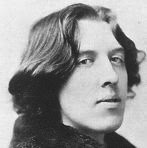
    Oscar Wilde (1854-1900) was an Irish writer and poet. His most notable works are “The Importance of Being Ernest” and “The Picture of Dorian Grey”.

     The Happy Prince and Other Tales (sometimes called The Happy Prince and Other Stories) is a collection of stories for children first published in May 1888. It contains five stories, “The Happy Prince”, “The Nightingale and the Rose”, “The Selfish Giant”, “The Devoted Friend”, and “The Remarkable Rocket”. It is most famous for its title story, “The Happy Prince”.

    Here is an animated film of  “The Happy Prince”. Watch the video and answer the questions below. (You can watch the video on YouTube if you wish to turn on the captions but keep in mind they might contain a few errors.)
      
    Comprehension Questions
    1. Where did the Happy Prince’s statue stand?
    2. Why hadn’t the swallow gone south with the other birds?
    3. Why was the Prince sad?
    4. What did the swallow carry to the sick child’s house?
    5. Who did the Prince give the gemstones from his eyes to?
    6. Why did the swallow finally decide not to fly south?
    7. Who received the gold leaf that covered the Prince’s body?
    8. Why did the swallow thank and kiss the Prince?
    9. What did the villagers decide to do with the statue? Why?
    10. Does the story have a happy ending?

     Vocabulary

    • A dagger is a sharp pointed knife that is used as a weapon.
    • When you ornament something, you make it more attractive by adding small objects to it. e.g. a dress ornamented with pearls
    • A gem or gemstone is a valuable stone that is used in jewellery/jewelry.
    • When you pluck something, you pull it quickly to remove it. e.g. My sister plucked a white hair from my head. 
    • If something is grubby, it is dirty or messy. e.g. He lives in a grubby little apartment.


    Now watch the video again and try the following quiz.

    Posted in Oscar Wilde, Videos | Leave a comment

    The Happy Prince summary (cloze test)

    Here is a cloze test I made on LearningApps.org. The text is taken from wikipedia.
    You might like to check the following related posts before doing the test.
    The Happy Prince by Oscar Wilde (video)
    The Happy Prince by Oscar Wilde (worksheet)
    Posted in Cloze tests, Oscar Wilde | Leave a comment

    Holidays (game)

    Play the game below to revise vocabulary related to Christmas, Easter, Halloween and Thanksgiving. Drag and drop each word into the correct bin.
    Posted in Christmas, Easter, Games, Halloween, Holidays, Thanksgiving, Vocabulary | Leave a comment

    Secret Santa saves Christmas

    CE-9A-CE-B1-CF-84-CE-B1-CE-B3-CF-81-CE-B1-CF-86-CE-AE
    Dec. 14, 2014. On behalf of a wealthy donor, police officers in Kansas City, Missouri, gave away money to unsuspecting drivers. Steve Hartman reports. (CBS News )


    Watch the video and answer the questions. Alternatively you can watch the video here . (Click the CC button at the bottom of the video to turn on the captions but keep in mind they might contain a few errors.)

     Comprehension Questions

    1. Who is “Secret Santa”?
    2. What does he do every year?
    3. What has he changed this year?
    4. What sort of people did the officers choose?
    5. What were the people’s reactions?
    6. How did Jessica Rodriguez’ initial attitude change through her encounter with the deputy?
    7. What was the main objective of this operation?
    8. What else did “Secret Santa” want to achieve this year?

    Vocabulary

    • A sting (operation) is a clever secret plan by the police to catch criminals.
    • A deputy is a police officer in some parts of the US who does the sheriff’s job when the sheriff is away.
    • When you deputize someone, you give them the power to do something in place of another person. e.g. The new system deputizes the nurses to perform some of the doctors’ duties.
    • Benjamins” is a common word for the United States one hundred-dollar bills ($100), which have Benjamin Franklin’s portrait on one side.
    • Bondo is a trademark for a variety of materials used to repair automobile bodies.
    • If something blows you away, it impresses you a lot and makes you very happy. e.g. I was really blown away by her latest movie.
    • If you are caught off guard, you are surprised by something unexpected. e.g. He was caught completely off guard by her questions.
    • Law enforcement is the job of making sure that people obey the law.
    • The law-abiders are the people who abide by (=obey) the law.
    • If you are assaulted, you are attacked violently. e.g. An elderly woman was assaulted and robbed.
    • You surrender when you admit that you have been defeated and you allow yourself to be caught, taken prisoner, etc. The enemy finally surrendered after three days of fighting.


    Now watch the video again and try the following quiz.

      To view the video transcript click here .

      Posted in Christmas, Holidays, News stories (video listening), Santa, Videos | Leave a comment

      The Fall of the Berlin Wall (25th anniversary)

      Panorama_BBT_links_final_Pano2_Header_ecf1a714c6
      The 25th anniversary of the fall of the Berlin Wall (November 9th, 1989) is being celebrated in Berlin this weekend.

      http://www.berlin.de/mauerfall2014/en/25-years-fall-of-the-wall/the-berlin-wall/
      Thousand illuminated balloons (along 15 km from November 7th to 9th) commemorate the division of Berlin.

      (Image source: http://www.berlin.de/mauerfall2014/en/25-years-fall-of-the-wall/the-berlin-wall/)

      Watch the following videos to find out about the rise and the fall of the Berlin Wall. (You can choose to turn the captions on or off)

      Berlin Wall Built (1961) 

      In August 1961, troops in East Germany began to seal the border between East and West Berlin. In doing so they blocked off the escape route for refugees from the East. The barrier ended up being 12 feet high and 66 miles long with a further 41 miles of barbed wire fencing. Over the years, nearly 200 people died trying to cross the wall. It became a symbol for the divided world.

      Comprehension Questions

      1. When was the Berlin Wall built and by who?
      2. How many zones was Berlin divided into?
      3. What was the western powers’ reaction to the building of the Wall?
      4. Why was the Berlin Wall built?
      5. What did it become a symbol of?

      Fall of the Berlin Wall (1989)

      On November 9, The Berlin Wall fell after nearly three decades of keeping East and West Berliners apart.
      Comprehension Questions
      1. When did the Berlin Wall fall?
      2. Where is the Brandenburg Gate located?
      3. What did the guards at the Brandenburg Gate do when the first West Berliners climbed up on the Wall?
      4. What used to happen to the people who tried to cross the Wall in the past?
      5. How did Berliners celebrate the opening of the border between East and West Berlin? 

      Vocabulary

      • mystification (noun): When you are mystified, you are confused because you do not understand something. e.g. He looked at her in mystification.
      • A flagrant action is shocking because it is done in a very obvious way and shows no respect for people, laws, etc. e.g. He showed a flagrant disregard for anyone else’s feelings.
      • If you act in contravention of a rule, a law, or agreement, you do something that is not allowed by this rule, law or agreement. e.g. These actions are in contravention of European law.
      • To make a dent (in something) is to decrease something slightly or to make it somewhat weaker. e.g. It’s going to take more than a new law to make a dent in the city’s drug crime.
      • If you breach a wall, fence, etc., you make a hole or opening in it so that you can go through it. e.g. The army breached the castle wall.
      • To straddle something means to be on both sides of something. e.g. The mountains straddle the French-Swiss border.
      • If you clamber up/over/into (etc.) something, you climb with difficulty, using your hands and feet. e.g. We clambered up the steep hill.

      Deconstructing History: Berlin Wall (history.com)

      Watch the following video to learn some more facts about the Berlin Wall.

        RELATED POSTS
        This Day in History: The Fall of the Berlin Wall
        The Berlin Wall’s 50th anniversary 

        Posted in Berlin Wall, Videos | Leave a comment

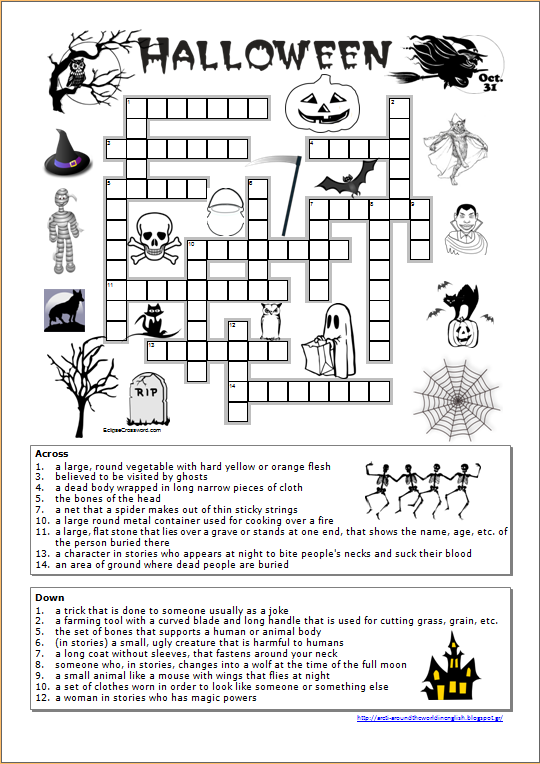
        Halloween Crossword (worksheet)

        CE-9A-CE-B1-CF-84-CE-B1-CE-B3-CF-81-CE-B1-CF-86-CE-AE
        Posted in Crosswords, Halloween, Holidays, Vocabulary, Worksheets | Leave a comment