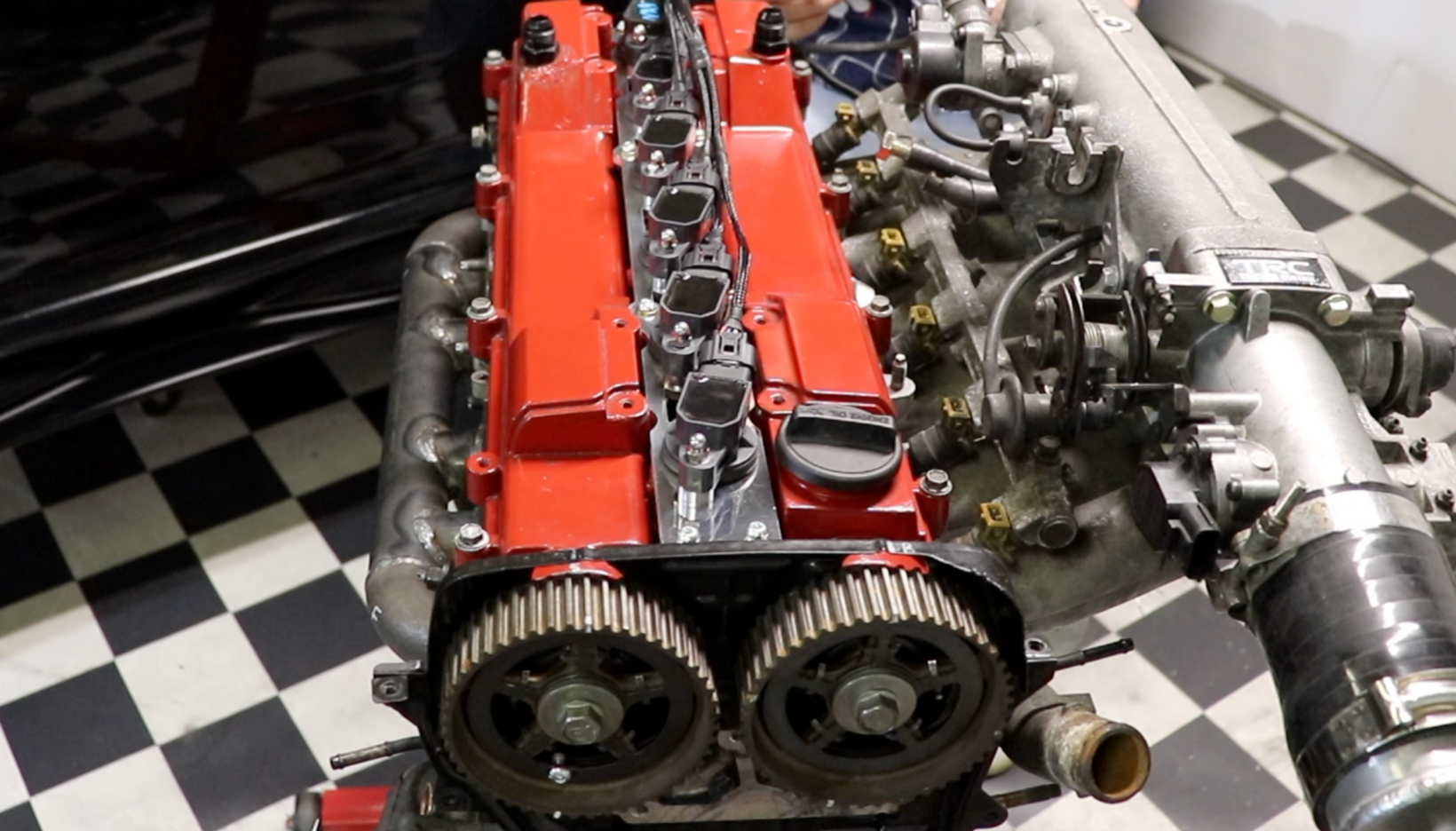
The first generation 1JZ-GTE employs twin CT12A turbochargers arranged in parallel and blowing through a side-mount or front mount air-to-air intercooler. With an 8.5:1 static compression ratio, the factory quoted power and torque outputs are 280 PS (206 kW; 276 hp) at 6200 rpm and 363 N⋅m (268 lbf⋅ft) at 4800 rpm. The bore and stroke are the same as for the 1JZ-GE: bore × stroke is 86 mm × 71.5 mm (3.39 in × 2.81 in). In 1991, the 1JZ-GTE was slotted into the all-new Soarer GT.
The early generation 1JZ-GTEs combined the inherent smoothness of an inline 6-cylinder engine with the revving capacity of its short stroke and early power delivery of its small, ceramic wheeled turbochargers. The ceramic turbine wheels are prone to delamination in the setting of high impeller rpm and local temperature conditions, usually a result of higher boost. The first generation 1JZs were even more prone to turbo failure due to there being a faulty one-way valve on the head, specifically on the intake cam cover causing blow-by gases to go into the intake manifold. On the exhaust side, a decent amount of oil vapor flows into the turbos causing premature wear on the seals. The later second generation engines had this problem fixed and in Japan there was actually a recall in order to repair the first generation engines, though that does not apply to 1JZs imported to other countries. The fix is simple, and involves replacement of the PCV valve (2JZ); all parts are available through Toyota.
The third generation of the 1JZ-GTE was introduced around 1996, still as a 2.5-litre turbo, but with Toyota’s BEAMS architecture.[2] This included a reworked head, newly developed continuously variable valve timing mechanism (VVT-i), modified water jackets for improved cylinder cooling and newly developed shims with a titanium nitride coating for reduced cam friction.[3] The turbo setup changed from parallel twin turbo (CT12A x2) to a single turbo (CT15B). The single turbo is in part made more efficient by the use of smaller exhaust ports in the head, this allows the escaping exhaust gasses to have more velocity as they exit the head, which in turn, spools the turbo faster and at lower RPM.The adoption of VVT-i and the improved cylinder cooling allowed the compression ratio to be increased from 8.5:1 to 9.0:1. Even though the official power figures remained at 280 PS (206 kW; 276 hp) at 6200 rpm, torque was increased by 20 N⋅m (15 lbf⋅ft) to 379 N⋅m (280 lbf⋅ft) at 2400 rpm. These improvements resulted in increased engine efficiency that reduced fuel consumption by 10%. The adoption of VVTi, a much higher efficiency single turbocharger than the twins as well as different manifold and exhaust ports were responsible for most of the 50% torque increase at low engine speeds. This engine was used primarily in Toyota’s X chassis cars (Chaser, Mark II, Cresta, Verossa, Blit), the Crown Athlete V (JZS171) and in the later JZZ30 Soarer, as the JZA70 Supra was long discontinued by this time.